

Faster shortlists, properly vetted candidates, and hiring support built for teams without a full-time recruiter:
Most small businesses don’t actually lose good hires at the interview stage. They lose them two or three weeks earlier, when nobody’s really looking for the role because the founder is stuck on sales calls and the office manager is buried in payroll. That’s the gap where weak candidate screening services quietly cost you money and it won’t show up on any scorecard until the role’s been open for eight weeks and the strongest applicant has already taken a job somewhere faster. SHRM’s research into small business hiring backs this up: smaller employers consistently report fewer recruiting resources and less bench strength than larger companies, so they’re already behind before a single CV lands in the inbox.
Our candidate screening services exist because of that exact problem. We’re not forwarding a stack of job board CVs with a recruiter’s name stapled on top. We source, vet and verify every candidate against your actual requirements before you see them, then hand you a pre-screened shortlist. Your team gets to spend its time interviewing, not sorting through applications that were never going to work out.
Why Does Small Business Hiring Feel Harder Than It Should Be?
Owners rarely struggle to write a job description. They struggle with everything that happens after it goes live.
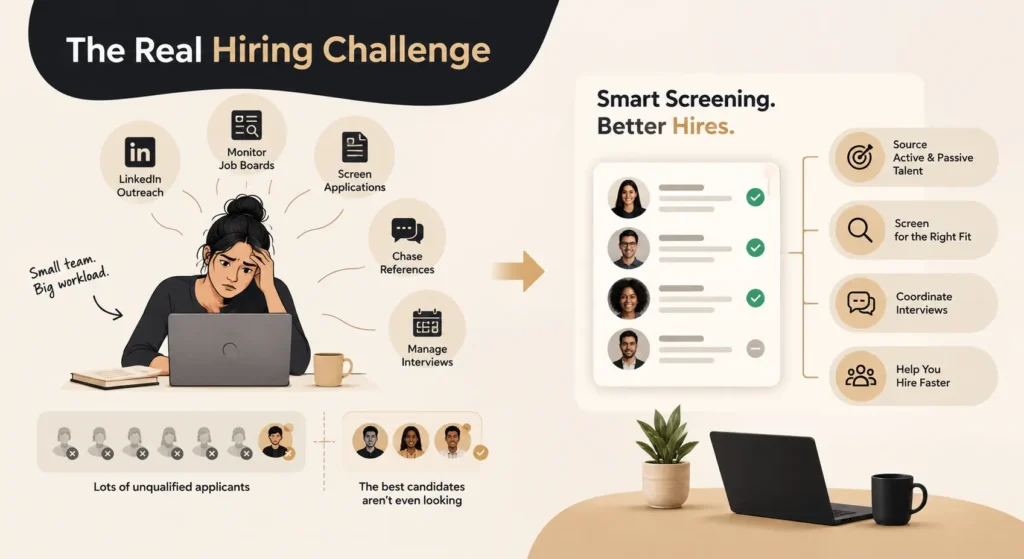
A small HR function is often one generalist, sometimes a founder wearing the hat part-time cannot realistically run outbound outreach on LinkedIn, monitor three job boards, screen incoming applications, chase references and manage a live interview loop at the same time. Something gets skipped, and it’s usually sourcing, because it’s the least visible task on the list. The inbox fills with applicants who clicked “easy apply” without reading the requirements, and the genuinely strong candidates, the ones already employed, not actively browsing, but open to the right offer never enter the funnel at all.
This is a labour market problem as much as a process problem. The US Bureau of Labor Statistics’ Job Openings and Labor Turnover Survey tracks millions of open positions nationally every month, and even in a cooling market, unfilled roles remain stubbornly high across sectors where small businesses compete in direct technical, operational and skilled administrative work among them. When demand for talent outpaces easy supply, employers who rely purely on inbound applications are fishing in the shallow end of a much deeper pool.
There’s a second, quieter cost: bad-fit hires. A small team absorbs a mis-hire far worse than a 500-person company does. One wrong hire in a ten-person business can stall a project, damage client relationships, or force a founder back into a role they’d already delegated. Sourcing without proper screening simply moves the risk downstream you get more applicants, not better ones.
See Exactly How We Source and Screen Your Next Hire
Explore our full range of sourcing and IT staffing services, built specifically for small business budgets and timelines. See what’s included before you commit to anything.
Explore Our ServiceWhat Our Candidate Screening Services Actually Do?
Screening and recruiting get used interchangeably, and that confusion costs businesses money. Recruiting manages the full hiring funnel job posting, interviewing, and offer negotiation. Candidate screening services cover the specific, research-heavy work of identifying, vetting and verifying candidates who match a role, including the ones who never applied anywhere because they weren’t looking.
Our candidate screening services sit upstream of your hiring process. We research your role and your market, look at where similar talent already works, then build a shortlist of people who genuinely fit the brief not just on paper, but in terms of whether they’d actually take the call. For technical roles, our IT staffing services take this further into specialised sourcing for developers, systems engineers and infrastructure staff, since generic job boards tend to fall short there.
Here’s roughly how it works in practice. A dedicated researcher works your open role directly, using Boolean search, professional networks, referral chains and niche community outreach not just waiting on whoever happens to click “apply.” Every candidate that surfaces gets checked against what you actually need: skills, experience level, availability, salary expectations, the works. You’re not getting a stack of forty CVs to sort through on a Friday afternoon; you’re getting a shortlist you can trust the moment it lands.
Why does that matter beyond convenience? Because speed has become a real differentiator in hiring, not a nice extra. Businesses that get structured sourcing right early tend to fill roles faster and lose fewer strong candidates to competitors who simply moved before they did.
Core Features of Our Candidate Sourcing & Screening Approach:
We’ve kept the process tight on purpose. A lot of agencies pad this out with steps that exist mainly to look thorough on a proposal deck. Ours comes down to three things that actually move the needle:
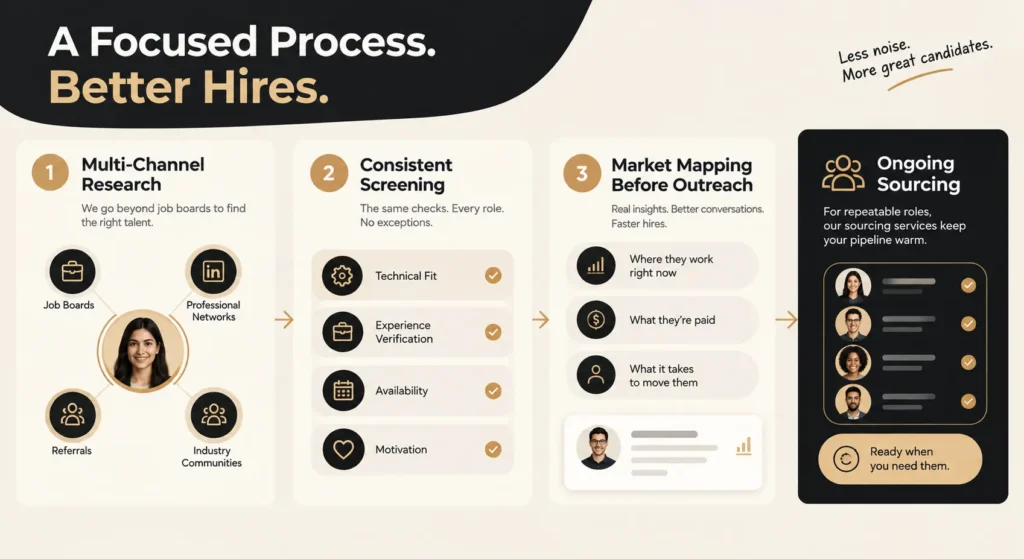
- Research across more than one channel: Job boards, professional networks, referrals, and industry-specific communities. Limiting the search to whoever happened to be online that week is a good way to miss the best candidate.
- A screening process that doesn’t change from role to role: Technical fit, experience verification, availability, and whether they’re genuinely motivated to move checked the same way every time, so a shortlist means something.
- Mapping the market before outreach starts: Where does someone like this actually work right now? What are they paid? What would it take to move them? Guessing wastes everyone’s time.
If you need this running as an ongoing function rather than a one-off project, say, for roles that open up repeatedly that’s what our sourcing services are built for. You end up with a warm pipeline to draw from each time, instead of starting cold.
The Business Impact of Getting Sourcing Right:
Better sourcing doesn’t just move your time-to-fill number. It changes who’s even in the running.
Strong candidates who already have a job rarely respond to a posting. They respond to a message that’s clearly about them, one that shows someone looked at their background before hitting send. Get that right and the quality of your applicant pool goes up before screening even starts.
There’s a cost most owners never actually calculate: what a bad hire really costs once you add up recruitment spend, onboarding time, lost output, and the drag on everyone else’s morale while they cover the gap. It’s almost always more than what proper sourcing would have cost upfront. Paychex’s research on 2026 hiring trends points to talent management as one of the top challenges reported by growing small and mid-sized businesses largely because internal teams are stretched too thin to run sourcing properly alongside everything else on their plate.
It also frees your team to focus on the part of hiring that actually needs their judgement: interviewing, gauging culture fit, making the final call. Not burning an afternoon on CVs that were never going to work out.
One more thing worth mentioning is that the benefit doesn’t stop when the role’s filled. A good sourcing engagement leaves you with a map of the market and a shortlist of near-miss candidates worth revisiting next time a similar role opens. The second search is almost always faster than the first.
How Our Candidate Sourcing Process Works?
It starts with a working session, not a form to fill in. We talk through the role properly: what’s a genuine must-have versus a nice-to-have, what the salary band realistically looks like, and where people who’d fit this role tend to sit in the market right now.
From there we map the market itself: who’s doing similar work today, what they’re being paid, and which channels are actually likely to reach them. Guessing at this stage wastes the outreach that follows.
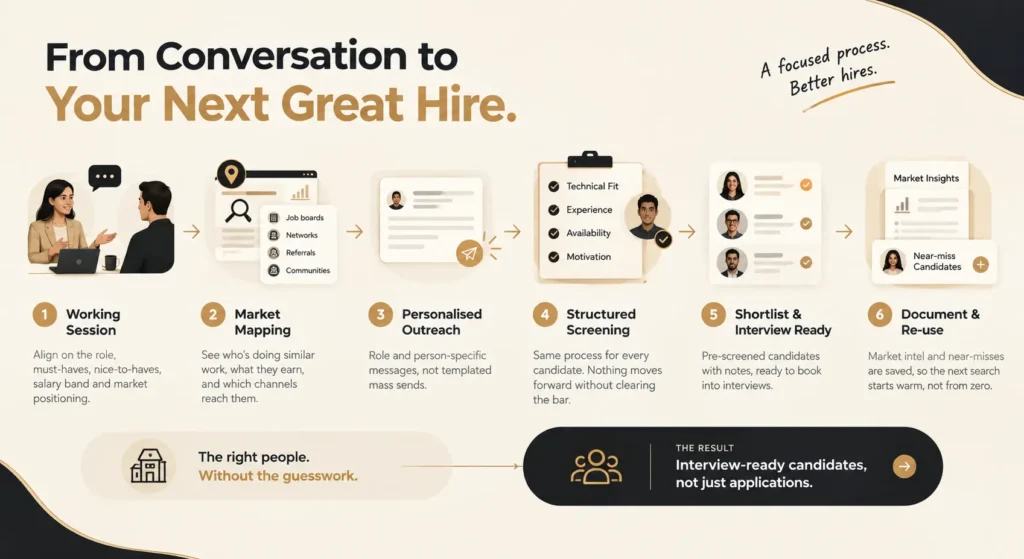
Outreach comes next, and it’s not a templated mass send. Each message is written for the role and, where it matters, for the person candidates can tell the difference, and it’s usually why they bother replying at all.
Every candidate who responds goes through the same structured screening: technical or role-specific competence, experience verification, availability, and whether they’re genuinely motivated to move rather than just curious. Nothing reaches your shortlist without clearing that bar.
What you get isn’t a raw stack of CVs. It’s a shortlist of pre-screened candidates with notes on each one, ready to book straight into interviews. And whatever doesn’t make the cut this time the near-miss candidates, the market intelligence we’ve built up gets documented, so the next search starts warm instead of from zero.
Most of the friction small businesses hit sits right between “we should probably hire someone” and “we actually have someone to interview.” That’s the gap this process is built to close.
Most of the friction small businesses hit sits right between “we should probably hire someone” and “we actually have someone to interview.” That’s the gap this process is built to close.
What Sourcing Support Costs, and Why It Pays for Itself?
What you’ll pay usually comes down to three things: how senior the role is, how specialised the skill set is, and whether you need one search or an ongoing pipeline. A generalist admin or operations role is quicker and cheaper to fill than a niche technical position, simply because there are fewer qualified people out there and finding them takes more targeted work.
Here’s the thing most owners don’t factor in when they balk at the fee: a role sitting open for two extra months costs you in lost output, in staff covering the gap, and in the risk of rushing a hire just to close the vacancy. Run the numbers and a proper sourcing engagement is usually the cheaper option, not the expensive one. If you keep a pipeline running for roles that recur, say, you hire the same kind of technician every few months, the per-hire cost drops further, because we’re not rebuilding the market research from scratch each time.
You’ll get a clear, role-specific quote before anything starts. No vague retainer, no undefined scope, and nothing charged for candidates who don’t clear your bar. And if what you actually need runs past the shortlist interviews, offer negotiation, onboarding that’s full cycle recruiting rather than sourcing alone, and it’s priced and scoped separately.
Why Do Small Businesses Choose Us Over Other Sourcing Companies?
There’s no shortage of sourcing companies to choose from. There’s a much shorter list of ones actually built around what small businesses deal with day to day thin HR bandwidth, a budget nowhere near what an enterprise client would pay, and zero room for a mis-hire that a 2,000-person company would barely notice.
We haven’t cut the screening step to move faster, which is where a lot of cheaper providers cut corners. Our team covers operations, admin and technical roles, with dedicated IT staffing services for businesses hiring developers, engineers or infrastructure specialists roles where a generic job board posting almost never reaches the people who’d actually be good at the job, because they’re not out there browsing. Hiring isn’t the only growth bottleneck we hear about, either — a fair number of clients bring us in for ecommerce solutions once their online storefront starts outgrowing whatever they set it up with originally.
SHRM’s 2026 Talent Trends Report found that nearly seven in ten HR professionals are still struggling to fill full-time roles, which tells you this isn’t a problem unique to your business, it’s the market. What we’d argue makes the difference is how a provider measures its own success. We’re upfront about scope and pricing before anything starts, we actually report on progress instead of going quiet for weeks, and we judge ourselves on whether you’re still happy with the hire six months later, not on how many CVs got sent your way. That’s a narrower bar than most agencies set for themselves, but it’s the one that actually matters if you’re watching every dollar of recruitment spend.