

For the e-commerce brand, advertising is not often merely an issue of generating traffic.
It is an economics issue.
The clicks, impressions, conversions and revenue can be increased while decreasing the profitability of the business. This is the reason why the task of hiring a PPC agency cannot be based on how fast they will be able to create Google Ads campaigns for the client. The task of hiring a PPC agency has to be based on getting a partner that will be able to connect marketing budgets to the business.
There are many opportunities here. US retail e-commerce sales were estimated to be $326.7 billion in Q1 2026 according to US Census Bureau, which amounted to 16.9% of total retail sales in that quarter. Growth from last year was 9.8%.
But a market’s growth does not guarantee that acquiring the market is profitable.
Commercial search traffic competition is stiff. Prices are volatile. Offers by competitors are changing. Google keeps innovating its ad formats. Consumer behavior is evolving on Search, Shopping, YouTube, social networks, and direct visits.
It has to understand the business behind the account.
This means identifying the products that make margins, customers who provide lifetime value, marketing campaigns that drive incremental demand and conversions that are really just capturing demand that would likely have converted anyway.
This guide discusses how successful PPC management operates for US e-commerce brands, what an effective team must really accomplish, and how digital marketing services can assist brands in creating a paid acquisition process geared towards sustainable profitability instead of meaningless numbers.

Why E-commerce Brands Need a Different PPC Strategy ?
E-commerce PPC is entirely distinct from lead generation advertising.
The value of a qualified inquiry for a lead generation company can be easily estimated and relatively consistent. The number of SKUs with varying sales prices, gross profit margins, returns, repeat purchase rates and lifetime customer value is often huge for an ecommerce business.
Consider two products:
| Metric | Product A | Product B |
| Selling price | $80 | $180 |
| Gross margin | 65% | 30% |
| Gross profit/order | $52 | $54 |
| Average repeat purchases | 1.2 | 3.5 |
| Refund rate | 5% | 14% |
| Indicative customer value | Moderate | Potentially high |
Initially, Product B appears much more appealing since its selling price is more than double that of Product A.
But the advertisement cannot be made solely based on revenue.
The company must have an understanding of the economics of each sale.
This is one of the major distinctions between effective account management and real strategy creation in a PPC company.
It does not mean that a campaign generating ROAS of 500% is better than another campaign yielding ROAS of 350%.
The former is selling low-margin items with many returns whereas the latter is selling high-margin items with repeat buys.
The principle is simple
Optimise your paid media spend for business value rather than advertising platform value.
This is evident even in Google’s own documentation, where its Value-based Bidding enables advertisers to optimise against the value of conversions rather than the number of conversions.
And this is huge for e-commerce.
What Does a PPC Agency Do for an E-commerce Brand ?
An effective team needs to exist somewhere between a media buyer, analyst, growth strategist and business advisor.
Campaign development is just one aspect.
PPC Strategy and Account Architecture
The first responsibility is deciding what the account should accomplish.
That means answering questions such as:
- Which products should receive the most budget?
- Which products should not be advertised?
- What is the acceptable acquisition cost?
- What ROAS is required to break even?
- Which products are designed for customer acquisition?
- Which products are primarily profitable through repeat purchases?
- Which categories deserve dedicated campaigns?
- Which products have enough conversion volume for automated bidding?
- Where is branded demand being confused with genuine acquisition?
Good account structure should mirror the commercial structure of the business, which is a defining characteristic of an effective SEO service.
It should not simply mirror the organisation of the website.
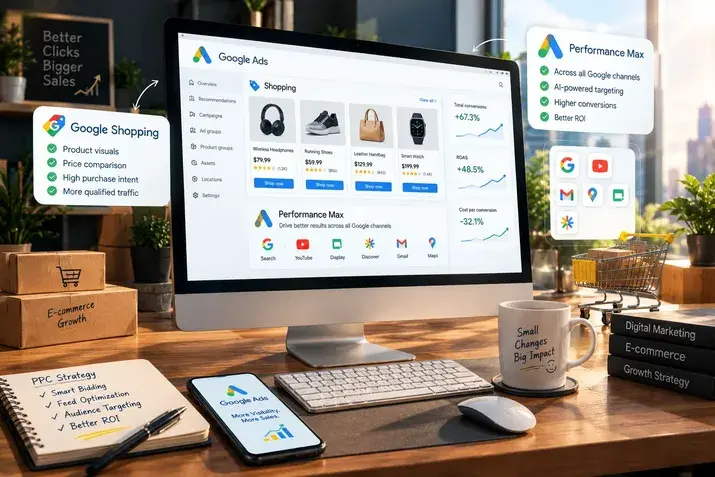
Google Shopping and Performance Max
For retailers, Shopping is one of the most crucial elements of Google Ads since the consumers will get product information prior to clicking through.
According to Google, Shopping ads include the product image, title, price, and store name, giving the consumer an idea of what offer is made before visiting the website.
Performance Max is another crucial element of Google’s advertising system for retailers.
According to Google, Performance Max is an AI-driven campaign type which allows distribution of products and creatives within Google advertising inventory. For retailers, it enables connection between Merchant Centre product feeds and Google advertising inventory.
But automation doesn’t take away the need for strategy.
It increases the importance of strategy.
Quality of the product feed, conversion triggers, creative elements, product segmentation, and profitability information decide the potential use of the automation.
Search Campaign Management
Search campaigns still hold value when the customers demonstrate commercial intent.
For instance:
Informational:
“best running shoes for flat feet”
Commercial research:
“best carbon plate running shoes”
Transaction:
“buy carbon plate running shoes”
A professional B2B digital marketing agency should never consider all searches to have the same business significance.
As the inquiry approaches a buying decision, it is crucial that the campaign is well-aligned with the product, offer, and landing page.
Product Feed Optimisation
The product feed is not administrative plumbing.
It is advertising plumbing.
Should the feed contain bad titles, missing attributes, wrong categories, bad images, or wrong availability details, then the campaign could fail right from the beginning irrespective of the bidding strategy used.
Guidelines from Google Shopping require that retailers use Merchant Centre to link their products, along with proper conversion tracking.
For larger catalogues, a PPC management team should regularly examine:
- Product titles
- Product types
- Google product categories
- Brand attributes
- Product identifiers
- Images
- Availability
- Pricing
- Promotions
- Shipping information
- Custom labels
- Margin classifications
It is the intention to make the catalog more comprehensible to the advertising system as well as the consumer.
Great marketing doesn’t stop at one channel.
Browse our complete service lineup and find the perfect fit for your brand’s next big move.
Explore Our ServiceThe PPC Management Framework We Recommend :
The process of executing a successful pay-per-click campaign for an online shopping business involves five steps: economics, measurement, structure, optimization and scale, with the aid of social media marketing service.
Step 1 — Define the Economics
Financial limits need to be set clearly, while optimisation must be done based on the business value rather than just converting leads. With value-based bidding, Google Ad campaigns can focus their optimisation efforts on value which is relevant for the business.
Step 2 — Fix Measurement
Make sure your Google Adwords, GA4, and e-commerce system track your sales, revenue, conversions, and product performance. Correct and accurate data is crucial for your PPC optimization.
Step 3 — Build Campaign Architecture
Design marketing campaigns based on relevant business issues like product segments, margins, top sellers, seasonal products, and so on. Avoid segmentation to a level where you fragment your data.
Step 4 — Optimise Product-Level Performance
Look at which products deliver the most profits, not just the most income or ROAS. Redirect the budget to products with higher margins, better conversion, and more valuable customers.
Step 5 — Scale Incrementally
Grow budgets incrementally as long as there is consistent performance. Watch marginal returns closely and don’t grow purely based on ROAS.
The framework is simple: Economics → Measurement → Structure → Optimisation → Scale. This approach helps e-commerce brands turn PPC into a predictable and profitable growth channel with the support of a PPC marketing agency.
Google Shopping and Performance Max for E-commerce :
Google Shopping is a product discovery and acquisition platform and not just another campaign type.
The product feed tells Google what you’re selling.
Your website tells Google why customers should buy it.
Your conversion data tells Google what success means.
And your bidding strategy tells Google how aggressively to pursue that success.
All four need to align.
Google’s latest guidance on shopping says Performance Max will leverage Merchant Centre feeds for promotion of products across Google’s inventory, along with automated bidding leveraging signals related to audiences, creative, and conversion performance.
The strategic mistake to avoid
Do not assume that Performance Max means “set it and forget it”.
A modern PPC management process should monitor:
- Search category insights
- Product-level profitability
- Asset performance
- Audience signals
- Conversion quality
- Search behaviour
- Budget allocation
- Seasonality
- New versus existing customers
- Geographic performance
- Landing-page performance
Google itself suggests that Performance Max insights should be periodically reviewed along with the consideration of conversion lag.
This last point is very significant.
The current weak performance of a campaign may be due to the fact that yesterday’s clicks haven’t yet converted into sales, and that is the reason why the best digital marketing agency emphasizes the importance of performance over time.
How to Set the Right ROAS Target ?
There is no universal “good ROAS.”
An ROAS of 300% is fantastic for some businesses but a catastrophe for others.
Assume that Brand A sells goods with a 75% gross margin.
Brand B sells goods with a 30% gross margin.
Their advertising efficiency goals may differ because of that.
It is the same with Customer Lifetime Value.
Brand A gets customers who purchase four times during 24 months, and thus it can pay more for first order acquisition than other brands.
This creates three different ROAS concepts:
First-Order ROAS
Initial purchase revenue per dollar spent on advertising.
Contribution ROAS
Contribution created after deduction of relevant variable costs from advertising cost.
Lifetime ROAS
Revenue or profit from the customer during their entire relationship with the company divided by the cost of acquisition.
The last measure can be quite strategic but needs to be carefully measured.
If the lifetime value is measured incorrectly, it can be a convenient justification for unprofitable acquisition.
The PPC agency thus needs to define its assumptions well and compare its predictions for LTV with the actual behaviors of the cohorts.
Why Revenue-Based PPC Optimisation Can Mislead E-commerce Brands ?
Revenue is one of the key PPC metrics, although this figure does not necessarily measure the profitability of the campaign. An online store might have good sales numbers, but still have poor or even negative profits from the sale of products.
For instance, a $100 item with 70% margins is much more valuable from an advertising point of view than a $100 item with 25% margins, despite the fact that both items yield the same amount of money. That is the reason why marketers should not focus solely on ROAS but look at other factors too.
Optimising PPC for profitability in terms of profitable customer acquisition is thus what e-commerce brands should do rather than maximising revenue. Knowing that some products and customers generate more value over the long term will help allocate marketing budget better.
The Metrics a Serious PPC Agency Should Monitor :
Monthly reports on PPC in terms of clicks, impressions, and CTR are not sufficient for an already existing e-commerce brand. SMM marketing should give more information on profitability, conversions, and growth.
The dashboard should connect media metrics to commercial outcomes.
| Metric | What it tells you | Strategic use |
| Spend | Media investment | Budget control |
| Revenue | Sales attributed to ads | Growth measurement |
| ROAS | Revenue efficiency | Media efficiency |
| CPA | Acquisition cost | Customer acquisition |
| Conversion rate | Site/ad effectiveness | Funnel diagnosis |
| AOV | Order economics | Offer and product strategy |
| Gross margin | Product profitability | Budget allocation |
| CAC | Customer acquisition economics | Growth planning |
| New customer rate | Acquisition quality | Growth assessment |
| Repeat purchase rate | Customer value | LTV modelling |
| Contribution margin | Economic value | Profitability |
| Impression share | Market visibility | Demand capture |
| Search terms | Real customer language | Intent discovery |
| Product-level ROAS | SKU performance | Catalogue optimisation |
The key is that none of these metrics should ever be considered in isolation.
Increasing ROAS with diminishing new customer acquisitions could be indicative of efficiency in capturing demand rather than sustainable growth.
It does not have to be a bad thing.
However, it must be understood.
PPC Management Across the Full Customer Journey :
A high-quality PPC campaign will consider the journey of the customer and not assume that all clicks are the same, and here’s where the PPC company can provide strategic advantage.
Let’s say there’s a customer who buys a high-end skin care product.
The customer path might be:
YouTube discovery → Google search → product comparison → branded search → Shopping click → purchase → email remarketing → repeat purchase
If your attribution model gives all the credit for the path to the last click on Google Search, then you would think that Branded Search gets most of the budget.
But the brand search was just reaping the benefits of other media channels.
The whole marketing strategy should link up the PPC with SEO, content, emails, social media, and conversion optimization.
The media work together.
They should not be measured as if they existed in a vacuum.

Common PPC Mistakes E-commerce Brands Make :
Chasing Clicks Instead of Customers
A high CTR does not automatically translate into profitable sales.
An excellent ad can get huge numbers of clicks but never turn into profitable clients.
Using One ROAS Target for Every Product
Each product has different margins, different demand functions, and different customer valuations.
An account-wide goal is blind to such distinctions.
Ignoring the Product Feed
An inadequate feed could negatively affect the Shopping campaigns prior to optimization.
Making Constant Campaign Changes
Such continuous alterations can make it tough for a company to develop reliable performance trends and affect machine-learning tools, making it essential for a B2B digital marketing agency to focus on consistent optimisation.
Optimising Only for Platform Revenue
The earnings from advertising platforms does not equate to financial contributions.
Ignoring Landing Pages
In case an ad promises a 20 percent discount but making it tough to locate on the landing page, it is not just about the advertising campaign anymore.
Treating Every Conversion as Equal
A customer making his/her first purchase of an expensive product can be more profitable to a company than the repeated purchase of an inexpensive product.
Scaling Too Quickly
Not all campaigns that work well for $500 per day will continue working when costs increase to $5,000 per day.
Efficiency is important.
A Critical Insight: Your PPC Agency Cannot Fix a Broken Offer :
This is one of the most important strategic principles in e-commerce acquisition.
If your:
- Price is uncompetitive
- Shipping is expensive
- Delivery is slow
- Product positioning is unclear
- Reviews are weak
- Product page is confusing
- Checkout is cumbersome
- Returns policy is difficult to understand
then increasing advertising spend may simply increase the volume of visitors who leave without purchasing.
According to Baymard Institute’s ongoing checkout studies, the average rate of cart abandonment is about 70%, while other studies have found shipping and taxes, slow shipping, mistrust and complexity in checkout as factors of abandonment.
It implies that PPC management should be integrated with conversion rate optimization and a Facebook Ads Agency.
A doubling of the conversion rate, from 2% to 2.5%, will ensure that more orders are created using the same advertising traffic.
The advertising account is a part of the revenue structure.
Mini Case Study: Turning PPC Data into Profitability
For example, let’s imagine a US-based online clothing retailer investing $100,000 per month into paid advertising, getting roughly $400,000 per month from the campaigns, thus having a 4.0x ROAS ratio. However, after the more detailed study carried out by the PPC agency, it turns out that there are differences in the profitability of the products. There are certain products which earn the retailer money but don’t have high contribution margins or even high return rates.
Rather than raising the total marketing budget, the PPC team evaluates the product performances individually and redirects the budget to those products with high margins that have the best conversion rate and CLV. The products with lower margins get tight budget control, whereas profitable products get scaled up slowly.
What is important here is that PPC scaling should be grounded in profitability and not just revenue. With the help of granular product-level information, proper conversion measurement and commercial metrics like contribution margin and customer acquisition costs, advertising agencies will be able to help e-commerce brands make better budget decisions for scaling advertising campaigns.
How to Choose the Best PPC Agency for Your E-commerce Brand ?
Selecting the right agency for your online store goes beyond just finding one that can handle Google Ads for you. The perfect agency understands your business model, product margins, cost of acquiring customers, and your future growth goals. They should also be capable of telling you why there are variations in performance and how their advertising efforts impact your bottom line.
Do They Understand E-commerce Economics?
A good PPC agency would have no problem talking about gross margin, contribution margin, CAC, AOV, LTV, repeat business, and breakeven ROAS. An agency that is only interested in clicks, impressions, and CTR without knowing your business model isn’t for you.
How Do They Measure Success?
Make sure that you ask them what measures they consider to assess their performance, and what information they will include in their reports. A professional social media marketing service should be able to give you detailed information about the spending, revenues, ROAS, conversions, and the overall product performance and profitability, and what factors affected their performance.
How Do They Manage Product Feeds?
Product feeds are very important for e-commerce businesses when it comes to Shopping and Performance Max campaigns. It would be ideal if the agency had an efficient process for handling product titles, descriptions, categories, images, price details and availability among other things in Merchant Centre.
What Is Their Approach to Performance Max?
An effective team should realize that Performance Max is more than just budgeting and automating processes. How do they handle conversion tracking, product segmentation, creative elements, bid management, search analysis, and budget management? Their process should be a balance between automation and human supervision.
Can They Connect PPC With Other Marketing Channels?
PPC Campaigns Must Also Complement SEO, Content Marketing, Social Media Marketing, CRO and Email Marketing. An agency which is aware of all aspects of digital marketing can extract insights from all these channels to craft a more cohesive customer acquisition strategy.
In the end, what makes a great best digital marketing agency is the one that values growth through profitability over vanity metrics. Find an agency that knows your business objectives, knows how to communicate effectively, has accurate data, and shows how their PPC management decisions benefit you.
A 90-Day PPC Management Roadmap :
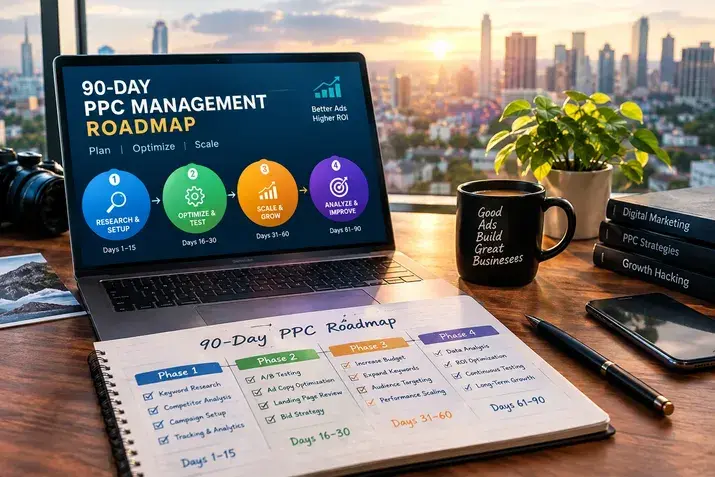
An organised 90-day plan for PPC management provides adequate time for e-commerce brands to study the performance of their accounts and create an approach for sustained growth. There are three main stages in this process: diagnosing, optimising, and scaling.
Days 1–30: Diagnose and Build
During the first month, the aim is to get familiar with the account and fix basic things. Such things would include auditing the Google Ads campaigns, conversion tracking, and GA4. There will also be an evaluation of the Merchant Centre and product feed, along with search terms and product level profitability analysis. The PPC agency can also look at the campaign structure, landing pages, and competitors.
Days 31–60: Optimise and Test
In the second month, the emphasis must shift to improving performance through controlled testing. Such activities can be done by segmenting the products, refining the search terms, testing the creatives, allocating budgets differently, and improving the landing page. The aim of this is to determine the products, campaigns, and customers that make profit.
Days 61–90: Scale
Having identified the pattern of performance, the last stage is that of growth. Digital marketing services can assist in gradually growing the budgets of those campaigns that have proven to perform well, growing their product lines and acquiring more customers. It will be important to carefully monitor the performance to ensure that spending pays off.
Within the span of 90 days, we aim to have a well-organized PPC campaign that is more profitable and has a road map for future development.
What Good PPC Reporting Should Look Like ?
There are five main points to include in a good report:
What happened?
Revenues, expenses, conversions and efficiency.
Why did it happen?
Product, target, search, creative and market level analysis.
What changed?
Campaign, budget, feed, bids and landing page changes.
What have we learned?
Customer intent, product performance and customer acquisition.
What is next?
Specific actions with priorities.
The last point is what sets reporting apart from strategy.
Reporting that states “ROAS dropped 12%” is not very helpful.
A report that states:
“Since ROAS has decreased due to the increase in allocation towards three low-margin products, their conversion rates have stayed the same, but contribution per order has reduced. Our suggestion is to reallocate 15% of the increased budget to high-margin products and conduct a different promotional campaign.”
is actionable.
That is the standard serious advertising agencies should aim for.
E-E-A-T, Trust and Responsible Advertising :
PPC marketing is not only about effectiveness.
It also should take into consideration the requirements of consumers and authorities.
According to the US Federal Trade Commission, advertising statements should be truthful, not deceptive, and substantiated.
For e-commerce brands, that means claims such as:
- “Best-selling”
- “Clinically proven”
- “Guaranteed results”
- “50% better”
- “America’s #1”
- “Lowest price”
should not be used casually.
The same principle applies to landing pages and product claims.
Also, the Google Search guidelines place much stress on useful and trustworthy people-oriented content as well as advise creators to develop authentic content instead of ranking-oriented one.
This becomes very pertinent to AI-based searches.
Google has emphasized that the key ingredients for success in AI-driven search experiences, such as AI Overviews, still revolve around unique and delightful content, along with good page experience.
For any agency, this implies that SEO, PPC, and content strategy shouldn’t revolve around trickery.
They must be crafted based on valuable information, true claims, clear business intentions, and real expertise, as the best digital marketing agency would.
Optimising PPC Content and Landing Pages for AI Search :
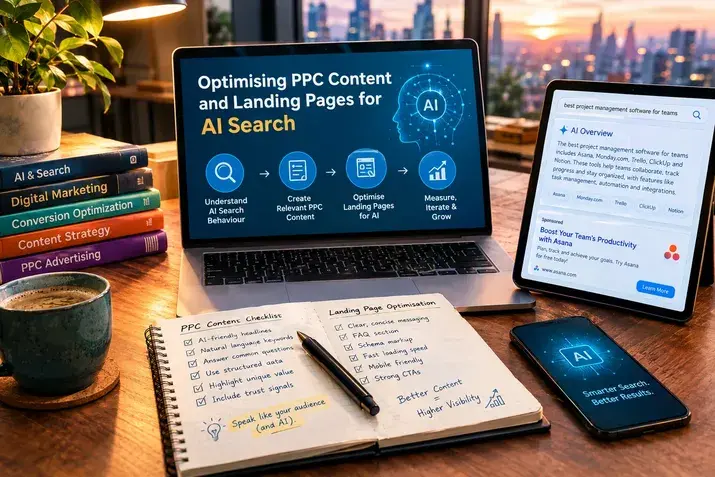
Though PPC is not directly connected to organic rankings, the landing page should be easy for both users and search engines to understand. All key information including product value, prices, features, delivery, return policy, reviews and FAQs should be communicated correctly on the page.
Create Clear, Helpful Content
A landing page must provide information on what the product is about, who it is intended for, and what problems it will solve. The landing page must not have any unnecessary information but only those needed in making a purchase decision.
Answer Customer Questions
Inclusion of relevant questions about product features, pricing, delivery, returns, compatibility, and usage scenarios will help achieve the objective of satisfying the intent and provide more accurate information to AI-based search systems.
Build Trust and Authority
Always use reviews, descriptions, guarantees, certificates and proof if necessary. Do not use exaggerated statements and make sure that all advertising texts and landing pages are supportable.
Maintain Consistency Across Channels
Consistency is the key to success in terms of the communication of your PPC campaign, product feed and landing page. Local business marketing will help you convey the same message through other platforms. The consistency in message, price, and product details will ensure that the customers get a better idea about the connection between the ad and the destination page.
This means that an effective landing page needs to cater to both humans and today’s search experience in order for e-commerce businesses to succeed.
Final Takeaway: Choose a PPC Agency That Optimises for Profit
There is increased automation in the world of digital ads.
But that does not mean that strategy becomes less important.
Strategy becomes more important.
The true value comes from knowing why performance has changed, which products should receive attention, customer behavior patterns, the actual cost of acquisition, and where incremental growth can come from by spending more money on ads.
When it comes to US e-commerce businesses, the best PPC strategies will include:
Precision measurement + excellent product data + intelligent campaign structure + business economics + rigorous experimentation.
If all these are combined, PPC ceases to be merely an advertising cost.
Instead, it becomes a growth engine that you can measure.
For an online retail brand that spends heavily on Google Ads but cannot accurately pinpoint profitable products, customers, and campaigns, there is a need to take a different route from increasing budgets alone.
A professional B2B digital marketing agency must be able to conduct an audit of your account, point out inefficiencies in spending, highlight scale-ups possible, measure effectively and create a road map based on your business goals.