Having your ad clicked on via Google Ads makes you feel great.
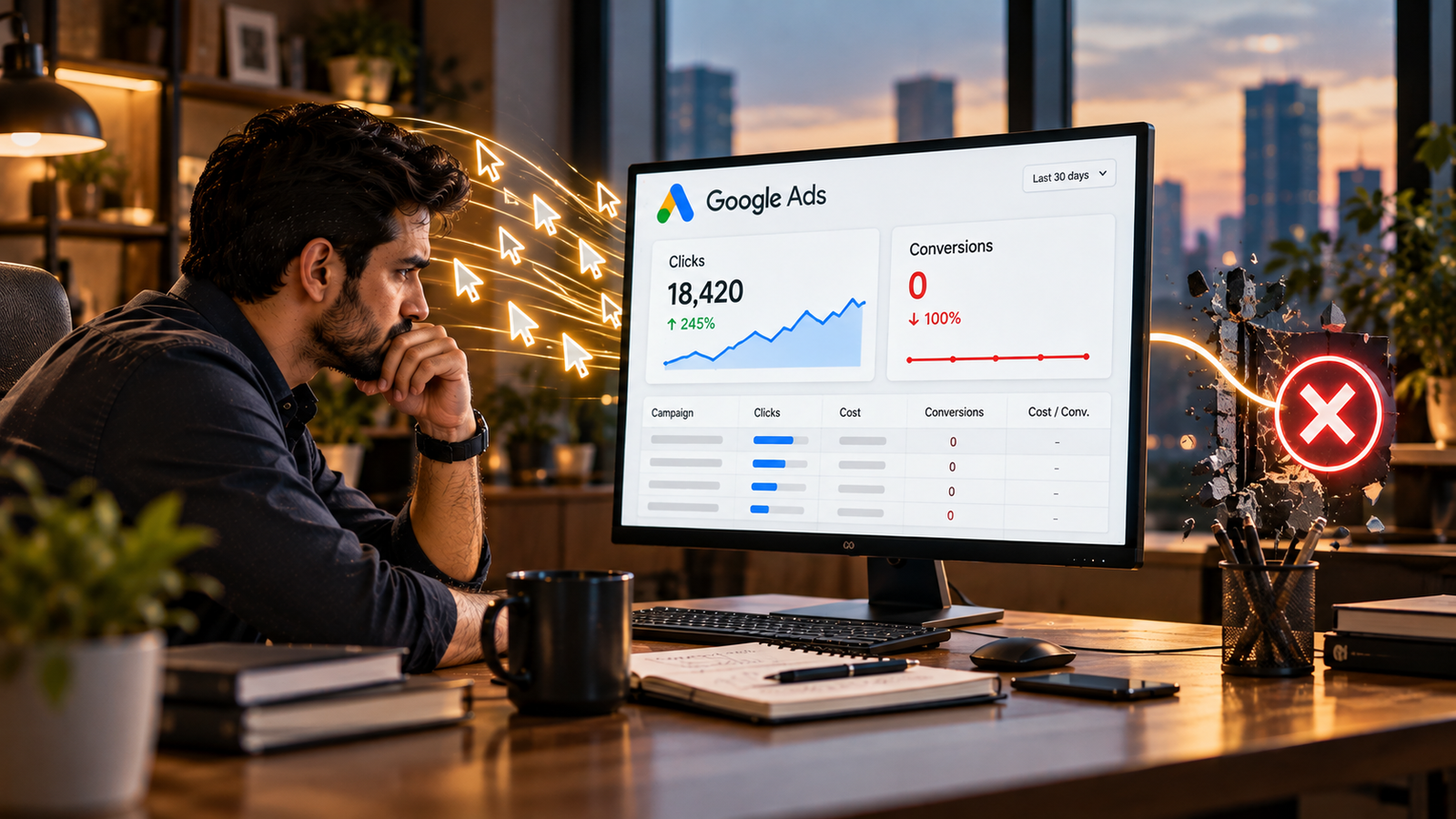
Your impressions are rising. Your CTR is decent. Visitors are landing on the website. However, when you look into your conversion tab, the figure which really counts proves to be disappointingly low – or non-existent at all.
What went wrong then?
The explanation is not usually something like “Google Ads don’t work”. The issue is normally in-between search intent, targeting, ad copy, conversion tracking, landing page, the offer and the sales process.”
This is where expert digital marketing services come into play and make all the difference. PPC management isn’t about spending your budget on unnecessary clicks. PPC management involves making a seamless system where the right person sees the right ad and clicks through to the right page where he/she performs the required action.
Google Ads itself advises that keywords, ads, and landing pages should be highly congruent with one another, while the Search Terms report in Google gives the advertisers the opportunity to see what kinds of search queries are causing their campaigns to fire off.
And this makes all the difference.
One campaign can have 1,000 clicks and provide virtually zero commercial value. Another one can have 200 highly qualified clicks and provide you with a solid pipeline.
This guide will help you identify the difference – and prioritize your fixes.
Google Ads Clicks but No Conversions: The Short Answer
If your Google Ads are getting clicks but no conversions, investigate the problem in this order:
| Area | What may be wrong | What to inspect |
| Tracking | Conversions are happening but not being recorded | Conversion actions, tags, GA4, enhanced conversions |
| Intent | People clicking are not genuine prospects | Search terms, keyword themes, negative keywords |
| Ad | The message attracts curiosity rather than buying intent | Headlines, offer, CTA, keyword-to-ad relevance |
| Landing page | Visitors do not see a compelling reason to act | Message match, CTA, proof, form, UX |
| Offer | The proposition is weak or poorly differentiated | Pricing, guarantee, value proposition, next step |
| Targeting | Traffic comes from low-value segments | Location, device, audience, schedule |
| Sales process | Leads arrive but are not converted | Response time, qualification, follow-up |
| Measurement | Campaign is optimising for the wrong outcome | Primary conversions, values, bidding strategy |
Things should not be done all at once.
The key is to find out what is the first broken link in the chain, fix it, and only then move on with changes in the campaign. The best digital marketing agency will help you figure it out.
This is the basic principle of a good digital marketing service.
Google Ads Getting Clicks but No Conversions? Let’s Find Out Why
Clicks without enquiries or sales usually point to broken tracking, the wrong audience, a weak landing page or a poor campaign setup. We audit your account, find the leak and fix it. See how our Google Ads and performance marketing services can help.
1. Your Conversion Tracking Is Broken or Misconfigured :
Before changing keywords, ads or landing pages, check if you actually have a conversion issue.
This is very basic stuff, yet it is one of the most often ignored aspects of PPC management.
Let’s say your sales department got eight legitimate contacts through Google Ads during the current month, but the thank-you page on the website does not trigger Google Ads conversion pixel.
And your ad network shows zero conversions.
So you decide that PPC is not working for you.
It isn’t. Your tracking is broken.
Google says that the purpose of conversion tracking is to link the interaction with your ad to a valuable action like buying, lead generation, making phone call, subscribing etc. Google also offers enhanced conversion tracking based on hashed first-party user data.
What to check in Google Ads conversion tracking
Audit the complete conversion journey:
- Does the conversion action still exist?
- Is it marked as a primary conversion where appropriate?
- Is the correct Google Ads account receiving the data?
- Does the tag fire after the intended action?
- Are duplicate conversions being recorded?
- Are form submissions actually reaching your CRM?
- Are phone calls being tracked?
- Are imported GA4 events configured correctly?
- Are consent or browser limitations affecting measurement?
- Is the campaign bidding towards the conversion that actually represents business value?
Don’t fine-tune your PPC campaign on the basis of an incorrect scoreboard because a good PPC agency will always know that correct tracking is crucial.
This is especially true for lead generation where the process from click to customer can span multiple different systems, such as Google Ads, the website, CRM and sales, and finally, the sale.
2. Your Keywords Are Attracting the Wrong Search Intent :
Click does not necessarily mean buying intent. The person who searches “digital marketing agency for SaaS companies” will definitely have more buying intent than the person who searches “what does a digital marketing agency do?” Review your Search Terms report on Google Ads to know whether the keywords you are using are getting you quality clicks or irrelevant clicks.
If you are using keywords like “jobs,” “salary,” “course,” “free,” “training,” “certification,” or “tutorial,” try adding negative keywords that are related. It is also possible to improve match types and create different campaigns according to search intent. The aim is not just to get clicks; the target audience should be those who need SEO services.
3. Your Ad Promises Something the Landing Page Does Not Deliver :
This is the single most important reason why Google Ads drive clicks but don’t create conversions.
Think about this experience:
Searching: “B2B PPC agency”
Advertising: “B2B PPC Agency – Generate More Qualified Leads”
Landing page: Generic digital marketing agency homepage
Clicking because the ad offered something specific.
But they got directed to a generic page offering SEO, social media, web design, branding, content marketing and lots more.
The user now needs to figure out if you specialize in PPC.
Friction like this is simply not required.
Build message match between keyword, ad and landing page
:
Your PPC campaign can be thought of as an evolving three-step process of promises as follows:
Keyword → Advertisement → Landing Page
The promise needs to be clearer in each step.
For instance:
Keyword: B2B digital marketing agency
Advertisement: B2B Digital Marketing for SaaS & Technology Companies
Landing page title: B2B Digital Marketing Services Designed for SaaS Growth
CTA: Schedule a B2B Growth Strategy Call
That is what message continuity means.
It is a perfect time to make internal links to your B2B digital marketing agency service page as well.
4. Your Landing Page Is Creating Friction :
Even a visitor who means business may decline to convert if the next step on the landing page is hard to take.
The best landing pages don’t need to be flashy.
The best landing pages make the decision easy.
The best landing page will answer five questions swiftly:
What do you sell?
Who is it for?
Why should I believe you?
How are you different?
What am I supposed to do now?
If your visitor needs to scroll down three pages to figure out what you’re selling, you’ve got a problem.
The five-second landing-page test :
On your mobile landing page, ask yourself:
If I knew nothing about this business, would I be able to comprehend the offer and next steps in five seconds?
If not, then simplify your landing page.
Place the commercially vital information at the top:
- clear value proposition
- specific service
- relevant proof
- primary CTA
- essential qualification information
Avoid forcing visitors to navigate through a complicated menu before taking action.
For campaigns that rely heavily on mobility, speed is definitely not an issue of appearance. It is an issue of money, particularly for companies selling social media marketing service.
Unbounce’s research, based on 41,000 landing pages and 57 million conversions, indicates that mobile-first landing page optimization is extremely important, since mobile visitors convert at lower rates compared to their desktop counterparts.
5. Your Offer Is Not Strong Enough
Other times, the PPC campaign may be performing as expected.
The issue arises from the offer being made.
“We provide digital marketing services, contact us” isn’t always a strong offer.
A better offer would be:
“Take advantage of a free conversion audit from Google Ads and find out how you’re losing money with your PPC ads.”
The second offer creates urgency within the visitor.
It’s especially essential when dealing with an audience that doesn’t know who you are.
Increase perceived value before increasing ad spend :
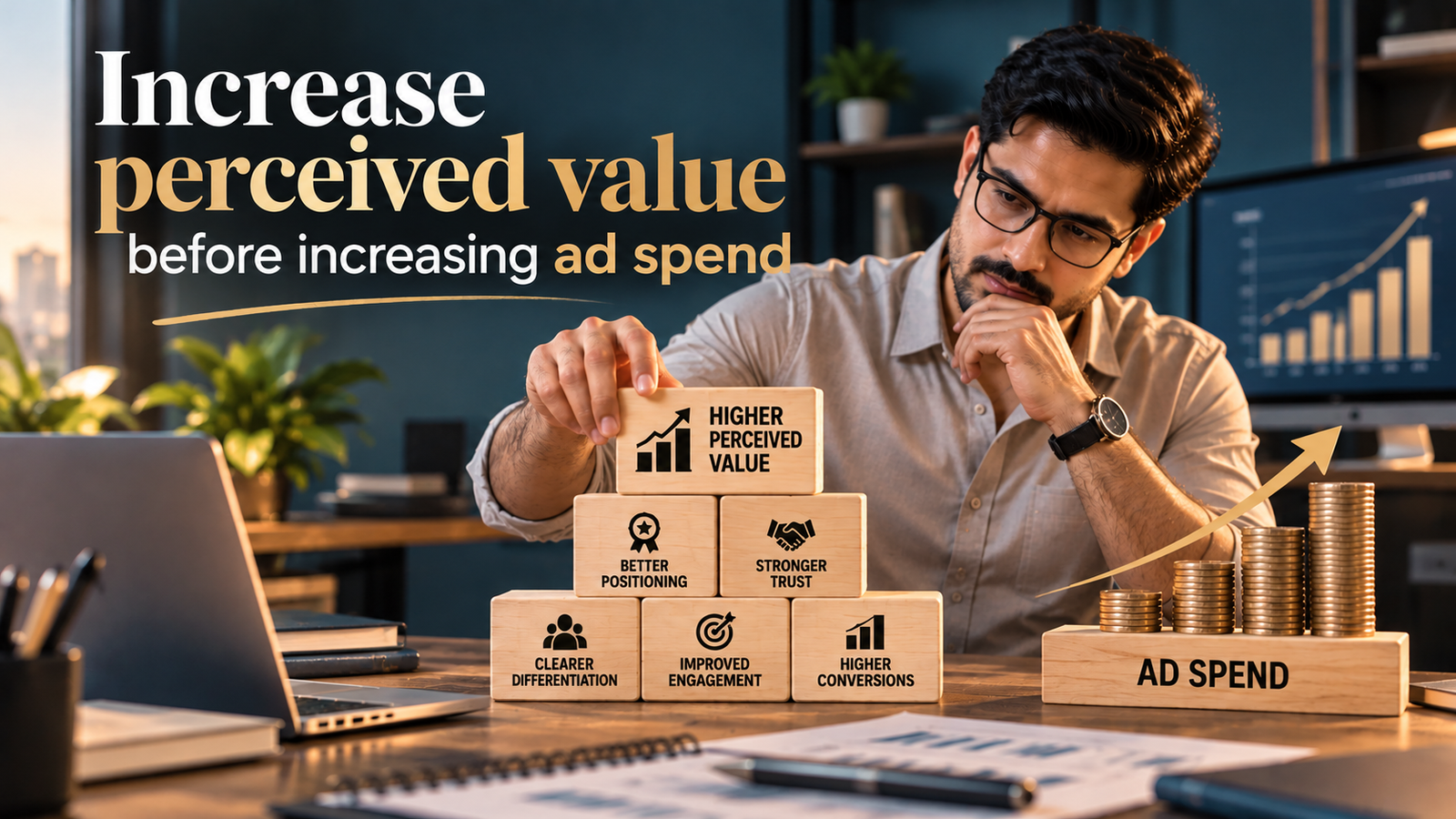
Before expanding your budget, consider:
The value proposition
What result do you deliver commercially?
Specificity
Who is the offering tailored for?
Proof
Are you able to show success, experience, or expertise from previous projects?
Risk reversal
Is there any way you can take the risk out of the first step?
Next step
Is the CTA appropriate to the stage of the visitor’s decision-making process?
For instance, “Sign up for a 12 month contract” is much more demanding on a cold lead than “Get a PPC account audit.”
Conversion optimization is to some extent a psychological issue, according to the best PPC marketing agency.
The objective is not simply to persuade people.
It is to reduce uncertainty.
6. Your Campaign Is Optimised for Clicks Instead of Business Outcomes :
Clicks are input.
Conversions are output.
Profitability is the business output.
The three metrics are not synonymous.
Assuming Campaign A generates:
1,500 clicks
75 leads
5 customers
And Campaign B generates:
600 clicks
45 leads
12 customers
Campaign B would have a more favorable commercial performance, even if it generates fewer clicks.
This is precisely the reason why professional digital marketing companies emphasize the whole funnel instead of just rejoicing over increased traffic.
Conversion should stand for something truly valuable.
In case of a lead generation company, this can be:
qualified enquiry
scheduled consultation
sales qualified lead
phone call for the period of time
application completion
Email subscription can be valuable as well, but not necessarily as valuable to optimize for as the sales qualified lead.
Instructions for conversion measurement by Google also point out the use of conversion data to know which ads and keywords lead to valuable actions for advertising agencies.
7. You Are Generating Leads That Cannot Become Customers :
There is one more thing that companies often miss out on.
Your Google Ads convert.
But they convert the wrong people.
That’s a lead quality issue.
For instance, a digital marketing firm could be running ads for:
“Affordable PPC Management.”
It can definitely get some leads for itself.
However, if its profitable customers tend to have £10,000+ monthly budgets, the use of the term “affordable” may lead to unqualified prospects.
The campaign works well in Google Ads.
The sales team sees through it.
Measure lead quality, not just lead volume
Create a simple funnel:
Click → Lead → Qualified lead → Sales opportunity → Customer → Revenue
Then compare campaigns at every stage.
| Metric | What it tells you |
| CTR | Does the ad attract attention? |
| Conversion rate | Does traffic take the desired action? |
| Cost per lead | What does each lead cost? |
| Lead qualification rate | Are leads relevant? |
| Opportunity rate | Do qualified leads enter the pipeline? |
| Close rate | Can sales convert them? |
| Customer acquisition cost | What does acquiring a customer really cost? |
| Revenue / ROAS | Does the campaign create economic value? |
This is especially true for a B2B digital marketing agency, as the sales process could span weeks or even months.
Focusing only on inexpensive leads may actually harm results.
8. Your PPC Campaign Does Not Match the Buyer’s Journey :
Not everyone who is looking for your business is interested in purchasing it right away. The effective PPC campaign will take into consideration that people have various degrees of intent when searching, and will adapt to the level of intent by using different messages, pages and offers. People who are searching with high intent like ‘PPC agency’, ‘Google Ads management company’ and ‘best digital marketing agency’ are most likely considering providers.
The lower intent keywords like “how Google Ads works” or “PPC advertising guide” will mostly have informational purposes. This does not mean that this type of keyword is not useful for content, audience development, and remarketing purposes because it is not. However, this will not drive leads right away. The problem here is the assumption that all searchers are alike. A good digital marketing services campaign aligns keyword, ad, landing page, and offer with the purchasing process of the client.
9. Your Geographic, Device or Audience Targeting Is Too Broad :
Even with good ads and an optimally designed landing page, your Google Ads campaigns can perform poorly if the targeting is too wide. Evaluate performance based on location, device, time, audience, campaign, ad group, keywords, and search terms to see where your money is really working for you.
For instance, you might notice that most of your budget is going to mobile users in places where your business doesn’t do any work, but another geographic area is providing you with the bulk of your qualified leads. The same can be said for your audience targeting.
Do not rely solely on the average figures at the campaign level. While a 3% conversion rate might be an average figure, it may hide a 7% conversion rate for your best market and only 0.5% in other markets. Through more detailed analysis of the performance, you can ensure more efficient spending and improve the efficiency of your PPC company.
10. Your Sales Follow-Up Is Losing the Leads
That is the point where PPC merges with sales.
Consider spending £100 on lead generation and waiting for three days to call.
The marketing strategy might be doing fine.
The business process is not.
For high intent leads, the speed of your response could mean speaking with the prospect or losing them to a competitor.
According to research done by InsideSales, which was based on over 5.7 million leads, the conversion rates were highest when sales teams acted upon their leads within the first five minutes. This shows why it is important to make lead follow-up an essential element of your PPC conversion strategy.
Establish an outlined follow-up process.
For instance:
Instantly: automated confirmation
Within a few minutes: sales alert
On the same day: personal reply
Days 1 to 5: follow-up routine
After qualification: CRM pipeline management
Ensure that you trace the result back to your initial campaign.
If not, you risk the PPC manager optimizing towards leads that the sales team rejects continuously.
This creates a vicious cycle.
A Practical Google Ads Conversion Diagnostic Framework :
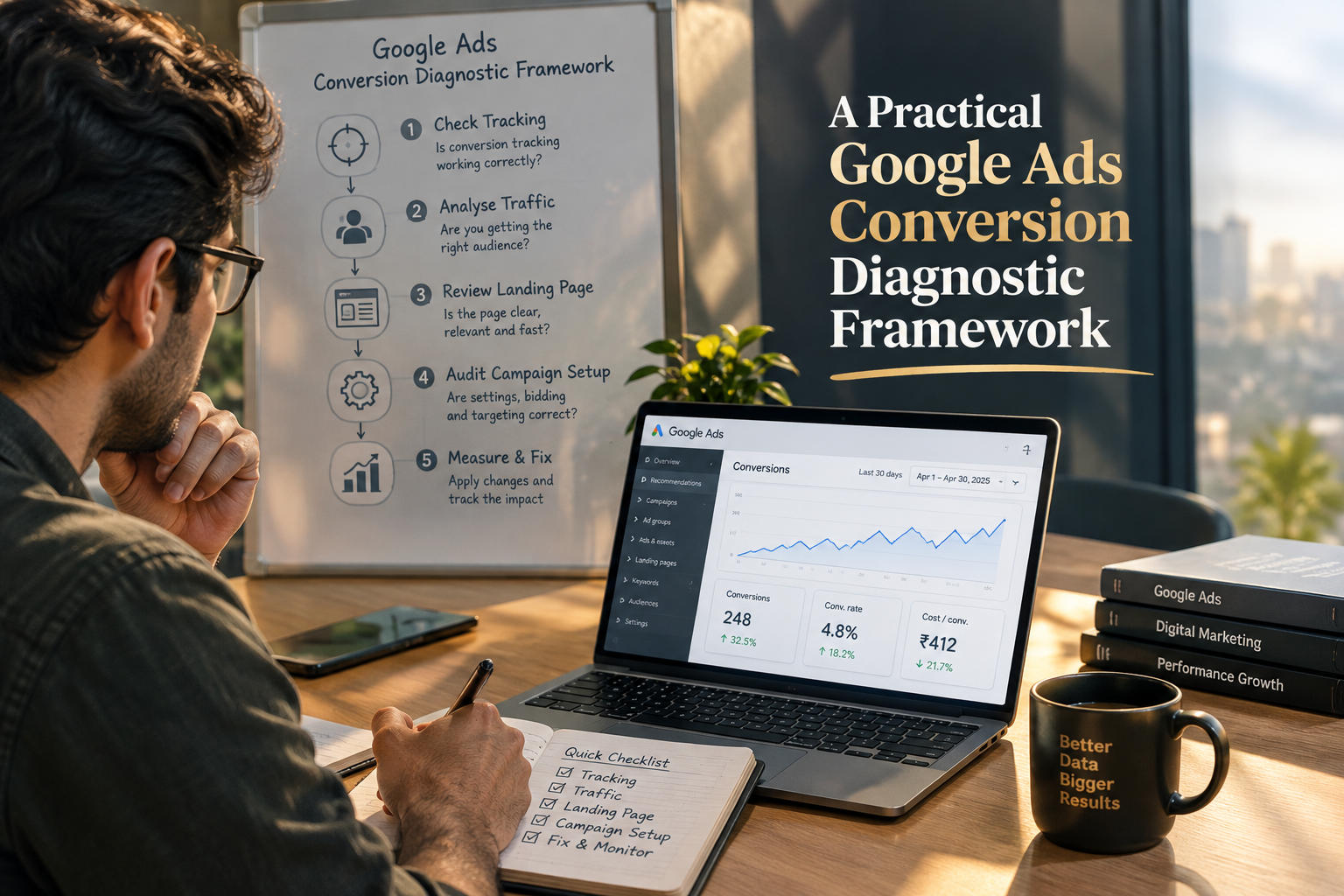
If your Google ads have clicks without conversions, you should not change the campaigns randomly. Rather, you need to use a systematic approach to determine at what point customers are losing interest in determining the best digital marketing agency.
Stage 1: Validate the Data
To start with, ensure that you are tracking your conversions correctly. This involves verifying the status of your Google Ads conversion actions, tracking tags, GA4 events, CRM submission, phone tracking, enhanced conversions, and duplicate conversions.
Stage 2: Validate the Traffic
In addition, examine your Search Terms report to find out if those who are clicking on your ads are really interested in the services that you offer. Before altering your landing page, you may want to make changes to your keywords and negative keywords first.
Stage 3: Validate the Promise
Make a comparison of the entire process of moving from the search query to the keyword, advertisement, and landing page headline and call-to-action. This needs to ensure that everything along the way is consistent with the user’s intent.
Stage 4: Validate the Experience
Check your landing page for mobile usability, page speed, navigation, form length, CTA visibility, trust badges, price details and contact possibilities. The more understandable your proposition and actions for visitors are, the more chances there are for conversions.
Stage 5: Validate the Offer
Ask yourself: “Why should the prospective buyer go with us instead of all those other companies he sees around?” In case your value proposition or offer is not clear enough, SMM marketing might help you with that, but increased effectiveness of your advertisements will not fix the issue by itself.
Stage 6: Validate Commercial Quality
Ultimately, integrate your PPC campaigns into your CRM system, and trace the entire process from lead to qualified lead, opportunity, customer, and ultimately, revenue. This way, you can be more concerned about achieving business results than just delivering click-through rates.
When Should You Hire a PPC Agency or Digital Marketing Agency ?
If you have enough internal expertise and time, many Google Ads issues can be diagnosed internally.
But specialist support becomes valuable when:
- spend is increasing without proportional revenue
- conversion tracking is unreliable
- campaigns have become complicated
- you cannot determine which keywords produce customers
- landing pages are not converting
- your sales team disputes lead quality
- you are unsure how to structure campaigns
- automated bidding is producing unpredictable results
- multiple channels need to work together
The right partner should not just give you a commitment for “more leads”.
How do they define “qualified conversion”?
What will happen if conversion rates drop?
How do they integrate Google Ads into CRM and Revenue?
How do they deal with landing pages?
How do they take advantage of search term intelligence?
And what would they stop doing, to save the budget?
This means that a good Facebook Ads agency is capable of justifying their advice instead of using all technical language associated with the platform.
Clutch recommends evaluating PPC agencies based on relevant experience, measurable results, case studies, communication and transparency when choosing a long-term partner.
Similarly, if your acquisition process involves SEO, paid search, content, social media, and conversion optimisation, then a wider marketing solution may be more suitable.
For instance, one could integrate search marketing, social media, organic search, retargeting, and conversion-oriented content instead of isolating each channel.
Conclusion: Turn Google Ads Clicks Into Conversions
If Google ads are being clicked but not producing any conversions, it means there is something wrong within the customer’s path. From conversion tracking to keyword selection and the quality of the leads generated, all aspects must be functioning well in order to ensure success. Before you decide to increase the budget, pinpoint where your clients are falling short.
A proper strategy for digital marketing services does not just revolve around clicks and impressions but revolves around qualified leads, clients, and profit generation. The PPC audit is something that can assist in finding the areas where money is being wasted through your Google Ads and help build an effective campaign to generate growth.