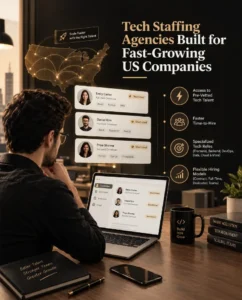
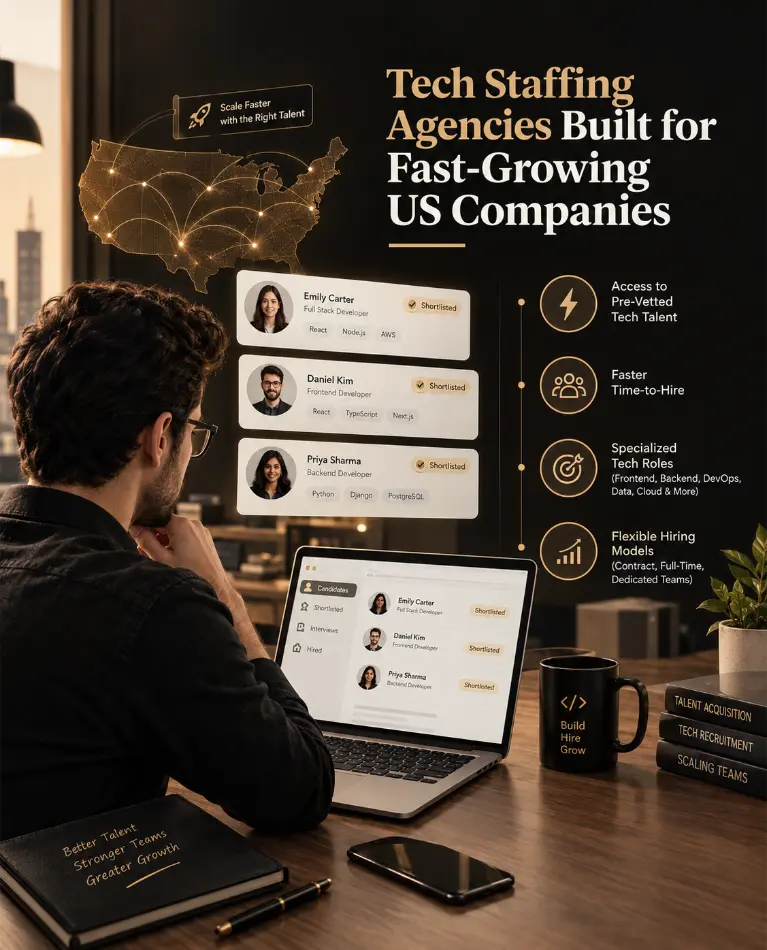
Skip the six-week hiring slog. Get vetted tech talent in front of you in days.
Most tech staffing agencies promise speed and quality, but stretching a small business budget too thin usually gets you one or the other, not both. Digifinity built its tech staffing agencies model around a simpler idea: engineers and IT specialists who can actually start contributing in weeks, priced so a lean team doesn’t have to choke on the invoice. That pressure isn’t imagined. SHRM’s 2026 Talent Trends Report put the number at nearly seven in ten HR professionals still struggling to fill full-time roles, and technical positions are usually the hardest of the bunch.
Say you’ve had a backend developer role open for two months. Your sprint planning has probably started working around the gap instead of through it. Someone on the existing team picked up the slack without being asked, a client demo got pushed because the feature wasn’t ready, and at some point you stopped updating the roadmap out loud because it kept slipping. That’s what an unfilled seat actually costs, and it’s rarely the number people budget for going in.
Why DIY Tech Hiring Is Quietly Costing You More Than You Think?
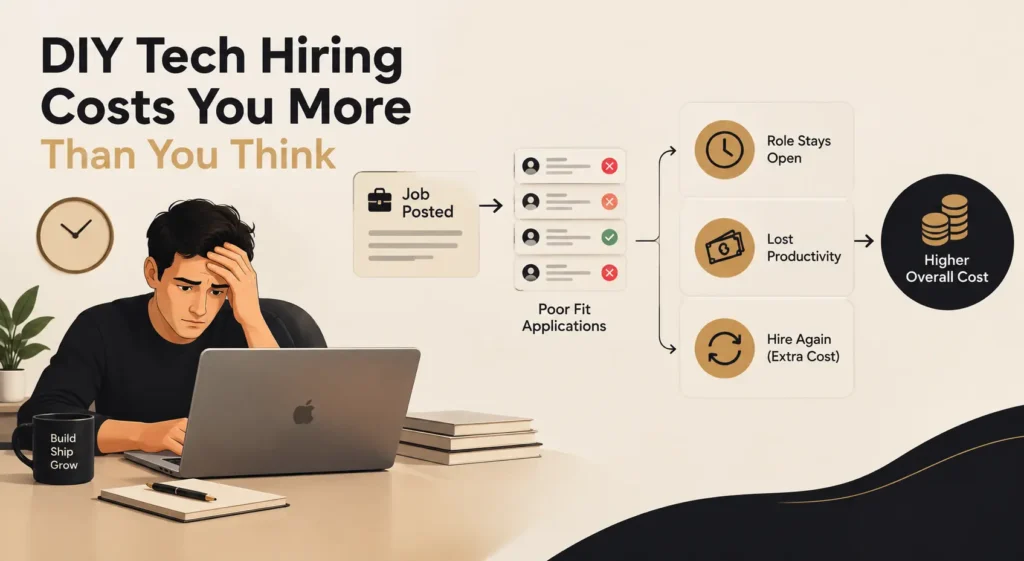
Founders and hiring managers rarely set out to run recruiting badly. They just don’t have the time to do it well. A job posting goes up, a trickle of applications comes in, most of them a poor fit, and three weeks later the role is still open. Meanwhile the actual work of running the business hasn’t paused to wait.
The US labour market hasn’t made this easier. Job openings held at 7.4 million nationally as of the latest BLS JOLTS report, and demand for skilled technical staff hasn’t cooled the way some other sectors have. Small businesses feel this more acutely than large enterprises. A Fortune 500 company can absorb a six-month vacancy in its engineering team. A ten-person startup usually can’t.
There’s also a cost most founders underestimate: the cost of a bad hire made under pressure. When a role has been open too long, the temptation is to lower the bar just to fill it. That decision tends to cost far more than the extra weeks of searching would have, once you account for onboarding time, lost productivity, and the eventual need to hire again.
What a Tech Staffing Agency Actually Does?
A good tech staffing agency isn’t a job board with extra steps. It’s a recruiting function you borrow instead of build. Digifinity’s sourcing services exist to solve the specific problem small and mid-sized companies run into: you need senior-level hiring capability, but you don’t have the headcount or budget to run an in-house recruiting team year-round.
Here’s the practical difference. Instead of posting a role and hoping the right person stumbles on it, we go find candidates who actually fit what you’re building, whether they’re job hunting or not. Most of the strongest developers and DevOps engineers aren’t scrolling job boards on a Tuesday afternoon. They’re already employed, reasonably content, and only worth a conversation if it’s genuinely worth their time. Getting in front of that group takes a different kind of sourcing than running an ad and hoping for the best.
See our full range of technical hiring support.
From single contract hires to full engineering teams, to see what’s included before you commit to anything.
What You Get When You Partner With Digifinity?
Working with a staffing partner should simplify your hiring, not hand you another vendor relationship to manage. In practice, that starts with a recruiter who actually learns your tech stack and team culture instead of treating your open role like a generic template. Every candidate who reaches your inbox has already cleared technical and communication screening, so you’re not the one filtering fifty resumes down to three worth a call.
- A dedicated recruiter who learns your tech stack, team culture, and hiring criteria before sourcing begins
- Pre-vetted candidates who’ve cleared technical and communication screening before you see a resume
- Flexible engagement models, whether you need one contract developer for a three-month project or a full permanent hire
- Direct access to our IT staffing services for roles beyond core engineering, including infrastructure, support, and systems administration
None of this works without honesty about fit. If a candidate looks strong on paper but wouldn’t actually thrive on your team, we’ll say so before you waste an interview slot on them. That’s the part of the job that builds trust over time, and it’s the part a lot of high-volume staffing firms skip because it slows them down.
The Business Impact of Getting Tech Staffing Right:
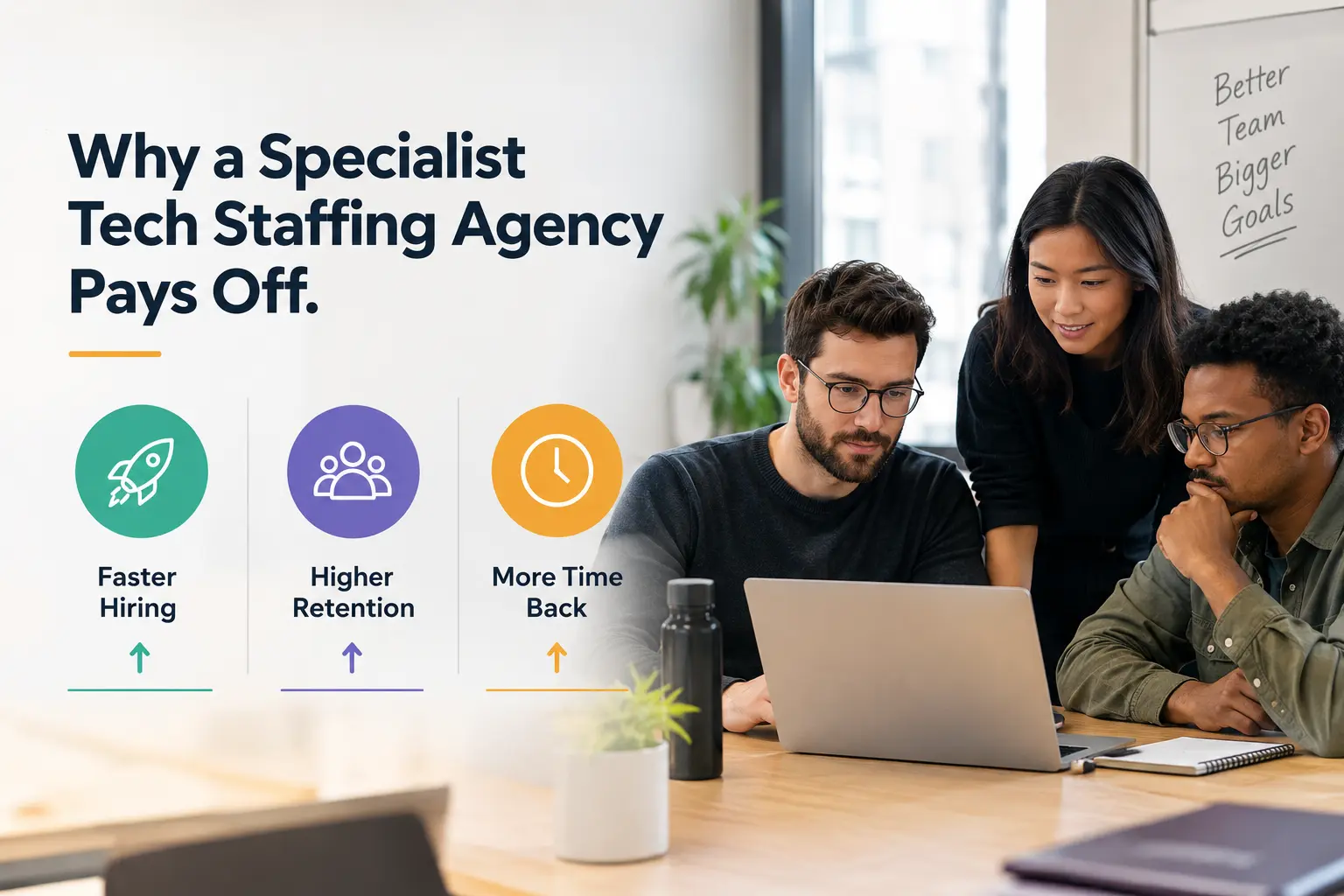
The payoff from working with a specialised tech staffing agency isn’t abstract. It shows up in three places: how fast you fill roles, how long the people you hire actually stay, and how much internal time your team gets back.
Speed matters more than most companies budget for. Every week a critical engineering seat sits empty, your existing team is either stretching to cover the gap or watching planned work slip. Retention matters just as much, arguably more. A candidate who was rushed through screening and turned over in four months costs you twice: once for the original hire, and again for the replacement search you now have to run under even more time pressure.
The best hiring strategies treat staffing as infrastructure, not a fire drill you run only when someone quits. Companies that build a steady sourcing pipeline, even a lightweight one through an external partner, spend less time reacting to vacancies and more time actually building. That shift alone is often the difference between a hiring process that drains a founder’s calendar and one that quietly runs in the background.
How Our Tech Staffing Process Works?
The process starts with a conversation, not a form. We sit down with you, or your hiring manager, and get specific about the role: the stack, the seniority level, the team it reports into, and what’s actually gone wrong in past hiring attempts if there have been any. That last part matters more than people expect. A lot of hiring problems are patterns, and once we see the pattern, we can design around it.
From there, sourcing begins immediately. We’re not starting from zero for most roles, since our recruiters maintain active relationships with technical candidates across common US markets. Every candidate who reaches you has already been through our candidate screening services, which cover technical competency, communication, and basic culture alignment. You’re not sorting through fifty resumes to find three worth a call. You’re looking at a shortlist that’s already been filtered for fit.
You run the interviews your way. We stay involved through offer negotiation and onboarding, partly because a hire isn’t really successful until they’re settled in and producing, and partly because that’s where a lot of good candidates get lost to competing offers if nobody’s managing the process closely.
More Than Engineers: Full-Team Support
Tech staffing agencies that only handle engineers are solving half the problem. Growing companies need product managers, QA specialists, IT support staff, and increasingly, the administrative and operations roles that keep a technical team functional. Digifinity works as a full technology staffing agency, not a single-discipline recruiter, which means you’re not managing three different vendors for three different types of hire.
That includes administrative support roles that often get deprioritised until they become urgent: the operations coordinator who keeps your engineering team’s calendars and vendor relationships straight, or the technical writer who finally gets your documentation into a state new hires can actually use. These roles rarely get the recruiting attention they deserve, mostly because they’re not the loudest fire on a founder’s list. They still slow a company down when they’re missing.
Roles and Tech Stacks We Recruit For:
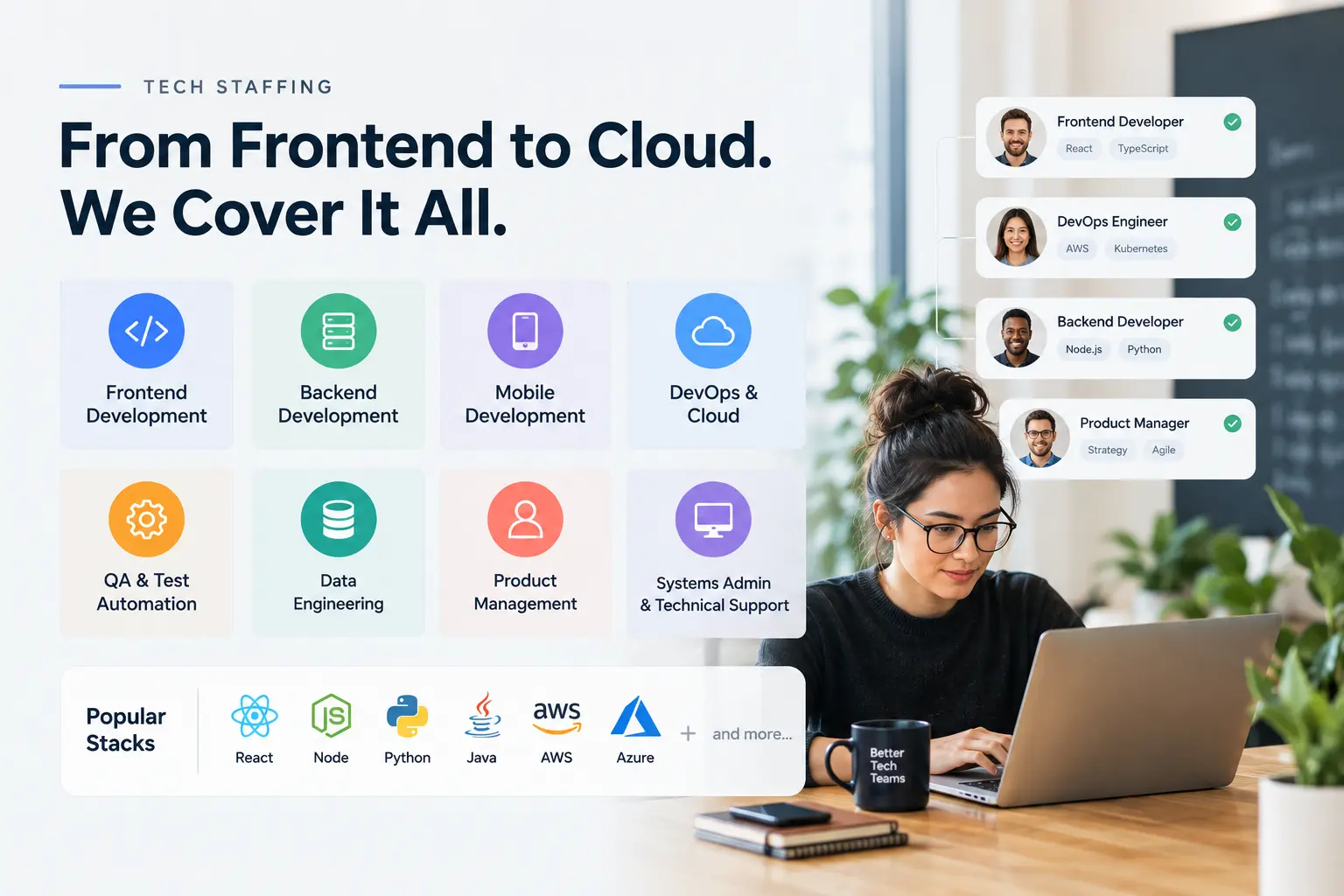
“Tech staffing” covers a wider range than most people expect going in. We place candidates across frontend and backend development, mobile, DevOps, cloud infrastructure, QA and automation testing, data engineering, and product management, spanning stacks like React, Node, Python, Java, AWS, and Azure, along with the less glamorous but equally hard-to-fill roles like systems administration and technical support.
The specific stack matters less to us than the ability to match seniority accurately. A mid-level developer who’s genuinely strong in one framework is usually a better hire than a generalist who’s spread thin across five, and part of what a specialised technology staffing agency brings is knowing which is which before you’re three interviews deep with the wrong candidate.
What Does It Cost to Work With a Tech Staffing Agency?
Pricing in tech staffing usually falls into one of three models: a flat placement fee for permanent hires, an hourly or monthly rate for contract staff, or a contract-to-hire arrangement that blends the two. None of these should require a long-term retainer before you’ve seen a single candidate, and if an agency insists on one upfront, that’s worth questioning.
What actually drives the cost is seniority and scarcity, not the agency’s overhead. A junior QA hire costs less to source than a senior cloud architect, simply because there are more of the former available and willing to move. We walk through pricing specifics once we understand the role, rather than quoting a flat number that doesn’t reflect what you actually need filled.
| Engagement model | Best for | How it’s priced |
| Permanent placement | Long-term roles you want owned by one person | Flat fee based on seniority |
| Contract staffing | Defined projects or short-term coverage | Hourly or monthly rate |
| Contract-to-hire | Testing fit before committing long-term | Contract rate, converts to placement fee |
Why Do US Companies Choose Digifinity as Their Tech Staffing Partner?
We built Digifinity specifically for US startups and small businesses, not as a scaled-down version of an enterprise staffing firm. That distinction shapes almost everything about how we work. We don’t require long-term contracts before you’ve seen results. We don’t pad candidate pipelines with people who technically match a keyword search but wouldn’t survive a real technical interview.
What we do bring is a recruiting team that treats your open role like it matters, because for a ten or fifty-person company, one bad hire in a key seat genuinely can matter more than it would for a company ten times the size. Small business employment growth held near its 2026 highs through the first half of the year, according to Paychex data, even as many of those same companies said they were still navigating persistent challenges finding qualified labour. That’s not a coincidence. Companies are growing and still can’t fill the roles fast enough to support it, which is precisely the gap a specialised tech staffing agency is built to close.
We also keep an eye on where hiring is heading, not just where it’s been. Gartner’s 2026 predictions note that AI proficiency is becoming a real differentiator in technical hiring, and we’re already screening for it rather than waiting for it to become standard practice everywhere else.