Introduction
Video editing has traditionally been built around manual workflows. Creators open an editing application, import their footage, organize clips, adjust timelines, add effects, improve audio, and refine every detail before publishing the final video.
For professional editors, this approach has worked for decades. Tools like Adobe Premiere Pro became industry standards because they provided deep control over every aspect of production.
However, the way people create videos is changing.
Businesses, marketers, educators, and content creators now need to produce more videos across multiple platforms. A single idea may need to become a social media clip, a product video, a training lesson, and a promotional asset.
The challenge is no longer only about having powerful editing tools. It is about creating high-quality videos faster and with fewer technical barriers.
This is where invideo editor introduces a new approach.
Built around AI-assisted and agentic workflows, invideo AI video editor represents a shift from traditional tool-based editing toward instruction-driven video creation, where creators can guide AI agents to help with different parts of the editing process.
Adobe Premiere Pro, on the other hand, represents the traditional professional editing model, offering extensive manual control and advanced production capabilities.
Both approaches serve different needs, but they represent two different directions in the future of video editing.
Invideo Editor: A New Era of Agentic Video Editing:
Invideo Editor represents a move toward a more intelligent editing workflow where AI becomes an active part of the creative process.
Traditional editing software requires users to manually perform every action. Creators need to understand the interface, locate specific tools, and complete individual editing steps themselves.
Agentic editing introduces a different approach.
Instead of only operating software through buttons and menus, creators can provide instructions and allow AI agents to assist with parts of the workflow.
For example, instead of manually searching through footage and making multiple adjustments, a creator can communicate the desired outcome:
- Improve the pacing of this video
- Make this content more engaging
- Create a shorter version for social media
- Highlight the important sections
The AI-assisted workflow helps translate creative intent into editing actions.
This changes the role of the creator. They are no longer only operating editing software; they are directing an intelligent editing assistant.
How Agentic Workflows Change Video Creation?
The biggest difference between traditional editing and agentic editing is the interaction model.
Traditional workflow:
Open software → Find tools → Perform manual edits → Review changes → Repeat
Agentic workflow:
Describe the goal → Provide instructions → AI assists execution → Creator refines the result
This approach can be especially useful for users who understand the message they want to communicate but do not want to spend most of their time managing technical editing processes.
For example, a marketing team creating weekly product videos may not need to manually handle every repetitive editing task. Instead, they can focus on campaign messaging while AI assistance helps accelerate production.
Why invideo Editor Fits Modern Content Workflows?
The demand for video content has expanded beyond professional production teams.
Today, many different roles create videos:
- Marketing professionals create campaigns
- Businesses create customer education content
- Educators create online courses
- Entrepreneurs build personal brands
Many of these users need professional-looking results but may not have years of editing experience.
Invideo Editor fits this changing landscape by focusing on accessibility and efficiency.
The goal is not to remove creativity from the process. Instead, it helps creators spend less time managing technical steps and more time focusing on:
- Storytelling
- Audience engagement
- Brand messaging
- Creative decisions
Adobe Premiere Pro: The Traditional Professional Editing Workflow
Adobe Premiere Pro has been one of the most recognized video editing applications for professional creators.
Its strength comes from providing detailed control over the entire editing process.
Editors can manually manage:
- Multiple video layers
- Audio tracks
- Transitions
- Effects
- Color adjustments
- Timeline structure
For filmmakers, agencies, and professional editors, this level of control is valuable.
A complex production often requires precise adjustments, and Premiere Pro provides the tools needed for detailed post-production workflows.
Adobe Premiere Pro and the Evolution of AI Features:
Adobe has also introduced AI-powered capabilities into Premiere Pro.
These features help editors improve efficiency through automation and intelligent assistance.
Examples include AI-powered tools that help with:
- Finding content within footage
- Editing workflows
- Extending clips
- Making specific adjustments faster
However, the overall Premiere Pro experience remains centered around the traditional editing workflow.
The editor remains responsible for manually controlling the project structure, making creative decisions, and managing most elements of production.
This approach works well for professionals who require maximum control.
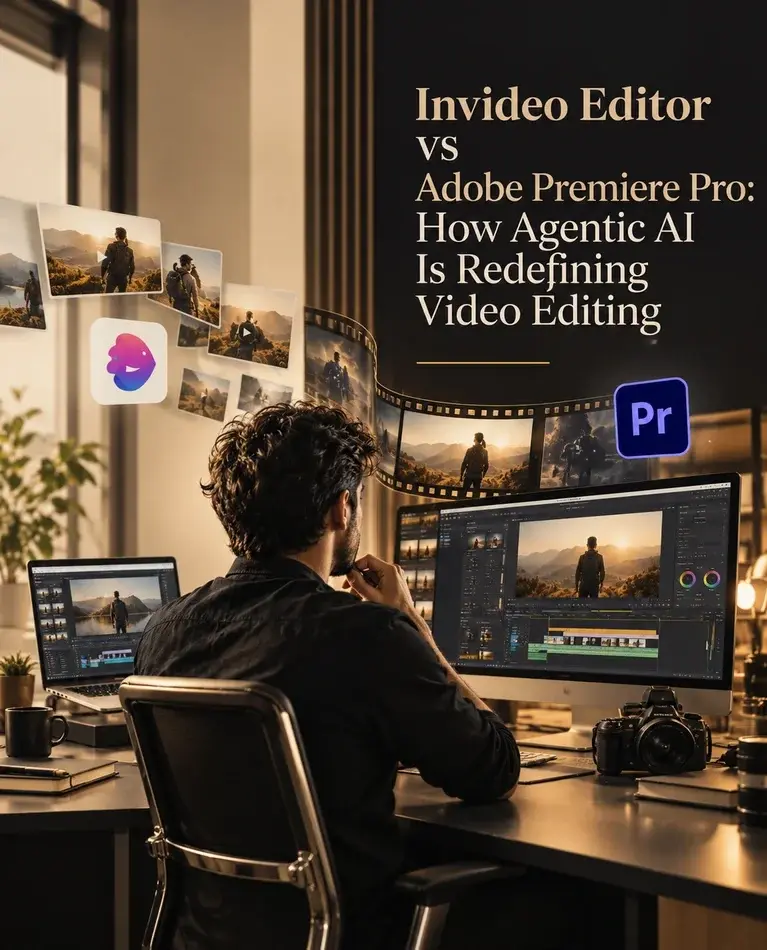
Invideo Editor vs Adobe Premiere Pro: Two Different Editing Philosophies
The biggest difference between invideo Editor and Adobe Premiere Pro is not simply the features they offer.
It is the philosophy behind how editing happens.
Invideo Editor Approach:
Invideo Editor focuses on:
- AI-assisted workflows
- Agentic editing
- Instruction-based interaction
- Faster content creation
- Simplifying complex processes
The creator communicates the goal, and AI assistance helps move the project forward.
Adobe Premiere Pro Approach:
Premiere Pro focuses on:
- Manual control
- Professional editing precision
- Advanced customization
- Detailed production workflows
The creator manages each stage of the process directly.
Neither approach exists for the same purpose. They represent different ways of creating video content.
Which Editing Workflow Is Better for Modern Creators?
The right choice depends on what the creator needs.
For businesses, marketers, and educators producing content regularly, speed and efficiency are often important factors.
An AI-assisted workflow can help reduce repetitive tasks and make video creation easier for teams that need consistent output.
For professional editors working on films, advertisements, or highly complex projects, detailed manual control remains important.
The difference comes down to workflow priorities:
Creators who want faster production and AI assistance may prefer an agentic editing approach.
Creators who need complete manual control may prefer traditional professional editing environments.
The Future of Video Editing Is Agentic:
The introduction of AI agents represents a broader change in how people interact with software.
For years, users have adapted themselves to software interfaces.
The next generation of tools is moving toward software that understands user intent.
Instead of asking:
“Where is the tool I need?”
Creators can communicate:
“Here is what I want to achieve.”
This shift has the potential to change video editing from a technical process into a more natural creative conversation.
AI agents can assist with repetitive tasks, while humans continue controlling creativity, strategy, and storytelling.
Conclusion
Invideo Editor and Adobe Premiere Pro represent two different generations of video editing.
Adobe Premiere Pro continues to serve professionals who need advanced manual control and detailed post-production capabilities.
Invideo Editor represents a newer direction built around AI-assisted and agentic workflows, where creators can use instructions to guide the editing process and work more efficiently.
As the demand for video content continues growing, the future of editing will not only be about adding more features. It will be about creating smarter workflows where AI helps creators transform ideas into finished videos faster.
The next generation of video editing is moving from simply using tools to collaborating with intelligent creative systems.