

You have created your job description. You have included knockout questions. Your ATS is filtering out resumes. Even your automation technology is ranking candidates based on their qualification and keyword matches.
But what keeps happening?
Your application numbers are high, yet the proportion of suitable applicants is low.
This is one of the most common recruitment issues confronting companies. Many times, this does not lie with your filtering technology.
The problem lies with the candidate pool you have invited to go through the filtering process.
Job post filter will be able to recognize if the resume matches pre-defined criteria. The technology does not have the capability to find out if these candidates can do the job, if the candidate’s experience is relevant or genuine and if they are truly interested in the position.
The difference is crucial.
In a good recruitment plan, there are three things that need to be segregated:
Attraction → Sourcing → Qualification
If you are depending on job posts and automated filters almost exclusively, you are optimizing only the last segment.
A professionally developed candidate sourcing service can make all the difference there.
Rather than waiting to receive applications and sifting through many resumes, professional sourcing begins with first identifying what a qualified candidate is, locating those that fit the profile, verifying their fit, and only then bringing these qualified candidates into the recruitment process.
The official guidelines from Google state how websites should produce useful and trustworthy content for humans and not for search engines. It serves as a good source of authority for the E-E-A-T and people-first SEO positioning of your article.
This article discusses reasons why job posting filters don’t work, the sources of unqualified applicants, how professional recruiting and filtering complement each other, and how companies can develop their recruitment pipeline to generate less irrelevant CVs and more interviewable candidates.

The Real Problem: A Filter Cannot Fix a Weak Recruitment Funnel
Imagine the recruitment process like a funnel.
At the very top is all of those who see the job opening. Next come applicants, then screened candidates, shortlisted candidates, interviewees, and finally, the hired ones.
Using quality sourcing services, you will be able to locate and draw relevant individuals at every step of the recruitment process.
A simple version looks like this:
| Recruitment stage | Primary question |
| Job visibility | Who sees the vacancy? |
| Application | Who decides to apply? |
| Resume filtering | Who appears to meet basic criteria? |
| Screening | Who actually appears qualified? |
| Interview | Who demonstrates relevant capability? |
| Offer | Who fits the role and business? |
| Hire | Who ultimately performs successfully? |
Improvement in the resume filter does not always mean improvement in the whole funnel.
It doesn’t.
The issue of recruiting an unsuitable applicant will not be resolved just by making the ATS more advanced.
You still have the issue of candidate acquisition.
The SHRM recruitment benchmarking research shows why recruitment efficiency must be measured throughout the whole process and not just by one metric.
Its 2026 benchmarking includes data from over 4,600 organizations on time-to-fill, cost-per-hire, requisitions per recruiter and quality of hire.
A professional sourcing agency will assist in closing this gap by identifying suitable candidates through appropriate pools of talent.
The strategic implication is straightforward:
Don’t merely ask, “How effective is our resume screening?” Also ask, “How effective is the candidate pool coming into the filter?”
It is at that point that sourcing becomes strategically important.
Still Getting Unqualified Resumes? Fix the Funnel, Not Just the Filter
A filter only sorts who applies. Our candidate sourcing service fixes how candidates are found and screened, so you spend more time on people who fit the role.
Why Do Job Posting Filters Still Let Unqualified Resumes Through ?
There could be several explanations why even a seemingly advanced filtering process would fail to generate good results.
Your job description is larger than your actual needs
Job descriptions usually blend in necessary requirements, nice-to-haves, and corporate jargon.
For instance, an organization may recruit for the following position: Digital Marketing Manager
The description could ask for:
- SEO
- paid media
- social media
- email marketing
- analytics
- content strategy
- CRM experience
- team leadership
- five years of experience
The company might even require an individual who will have the management of a £1 million paid acquisition budget as his primary responsibility.
These are two very different skill sets.
The ATS finds keywords.
A professional recruiter is able to distinguish core success criteria from complementary success criteria while interacting with staffing agencies in Chicago.
If your recruitment team hasn’t been able to define the skills needed for success, then you have a recruitment filter with no real definition of “qualified.”
Keywords do not measure competence
The resume could use appropriate language but lacks experience.
Two different candidates
Candidate A
“Managed SEO campaigns, content strategy, and keyword research.”
Candidate B
“Generated 63% organic qualified leads in 12 months via redesigning the website’s information architecture, merging overlapping content and creating topic clusters based on commercial search intent.”
Both resumes can set off an SEO keyword filter.
However, the second resume offers much stronger evidence of business results.
This is one of the reasons skills-based hiring has become essential.
The LinkedIn 2025 Future of Recruiting study revealed that nearly all talent acquisition experts polled believe the need for skill assessment is critical in enhancing quality of hire. According to LinkedIn, companies carrying out the largest number of skill-based searches are 12 percent more likely to make a quality hire.
For employers, the conclusion is very important because through collaborating with dependable sourcing companies, it becomes easier to find suitable candidates.
Matching words is not the same as matching capability.
Candidates optimise their resumes for screening systems
This is because candidates know that recruitment technology relies on keywords and filters.
Hence, most resumes are written in such a way as to get the maximum exposure based on the job description.
However, this does not have to be unethical.
This is because sometimes the process of matching keywords can give rise to false positives.
A candidate might write about:
- Salesforce
- HubSpot
- Google Ads
- Python
- project management
- account management
without possessing the experience level that your position demands.
The filter recognizes a match.
The hiring manager recognizes a lack.
Screening happens too late
Yet another prevalent problem is viewing screening as a process that comes after receiving applications.
For hard-to-fill jobs, this approach is upside down.
Instead, it should be:
Define → Source → Validate → Screen → Shortlist
and not:
Advertise → Receive → Filter → Hope
The sooner the initial screening occurs, the less irrelevant information ends up in the hiring process, which makes the sourcing company a very useful ally when finding the right candidate.
Your sourcing channel determines your candidate pool
It may be the least considered factor.
Should your recruitment process rely on job postings, then your candidate pool is going to consist mostly of those that have actively applied themselves.
This may work for certain positions.
It may not for specialized or senior positions, highly competitive positions, or positions where good candidates are not actively looking.
This is where specialized recruitment firms come in as they can utilize a different method by identifying potential candidates through various professional channels.
The goal here is not just to bring more candidates.
The goal is to identify more candidates that match your success profile.
The Difference Between Filtering Candidates and Sourcing Qualified Candidates :
Filtering and sourcing are complementary, but they solve different problems.
| Filtering | Candidate sourcing |
| Processes people who have applied | Finds relevant people before or outside the application pool |
| Relies heavily on available application data | Uses research and targeted candidate identification |
| Usually operates after attraction | Operates before and alongside attraction |
| Can identify keyword matches | Can assess relevance and career context |
| Optimises application volume | Optimises candidate quality |
| Often technology-led | Combines technology with human judgement |
| Answers “Who meets these criteria?” | Answers “Who should we consider?” |
The differentiation provides the reason why a company may have great ATS but fails to recruit despite having sound administrative support systems in place.
Technologies make the process of selecting more efficient without changing anything regarding candidate sourcing.
A good recruiting partner takes care of the problem of candidate sourcing.
It finds the candidates you wish to communicate with rather than limiting itself to those who apply.

The Candidate Sourcing Service Approach: Build Quality Before Screening
A high-end recruiting strategy will never consist only of sending a recruiter a spreadsheet of names.
The recruiting process must start with defining what makes a quality candidate.
Define the candidate success profile
Before searching for candidates, establish what success looks like.
A useful candidate profile should include five dimensions:
| Dimension | What to define |
| Technical capability | Skills required to perform the job |
| Relevant experience | Context in which those skills have been used |
| Evidence of performance | Outcomes, achievements and measurable impact |
| Behavioural requirements | Communication, leadership, adaptability or other relevant behaviours |
| Practical fit | Location, availability, compensation and working arrangement |
This will help the recruiting team avoid confusion between experience and qualification.
A person may have been working for ten years and not yet have the experience you need in filling your position, and that is why it is important to use a candidate sourcing company.
On the other hand, a person who possesses four years of very relevant experience can prove to be superior to one having ten years of less relevant experience.
Map skills rather than job-title matches
Job titles tend to be notoriously inconsistent.
A “Marketing Manager” at a twenty-person SaaS company might do an entirely different job than a Marketing Manager working at a large multinational consumer goods company.
Therefore, recruiting needs to concentrate on:
skills + context + duties + results
instead of:
title + number of years in position
This is especially true in the context of modern recruiting, where the goal is to find transferable competence and not just replicate a title search.
Search beyond active candidates
Some of the strongest candidates will never see your job advertisement.
They may be:
- employed and not actively job hunting;
- open to the right opportunity but not applying;
- working in adjacent roles;
- employed by a competitor;
- members of relevant professional communities;
- referred through industry networks.
This is why passive candidate sourcing remains an important component of strategic recruitment.
This is not about convincing everybody to change jobs; rather, it is about making the right professionals meet their chances via professional candidate screening services.
It is to identify people whose background warrants a conversation.
Validate candidates before submission
Here is where sourcing and screening must be aligned.
Prior to offering up a candidate to a client or hiring manager, verify the critical needs.
For instance:
Position need: B2B SaaS demand generation
Don’t leave it at:
“Candidates possess demand generation experience.”
Instead go further:
“Candidate possesses six years of experience in B2B SaaS demand generation, has hands-on experience in managing paid acquisition on Google and LinkedIn, and has handled a £750k annual budget while previously improving marketing-qualified pipeline by 41%.”
The latter will provide a hiring manager something to measure.
This is what separates volume from intelligence.
A Practical Framework for Reducing Unqualified Resumes :
A useful framework for improving recruitment quality is the SOURCE model:
| Stage | Objective |
| S — Specify | Define must-have and success criteria |
| O — Open the talent pool | Identify active and passive candidates |
| U — Understand evidence | Review actual experience and outcomes |
| R — Rank relevance | Compare candidates against consistent criteria |
| C — Confirm interest | Establish motivation, availability and expectations |
| E — Evaluate | Conduct structured screening before submission |
This recruitment strategy shifts the focus of recruitment from the initial question that is based on the identification of qualified individuals and their recruitment through proper sourcing services.
Rather than asking,
“Does this resume have the appropriate keywords?”
the hiring question should be:
“Is this individual capable of succeeding in this position?”
This is clearly a much better hiring question.
How Candidate Screening Services Improve Hiring Quality ?
Sourcing alone is not enough. You could find great talent but end up making bad hiring decisions due to an inadequate screening process. An effective screening process will be instrumental in evaluating candidates in the context of actual job requirements rather than general qualifications.
For instance, when sourcing for a sales executive for B2B technology sales, the basic screening will evaluate sales experience, CRM knowledge and business development skills. An effective screening process will further assess deal size, sales cycle, quotas, target customer base and decision maker sales experience.
Structured screening score card may facilitate consistency in the process. The criteria may comprise technical ability, industry experience, performance, experience in role, and career motivation. Additional considerations may be availability and salary expectations. Such considerations may assist the sourcing agency in finding the candidate that best matches the position.
The weights will differ based on the job, but all candidates need to be evaluated against the same important criteria. Another good point from LinkedIn’s research about the future of recruiting in 2025 is that some structured techniques like skill testing, task evaluation, and standardized interviews are great ways to evaluate the capabilities of the candidates. The tips provided by the U.S. Office of Personnel Management about the standardized interviews are also relevant here.
Where Recruitment Automation Helps – and Where It Fails ?
Automation has an important role in modern recruitment.
It can help recruiters:
- process large application volumes;
- identify potential matches;
- organise candidate records;
- automate communication;
- schedule interviews;
- search large talent databases;
- surface skills and experience;
- reduce repetitive administrative work.
However, automation has limits.
Automation can speed up a bad process just as well as a good process.
If your selection criteria are not correct, automation will help to process the wrong candidates more quickly.
If your job description is badly written, automation will compound this problem.
Even if the talent pool that your sourcing companies cover is limited, improving the process of filtering will not guarantee widening it.
The need for human judgment is critical in many cases since the suitability of a candidate is based on certain situational factors.
There is a compliance issue as well. In fact, the US Equal Employment Opportunity Commission specifically pointed out that automated technologies can be applied in recruitment, selection, and hiring processes; at the same time, these processes have to comply with anti-discrimination regulations.
Also, the EEOC has mentioned situations when algorithms might unfairly screen out disabled individuals.
What this means strategically is that one should not ignore technology
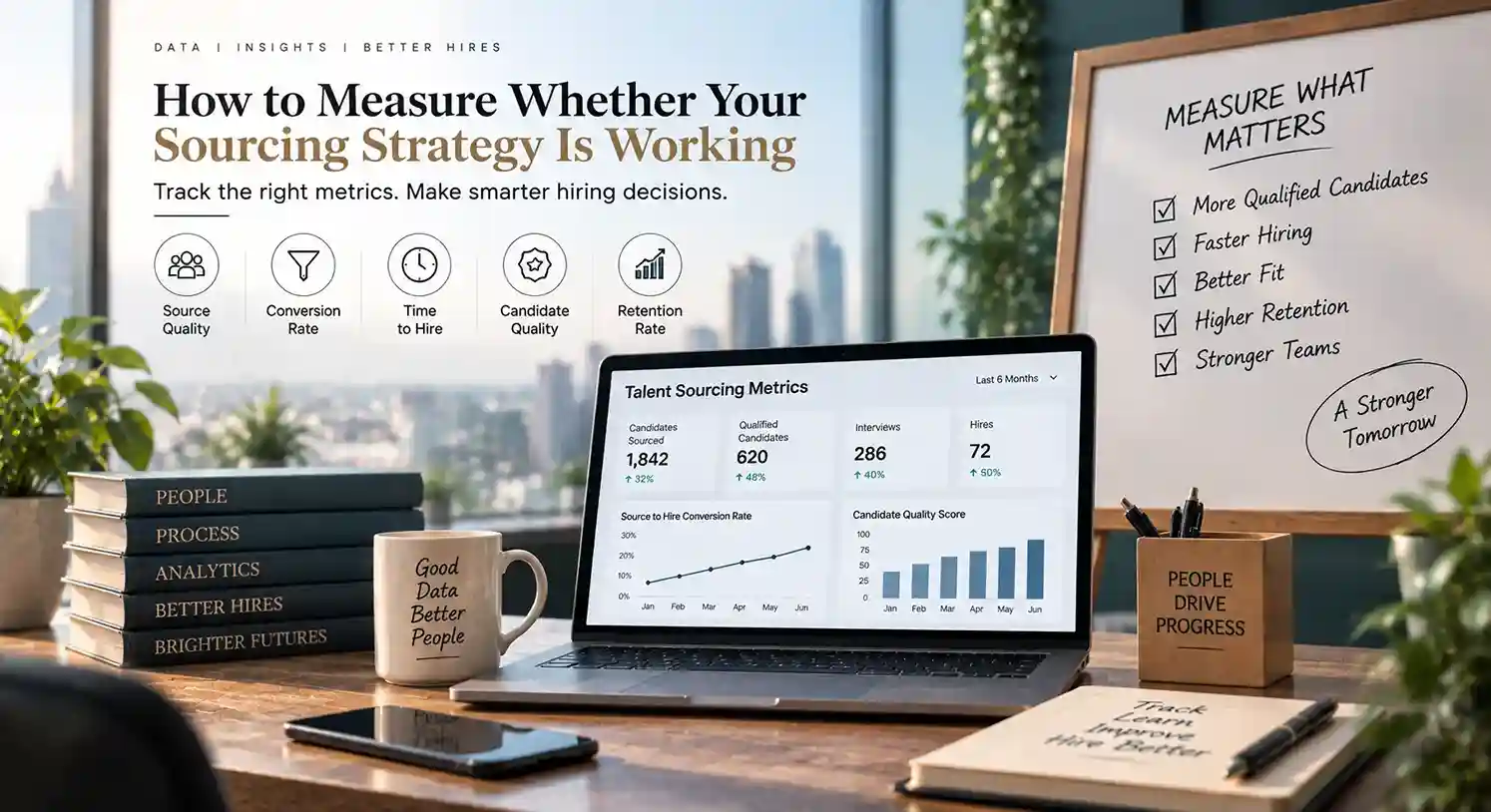
How to Measure Whether Your Sourcing Strategy Is Working ?
Most organizations use the number of applications to evaluate the performance of their recruitment efforts.
This could be very misleading.
While one recruitment source may yield 500 applicants, another could generate only 50 applicants.
But suppose:
- 500 applicants produce 10 interviews and one hire;
- 50 sourced candidates produce 15 interviews and three hires.
The second candidate sourcing method provided lower volume but much more useful output.
Track the entire funnel.
| Metric | What it tells you |
| Applications per vacancy | Attraction volume |
| Qualified application rate | Initial candidate quality |
| Screening pass rate | Relevance of applicant pool |
| Interview-to-shortlist rate | Quality of screening |
| Shortlist-to-offer rate | Candidate quality |
| Offer acceptance rate | Candidate alignment |
| Source-to-hire rate | Channel effectiveness |
| Time-to-fill | Recruitment efficiency |
| Quality of hire | Longer-term outcome |
Time to fill, source of hire, and quality of hire are some of the metrics SHRM has highlighted that can help link recruitment effort to organizational performance.
This alters how one assesses the recruitment firm.
One should not merely ask:
“How many resumes will you give me?”
But rather:
“What percentage of candidates fulfill the qualification criteria?”
And:
“How many of your candidates go into an interview process?”
And finally:
“What becomes of the candidates you placed post-hire?”
Mini Case Study: What Happens When You Replace Resume Filtering With Qualification
A sourcing company working for a hypothetical B2B software firm gets 380 applicants for the job of Account Executive, of whom 94 pass the test for keyword matching resumes done by the firm’s ATS. But there are numerous applicants who lack enterprise sales experience or are novices at generating new business or do not meet the criteria for meeting their quota. Hence, it became obvious to the company that keyword matching alone was insufficient to measure commercial acumen.
Then the company engages in targeted sourcing of candidates to source the right talent. In addition, each candidate is screened using the same set of requirements. Although the number of candidates at the end of the process is lower, the candidates are more suited for the job position. It is not about collecting as many CVs as possible; it is about making the most of the conversations.
When Should You Use a Sourcing Agency or Candidate Sourcing Company?
Having a recruitment partner can prove very helpful when the internal recruitment team faces difficulties in the following areas, among others, especially when external assistance from a candidate sourcing company becomes necessary:
Specialist roles
Market research is very important when the job is technical, regulated, senior, or specialized.
Passive talent
Outbound sourcing assumes importance when the right candidate is not likely to come forth on their own.
High-volume recruitment
Hiring drives that are too big for internal recruiters, especially when the recruiters are involved in interviews, job offers, and orientation.
Difficult markets
Other talent pools can be very competitive, and simply announcing an opening may not generate enough interest.
Repeated poor-quality applications
In cases where recruitment involves substantial amounts of time spent on rejecting applications instead of evaluating those that meet certain criteria, the recruitment process should be looked into.
New markets
Being part of a new geographical or industry market may make it hard for you to know where your relevant candidates are located.
In such cases, an external recruitment partner becomes an extended arm of your internal talent acquisition team.
The best external partners do much more than searching databases.
They understand the position, the business, the market, find the right people, qualify them and communicate to them the right message.
How to Build a High-Quality Candidate Pipeline ?
A successful recruitment pipeline must not be considered a one-time process but rather an ongoing one that should support a full cycle recruiting process.
Begin by writing down all the positions which are notoriously hard to source.
For each position, develop a candidate persona consisting of:
Role → Skills → Experience → Evidence → Market → Sources → Screening → Outreach
Afterwards, determine from where you attract your best applicants at the moment.
In case 80% of your successful hires are sourced through referrals and targeted recruiting, and only 5% are found through a certain online job portal, you have a reason for adjusting your recruitment spend.
The same is true when your company always attracts many applications, but rarely gets to conduct interviews.
It makes sense to improve the ratio of good applicants to all other applicants.
Internal cooperation plays an important part here as well.
Your recruiters need to cooperate with your hiring managers to understand what good means before the sourcing starts.
A 5-minute discussion on the topic will save you hours of screening afterwards.

Why Candidate Sourcing Is Becoming More Important in Skills-Based Hiring ?
The trend of skills-based hiring is increasing the importance of candidate sourcing service in companies seeking suitable candidates. Traditional recruiting is characterized by the search for a person having worked in the same job position before. Skills-based hiring is more concerned with the identification of candidates possessing the required skills for the job rather than having had similar job positions. This will widen the candidate pool as skills will be identified even in people working in other job positions.
The OECD research indicates that the first skill-based recruitment involves looking at an applicant’s skills and competencies instead of depending mainly on their qualifications and job titles. The research also outlines how such a recruitment approach can be used by employers to find applicants with diverse career paths.
For businesses, it is important that effective sourcing be about skills, experience and capabilities as opposed to focusing only on titles.
Some of the key indications of capability include the project completed, technologies deployed, business results, size of team, budget, customers served, certification, responsibility and achievement. Even as a CV continues to be an important part of the recruiting process, it is essential that it be seen as something that needs to be investigated as opposed to being the last word on the candidate.
Conclusion: Stop Filtering the Wrong Pool
Candidate screening services may help solve one of the common problems in recruiting process: having many CVs does not always indicate that the recruitment process is successful. In case when the filter of the job offer results in unqualified candidates, the issue may lie in the pool quality and not in the filter technology. The recruitment process begins from defining what skills, experience, and achievements are needed for this position.
The professional recruiting firm helps you find relevant people apart from those who apply for an advertised vacancy, and structured screening confirms their competencies before the candidates get through to your hiring team. This will save time reviewing unqualified resumes and provide you with the right pool of candidates.
Rather than thinking about receiving more resumes, companies should start with recruiting the right candidates. Through the right sourcing, screening and evaluation, you can achieve recruiting efficiency and build a strong pool of candidates.