
While your website may have solid technical foundations and professional design, ranking in highly valuable searches on Google – it can nevertheless remain virtually undiscovered when a customer performs a search through ChatGPT, Google AI Overview or any other generative search engine.
Thus, there has emerged an entirely new challenge for business owners.
For years, the main question used to be:
“How do I make my website rank in Google?”
Now the additional questions are:
“How do I get my business mentioned/cited/recommended when a person turns to the AI search engine with the question about my industry?”
The solution is not to generate hundreds of articles with an AI or include mentions like “the best company” on every page.
Google’s current guidance reinforces this point. Its documentation for generative AI search states that established SEO practices remain foundational and that there is no special technical requirement or secret “AI markup” that guarantees inclusion in AI Overviews or AI Mode. Google instead emphasises valuable, unique content and sound SEO fundamentals.
This is where experienced advertising agencies can provide value.
These agencies no longer think only about ads or even classic search ranking. Instead, they are developing digital ecosystems where brands can be found through search engines, AI, social media, publishing channels, and all kinds of digital platforms.
Thus, if your website is not showing up in ChatGPT or AI searches, the problem might not be an SEO one.
It might be a visibility problem across your whole digital ecosystem.

What Does It Mean to Appear in AI Search ?
The typical search engine usually presents the user with links.
However, generative search engines can do things differently by generating answers rather than just presenting ten blue links.
This alters the visibility equation.
For example, let us say there is a customer searching for something like:
“What are the best advertising agencies for a B2B technology company that requires PPC, SEO and LinkedIn lead generation?”
A conventional approach would involve optimizing a service page for the term “B2B advertising agency” or digital marketing services.
An AI-search strategy needs to establish something broader:
- What does the company actually specialise in?
- Does it work with B2B technology businesses?
- Does it offer PPC?
- Does it provide SEO?
- Does it have evidence of results?
- Is its expertise independently supported?
- Does its website explain its services clearly?
- Is the business mentioned by credible third-party sources?
- Can search systems crawl and understand the relevant pages?
In other words, AI search demands context.
You must make sure that your website contains enough information for the AI system to be able not only to understand what your business does but how it fits into a specific search dialogue.
According to Google, AI search can leverage relevant searches to investigate various angles of a difficult query. The technique, known as query fan-out by Google, can help their systems gather data from various sub-topics and form an answer.
And that means:
One perfectly optimized page is not enough to build complete topical authority, even for a brand trying to establish itself as the best digital marketing agency.
Is Your Agency Invisible in ChatGPT and AI Search?
Ranking on Google is no longer enough. AI tools now pick which agencies to recommend, and they choose based on clear content, strong internal linking, trusted mentions and consistent brand signals. At Digifinity, we audit how your website appears across AI search and fix the gaps that keep you out of the answers.
Why Your Website May Not Be Showing Up in ChatGPT or AI Search ?
There is no one AI search-ranking lever that you can flip that will automatically cause your site to be visible in every possible AI-generated response. There could be any number of reasons why your site is not included, ranging from lack of accessibility, bad content, narrow topical focus, low authority, poor brand recognition, and many more.
1. Search Crawlers Cannot Access Your Website
Prior to the use of GEO, cluster/content strategies, or digital PR in order to drive traffic and visibility through these channels, make sure that the pages you want found can actually be accessed by the search engines. For ChatGPT Search, according to OpenAI, OAI-SearchBot is the crawler used to crawl web content to build ChatGPT Search.
Technical accessibility is an important aspect of your AI-search methodology. It is important to test your site for robots.txt restrictions, noindex restrictions, canonical tags, HTTP codes, server accessibility, firewall configuration, CDN configuration, bot-blocking solutions, JavaScript-based information, authentication mechanisms, XML sitemaps and internal linking, and then perform a complete SEO service analysis. Sometimes a secure configuration which aims at keeping away malicious bots may inadvertently block legitimate bots.
Lesson from the strategy is clear: crawling takes priority over optimisation. It is impossible to optimise the page for AI detection when it is not accessible to the search crawler.
2. Your Most Important Pages Are Not Indexed
The existence of hundreds of URLs does not guarantee the presence of many useful search assets. The real challenge here is how well your valuable pages can be discovered by both humans and search engines. It makes sense to pay special attention to the pages that you offer commercially: your service pages, industry pages, location pages, case studies, author pages, resource pages, comparison pages, and original research or valuable articles. Your PPC service page hidden somewhere in the depth of your website will make more efforts required to find it.
This is why information architecture is so important. To give an illustration, a company may organize its website by having a main area for the B2B Digital Marketing Agency and additional pages dedicated to each of the following services: SEO Services, PPC Services, Social Media Marketing, B2B Marketing, Content Marketing, Digital PR and Case Studies. All service pages are linked to their corresponding educational material.
3. Your Content Is Too Generic
Generic information is one of the main issues that plague modern-day websites. Think of two different agencies writing an article on PPC. The first agency writes, “PPC is a successful form of digital marketing that can enable companies to generate more traffic and leads.” The second agency, on the other hand, writes an extensive analysis of how it evaluated various B2B PPC campaigns and the results that were obtained.
This shows much more experience and expertise as the article involves an observation, methodology, real-world experience and a business insight.
What Should You Publish Instead?
Your information strategy should center around developing knowledge that is actually proof of your authority. This could include original research, data that is proprietary to your organization, campaign intelligence, expert opinions, social media marketing service intelligence, real-life case studies, industry analysis, lessons learned, methodology, frameworks, and customer questions.
This is where established agencies can really add competitive value. Agencies have the advantage of campaign data, customer inquiries, experience in testing, and general industry observation that generic publishers cannot have. Instead of merely explaining the terms PPC and SEO, make use of your experience to demonstrate how things operate in practice.
The aim is not to generate as many content as possible. The aim is to generate content that delivers information, facts, and insights that customers will find valuable.
4. Your Website Doesn’t Demonstrate Who You Are
Context is vital to any AI, and your website helps to provide that. A company that offers marketing advice anonymously and without information about their location or their knowledge and experience provides much less context than a company with a transparent online identity.
It must be easy to comprehend who you are, what you do, who your clients are, what services you offer, how experienced you are, what is your proof and who are behind your site when looking at a PPC marketing agency. It must also be easy to find out about your company through your site.
It is highly related to E-E-A-T which stands for Experience, Expertise, Authoritativeness, and Trustworthiness. The Ahrefs’ E-E-A-T guide tells how businesses can show their experience, expertise, authority, and trust using author credentials, original research, authoritative citations, About pages, customer testimony, and business details. This further reinforces the idea that trust and credibility need to be backed by real evidence.
For the agency’s website, this translates to creating extensive About sections, biographies, client stories, testomonials, awards, association affiliations, press coverage, original research, methodologies, and business information.
Trust is not just something that should appear on a website; trust is something that is required for the foundation of a website.
5. Your Brand Has Weak Entity Signals
“We are among the best advertising agencies” is a claim which a web site can make, but that will not be enough to create any kind of authority for the web site.
Consistency is key for your business information in terms of your company name, your website, your contact information, and all your services and social media profiles. If you own a PPC agency, there are other resources to help you build credibility.
The aim here should not be to generate a large number of poor quality listings on directories. The aim should be to build an online identity that actually reflects who you are.
This can be called entity consistency, where your business is consistently portrayed by credible sources so that it makes it easier for humans and computers alike to understand what you do and what you are all about.
This is especially true when it comes to commercial searches, where users are looking for solutions to a problem rather than just information.
6. You Have Content, But No Topical Authority
Simply having numerous individual posts on a topic doesn’t guarantee authority in that field. The alternative would be creating content clusters where several pages together exhibit knowledge of that topic.
For instance, a B2B tech-oriented marketing company can create a central B2B marketing page backed up with extensive resources such as B2B SEO, B2B PPC, LinkedIn advertising, PPC company services, account-based marketing, lead generation, marketing attribution, demand generation, landing page optimization, content marketing, and B2B case studies.
Each page answers a unique customer question while adding to the broader subject area. This creates semantic depth and provides search systems with more information on the business’s topic expertise.
Here is an easy way to remember what topical authority means:
Breadth + depth + relationships + evidence.
Breadth makes sure that you include all the important subject areas. Depth shows that you have expert knowledge of each topic. Internal relationships link these topics together. Evidence shows that your expert knowledge comes from practical experience.

7. Your Internal Linking Is Weak
However, internal linking is often considered a secondary SEO technique, although it helps find the relevant information for both users and search engines. According to Google, it is necessary to make your links crawlable for search engines to find other pages on your website.
Intra-linking is also used to signify relationships between pages. If the organization decides to develop visibility on the issue of digital marketing services, their website could link up the main digital marketing page to other pages discussing digital advertising, PPC advertising, social media advertising, B2B advertising, Google Ads, LinkedIn Ads, advertising strategy, and advertising case studies.
These supporting articles will seamlessly link back to the service pages where they belong. The PPC article, for instance, may link back to the service page of the agency in relation to campaign management, conversion tracking and landing page optimisation.
The critical point to note here is that the anchor texts should be descriptive and valuable to the reader rather than be artificially included just to boost the ranking of the page. This helps the visitors navigate through your website and find related information.
8. You Have No Independent Evidence Supporting Your Claims
Many agency websites make broad claims such as “best agency”, “award-winning team”, “proven results”, “industry-leading experts” or “trusted partner”. The problem is that these statements often appear without enough supporting evidence.
A better way to do this is by replacing general statements with concrete examples that can be validated. In the case of an agency that wants to establish itself as the best digital marketing agency, a case study can show how the campaign was redesigned, the existing problem with the business, the method adopted and the resulting outcome.
Providing that client confidentiality allows it, such information could be included as support for the information provided, including time period, beginning situation, limitations of the campaign, process and measurable results in context of business reality.
The information of such type is much more valuable than simply repeating yourself by stating that you are a “leading advertising agency”. Your statements become more trustworthy as soon as people can see some proof behind your claims..
9. Your Service Pages Don’t Answer Commercial Questions
A typical problem with agency websites is that service pages give definitions of what a particular service is but not how the agency implements it. The basic page about PPC may say something like “PPC is a form of online advertisement where companies pay for clicks.”
The definition is correct, but it does not help a potential client to understand if the agency is suitable for him/her.
A useful PPC service page for business use should detail the platforms managed, industries served, onboarding process, campaign management, and how the B2B digital marketing agency generates and qualifies leads and optimizes landing pages.
Answering these questions makes the page more useful for potential customers while also expanding its ability to satisfy detailed commercial search intent.
10. You’re Treating GEO as a Shortcut
GEO or Generative Engine Optimisation has become a popular term; however, organizations need to beware of using GEO like a mere checklist. There is no guaranteed method that will force an AI engine to recommend a business just because of the repetition of any specific keyword.
This technique should ideally combine technical accessibility, relevance to searches, creation of unique content, authority on a topic, entity recognition, verification and brand presence. Alone, each factor cannot ensure visibility, but all of them combined together can form a digital foundation for being discovered through traditional or even AI-driven search engines.
It is not about trying to trick an AI into talking about your organization. It is about building a website which would be accessible, relevant and useful enough for people who look for answers to their questions in your domain of expertise. This is why genuine AEO and GEO Optimization Services focus on accessibility, relevance, evidence and authority rather than keyword repetition.
How Advertising Agencies Can Improve AI Search Visibility ?
The way in which digital marketing works is evolving, because companies need an integrated process for achieving digital visibility that incorporates SMM marketing.
Advertising will not fix all organic visibility issues.
SEO will not fix all brand issues.
Content may not automatically lead to authority.
And PPC will not automatically get a website ranked organically.
The solution lies in bridging the gap between them.
The marketing guide of HubSpot discusses the process of combining all these marketing strategies into one consistent approach. It proves the fact that marketing channels should not be considered individually but can operate as a part of an integrated marketing strategy.
1. Technical SEO
Technical SEO establishes whether your website can be discovered and understood.
An audit should cover:
| Area | What to investigate |
| Crawlability | Can relevant crawlers access important pages? |
| Indexation | Are valuable pages indexed? |
| Robots.txt | Are important resources accidentally blocked? |
| Canonicals | Are preferred URLs clearly defined? |
| Internal links | Can important pages be discovered easily? |
| Sitemaps | Are relevant URLs included? |
| Status codes | Are important pages returning successful responses? |
| Mobile experience | Is the site usable on mobile devices? |
| Structured data | Is relevant structured data implemented correctly? |
| Page experience | Are users getting a strong overall experience? |
2. Content Strategy
Base your content marketing strategy on customer problems, rather than keywords, even for social media marketing service.
Rather than asking,
“What keywords can we use for publication this month?”
Ask:
“What should our potential customer understand before purchasing from us?”
It will result in totally different content.
For instance, a marketing firm dealing with business-to-business products might come up with:
Awareness content
- What is B2B demand generation?
- SEO vs PPC for B2B companies
- How long does B2B SEO take?
Consideration content
- How to choose a B2B digital marketing agency
- PPC agency vs in-house PPC team
- What should an enterprise SEO strategy include?
Decision content
- Our PPC methodology
- B2B marketing case studies
- Pricing and engagement models
- Client results
- Our onboarding process
This creates a complete information journey.
3. Digital PR and Authority Building
If your website makes a claim that nobody else corroborates, the claim has limited external context.
Digital PR can help create legitimate third-party references through:
- original research
- expert commentary
- industry reports
- news coverage
- expert interviews
- research collaborations
- relevant publications
- thought leadership
The objective should not be “build 500 backlinks”.
It should be:
Become worth referencing.
As another example, rather than asking the publication to provide a link for a generic blog post on PPC, advertising agencies can conduct their own research on PPC benchmarks or surveys of anonymous PPC campaigns.
The resulting asset has a reason to be cited.
That is a far more sustainable authority strategy.
Where Social Media Fits Into AI Search ?
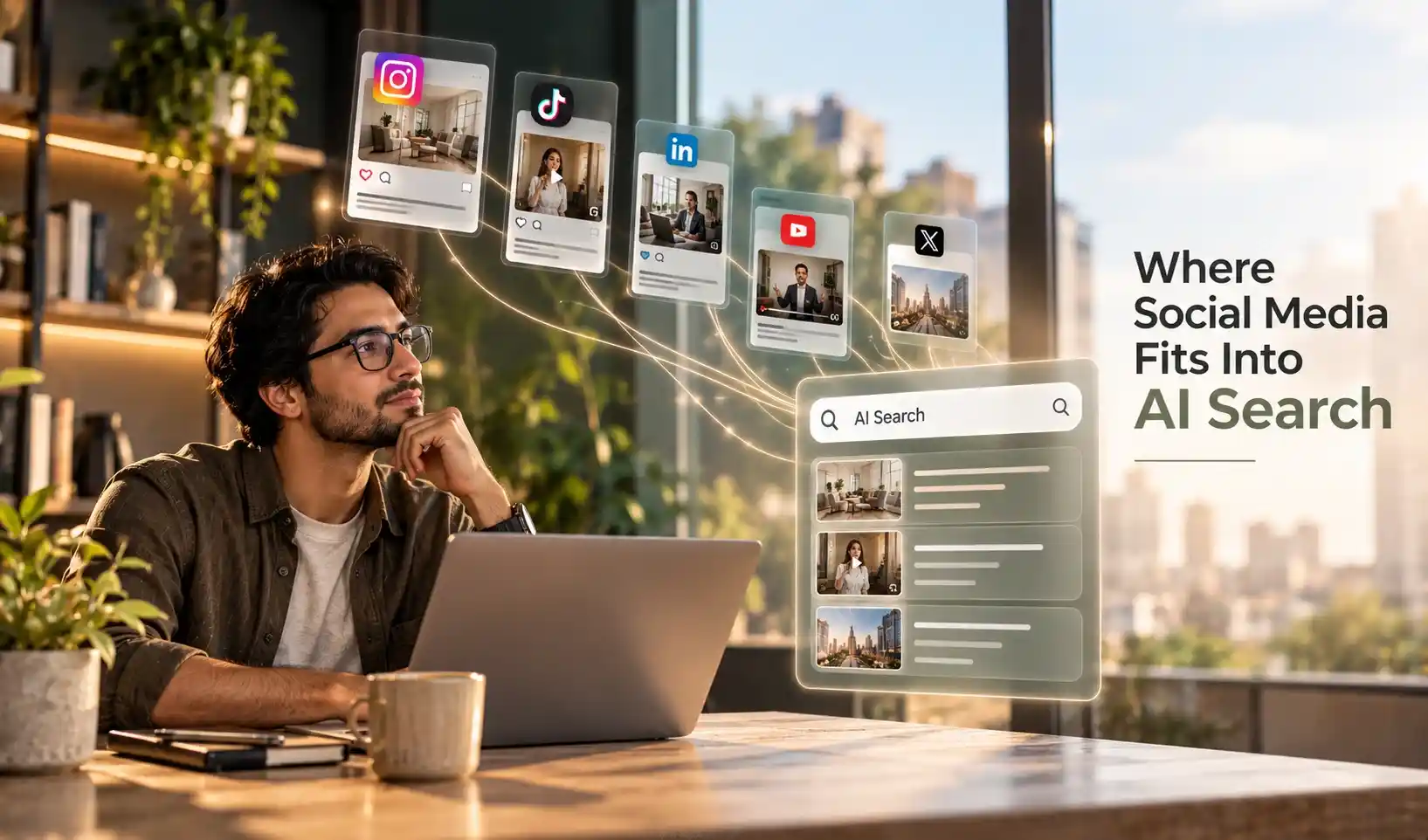
Social media should not be seen as an assured ranking factor of every search engine. Instead, the benefits it can bring to a company are much wider in scope – knowledge dissemination, audience recognition, industry discussion, and original research dissemination. Social media strategy may help with all this by distributing useful information and connecting content to interested audiences. Thus, the agency, which has published a report about the performance of B2B advertising, can post the key points on LinkedIn, initiate a discussion of the report among the subject matter experts, contact the publications interested in this research and create visual materials based on the results.
In this way, the piece of original research will become an asset for digital authority on a larger scale, and not just a part of the website. The follow-up articles, social conversations, expert opinions, media coverage, et cetera, can continue building up the visibility of the original research. For businesses that use digital marketing services, social media thus becomes more useful if it is used in combination with other digital marketing services like content marketing, digital PR, SEO, et cetera.
PPC Still Matters, But for a Different Reason :
It’s vital to know that paid advertising and organic visibility do not behave similarly. Just because you have hired a paid media team does not mean that your site would organically show up in ChatGPT and Google AI Overviews. Nevertheless, it can bring important information on keywords, language, behavior, intent, and message of customers that can be implemented in your organic content and landing pages.
Here comes the use of a comprehensive strategy. SEO can help in developing PPC, PPC can help in developing messages, social media can help in distributing the content, and digital PR can help in building brand authority.
B2B Businesses Need an Even Stronger Authority Strategy :
B2B purchasing process can be complicated, which explains why most companies engage a Facebook ads agency to target decision makers throughout the entire process.
A prospect may interact with:
- Google Search
- industry publications
- review platforms
- company websites
- webinars
- case studies
- AI search
- sales representatives
- competitor comparisons
before contacting a supplier.
It should build a consistent authority ecosystem.
For a B2B technology business, that might include:
| Asset | Strategic purpose |
| Service pages | Explain commercial offering |
| Industry pages | Demonstrate sector expertise |
| Case studies | Prove experience |
| Research | Create original authority |
| Expert articles | Demonstrate knowledge |
| Comparison pages | Capture decision-stage intent |
| LinkedIn content | Build professional visibility |
| Digital PR | Generate third-party validation |
| PPC | Capture immediate demand |
| SEO | Build long-term discoverability |
This approach is particularly relevant as search behaviour becomes increasingly conversational.
A Practical Framework: Discover, Understand, Verify, Associate, Recommend
The most effective way of considering AI-search optimization is by breaking the process down into five related stages that include Discover, Understand, Verify, Associate, and Recommend. Each of these stages deals with one aspect of how the search system finds, interprets, and evaluates your company and its content.
Stage 1: Discover
The first step is ensuring that your content can be accessed by search engines through checking robots.txt, xml sitemap, internal links, indexing, availability of your server to crawlers, etc. A ppc agency can assist in auditing landing pages as well. In the case of ChatGPT, businesses must ensure that OAI-SearchBot is not blocked.
Stage 2: Understand
When your content is accessible, your website should convey exactly what your company can do. Your services, industry focus, geographical areas served, expertise, people, products, customer pain points, and methodology must be very clear. Don’t use ambiguous statements like “full service digital solutions,” but rather use detailed statements like “B2B PPC, SEO and LinkedIn demand generation for SaaS companies.”
Stage 3: Verify
Your search engines will also require some signals to back up what your company says. Build your site through case studies, testimonials, original research, authorship by experts, external citations, real reviews, and relevant industry awards. These could give more context about your expertise.
Stage 4: Associate
Your company needs to continually be seen in connection with what you want to be considered an expert on. If you are trying to build authority in the world of B2B PPC advertising, then all of your company’s content, research, and articles should continually show off experience in this field.
Stage 5: Recommend
The last phase is recommendation; however, this cannot be promised. There is no such genuine process which will guarantee that the AI system will choose a certain ppc company. The idea is to make yourself relevant, provide evidence, and be authoritative to be seen as a potential candidate.
A 30-Day AI Search Visibility Audit :
If your website does not yet show up in AI-powered searches, there’s no need for you to completely redesign it from scratch right away. Instead, a 30-day audit may allow you to determine what are the major issues that affect your site’s visibility.
Week 1: Technical Discovery
Begin by auditing the technical structure of your website, such as robots.txt, XML sitemap, indexing, noindex, canonical URL, internal linking, HTTP codes, crawl error reports, firewalls, and OAI-SearchBot access. It is also important to audit Google Search Console data to see how your pages are being found and indexed. As search engines continue to evolve, Google Search Console is still a valuable tool.
Week 2: Content Audit
Now, analyze all of the existing pages to determine whether they will be kept, improved, combined, or removed.
The process for content audit at Ahrefs provides guidelines to assess website pages in relation to metrics such as organic traffic, business value, backlinks, relevancy, indexation, and content performance, in order to determine if content needs improvement or consolidation.
Retain good performing pages, update underperforming pages, consolidate overlapping pages, and delete low-value pages. In addition, look for topics that your competitors have covered but you haven’t yet, like Local Business Marketing.
Week 3: Authority Audit
Week three must be all about building up your authority and reputation online. Search for the name of your organization, the founders of your organization, the experts, services offered by you, and the other things that are associated with you to see whether there is any credible third-party reference available for you. Think if a researcher working independently has enough proof of your experience in the areas where you say you are specialists. If not, you need to generate some assets that would be worth referencing.
Week 4: Build and Measure
For the last week, focus on the key changes first, focusing on the necessary technical fixes and commercial pages first, then missing topics clusters, case studies, original research, internal linking, expert pieces and digital PR opportunities. Set a baseline and track traditional search metrics, as well as branded searches, AI-platform referral traffic, citations/mentions, organic impressions, lead generation and engagement on key service pages. Do not base your entire strategy on whether you get your company mentioned in one particular ChatGPT question, as the results generated by an AI could depend on many things.

What Advertising Agencies Should Not Promise About AI Search ?
Businesses should be cautious when advertising agencies promise:
“We can get your company listed in ChatGPT.”
No honest and legitimate strategy can ensure this.
Be wary of any claims like:
“We can guarantee placement for AI Overview.”
Or:
“We have a secret GEO algorithm that Google doesn’t know about.”
Search technology is ever-changing.
Queries differ.
So do the results.
There may be different data inputs and retrieval techniques in AI.
Google itself mentions that “there are no further technical requirements for inclusion in AI features apart from the regular Search inclusion requirements,” stressing unique and valuable content.
A good agency must promise processes and improvements, not guarantees of AI recommendations.
A professional engagement should explain:
- what will be audited;
- what will be changed;
- why those changes matter;
- how progress will be measured;
- what is controllable;
- what is outside the agency’s control.
That is a much stronger foundation for a client relationship.
The Future of Search Is Bigger Than SEO vs AI :
The use of AI for searching is not just about beating Google. Searching will become multimodal and conversational across multiple platforms, which means that people can discover the business through the answers provided by AI, social media, videos, mapping services, communities, recommendations, and advertising. The business, as well as the best digital marketing agency working for it, needs to consider this fact.
The effective brand must be discoverable, comprehensible, verifiable and evaluable in the online space. Current marketing alliances have to be equipped with something more than just media buys, combining together SEO, content, paid media, social media, digital PR, conversion optimization and analytics. It’s not about manipulation of AI systems; it’s about the business usefulness and credibility.
Conclusion :
If your website is not showing up in ChatGPT, Google AI Overviews or any other form of AI search engine, you cannot just increase the number of keywords or content that you post. A good marketing team will always look at the basics which help in increasing visibility over time. The basics include SEO, value content, topical authority, brand credibility, digital PR, internal link building and a great user experience
AI search engine is changing the way consumers find business online, but the fundamentals still hold true. Accessibility, relevance, authority and usefulness will take your business a long way in generating opportunities through marketing strategies and online presence.