
Marketing for a single-location business can be difficult enough. Marketing a company that has multiple locations involves taking a completely different approach.
For businesses operating with multiple locations in Illinois, the question isn’t just about attracting more visitors to the website. It’s also about making each of those individual locations visible for local search. The customer looking for information in Chicago will have different needs from the person looking in Aurora, Rockford, Naperville, or Springfield.
This is precisely why multi-location digital marketing services should involve a combination of brand strategy from the center with implementation at the local level.
This is further supported by Google’s own instructions for creating valuable content for users. It is stated there that companies must create content with user benefit in mind rather than producing pages in order to play games with search rankings. This means that when you have a multiple-location business, every location page, service page, and relevant article must provide genuine value according to local customer needs and not be just a template with a name of a different city.
A successful local business marketing strategy therefore has three priorities:
- Make every legitimate business location easy for customers and search engines to discover.
- Establish location-specific relevance, expertise and trust.
- Connect search visibility with measurable enquiries, sales and revenue.
Incorporating such values into an effective strategy will allow a multi-location business to create an efficient marketing system rather than running multiple unrelated campaigns.
Why Multi-Location Marketing Requires a Different Strategy ?
This type of marketing differs greatly from traditional online marketing as the business works in several geographic markets at once.
Think of an Illinois based home service company working in cities like Chicago, Naperville, Aurora, and Rockford with the help of the best digital marketing agency, where the brand name, logo, and services have not changed at all.
The search context does not.
Someone who is looking for a particular service in Rockford is probably going to compare firms which provide services in Rockford. He is definitely not concerned that the firm enjoys high visibility in downtown Chicago.
It results in a need that most firms ignore.
The firm needs to stay consistent at brand level but become relevant at local level.
Centralization will take care of the brand identity, technology, analytics, marketing standards and strategy. Localization will guide the individual location pages, customer reviews, photography, local messaging, search targeting and community-related content.
Too much centralization leads to generic marketing. All locations appear the same, all pages have the same messages and local relevance is low.
Too much decentralization creates another problem. Locations start applying inconsistent brand, messaging, data and marketing approaches.
There is a sweet spot between the two.
A centralized marketing framework is created along with individual locations providing the local evidence, knowledge and customer feedback.
Grow Every Location, Not Just One
Stop managing each branch with a separate strategy. Our digital marketing team helps multi-location companies in Illinois boost local visibility, win more customers, and scale consistently across every market.
What Digital Marketing Services Do Multi-Location Businesses Need ?
A multi-location company does not need every possible marketing channel. It needs the channels that improve customer acquisition within specific markets.
The most significant services from a B2B digital marketing agency for most Illinois companies that have a physical presence or defined service areas include Local Search Engine Optimization (SEO), Google Business Profile Optimization, Location Page Optimization, Paid Search, Social Media Marketing, Review Management, Content Marketing, Conversion Optimization, and Marketing Analytics.
These streams must not work in isolation.
Local SEO helps visibility. Google business profiles help discoverability. Reviews help establish trust. PPC helps capture immediate business intent. Landing pages help turn this intent into action. Analytics helps us decide whether these inquiries will be profitable customers.
The goal here is not just to ramp up the marketing efforts.
The goal here is to develop an integrated acquisition process.
Local SEO Should Form the Foundation :
One of the most critical aspects of multi-location marketing is local SEO since many consumer journeys usually start with searches with geographic intent.
Geographic searches include service-and-locations searches, category searches, “near me” searches, and Google Maps or local pack searches.
A good multi-location SEO strategy combines the following three elements: the company, the service, and the location.
For instance, the search “commercial cleaning company” conveys less information about geography compared to “commercial cleaning company in Naperville”.
The second search contains both commercial and geographic information.
It should be reflected in website architecture.
The home page defines the whole company. The service pages highlight their capabilities, and the SEO service helps with localization. The articles show their expertise and address client inquiries.
The internal linking from anchor text “local SEO services” should ideally lead to a separate local SEO services page, which can be something like “/local-seo-services/”
A second useful internal link would be “multi-location SEO services,” directing users to a page on how the agency handles multiple location businesses.
Build Location Pages Around Customer Value :
Location pages are commonly one of the most under-developed elements of multi-location websites.
Firms tend to develop tens of almost identical pages with only the name of location changing, and nothing else.
Thus, the company will have a web-page dedicated to its presence in Chicago, and replicate this web-page in order to create another one for Aurora, Joliet, Springfield, and Rockford.
Search engines do not get any unique information from this strategy; more importantly, potential clients do not either.
The location page should demonstrate that the firm knows about this market and provides the relevant services there.
The location page should present services offered in this location, geographical coverage, ways to contact this office, uniqueness of this business, and reasons for this.
Such evidence can include actual customer reviews, pictures of the team, case studies from the region, projects from around there, regional partnerships, social media marketing service, regional customer questions, or service information.
It is not about trying to have a lengthy page just because it is considered more thorough.
Quality of information is what counts and not the number of words.
A location page that has 700 words but contains real local information can offer much more than a 1,500 word page with repeated sales talk.
Create a Logical Multi-Location Website Architecture :
Architecture of your website is a key element which helps to establish relationships between your brand, locations, and services.
If you run a company in Illinois, you can start from a locations page that is connected with specific market pages.
Location pages can be further linked with related services.
For instance, a Chicago location page can be linked with commercial cleaning, office cleaning, and industrial cleaning services provided in this market.
Similarly, services pages can be linked to Illinois locations.
In this way, you create a network of relevant connections rather than just isolated pages.
Contextual internal links are required.
Rather than having to rely on general terms for links like “more info” or “click here,” it is recommended that companies opt for relevant links like advertising agencies.
For instance, a paragraph on paid acquisition may flow into PPC management services. A paragraph on social media may flow into social media marketing services. Lastly, a paragraph on location visibility may flow into Google Business Profile management.
This helps improve navigability while ensuring that search engines understand the relationship between pages.
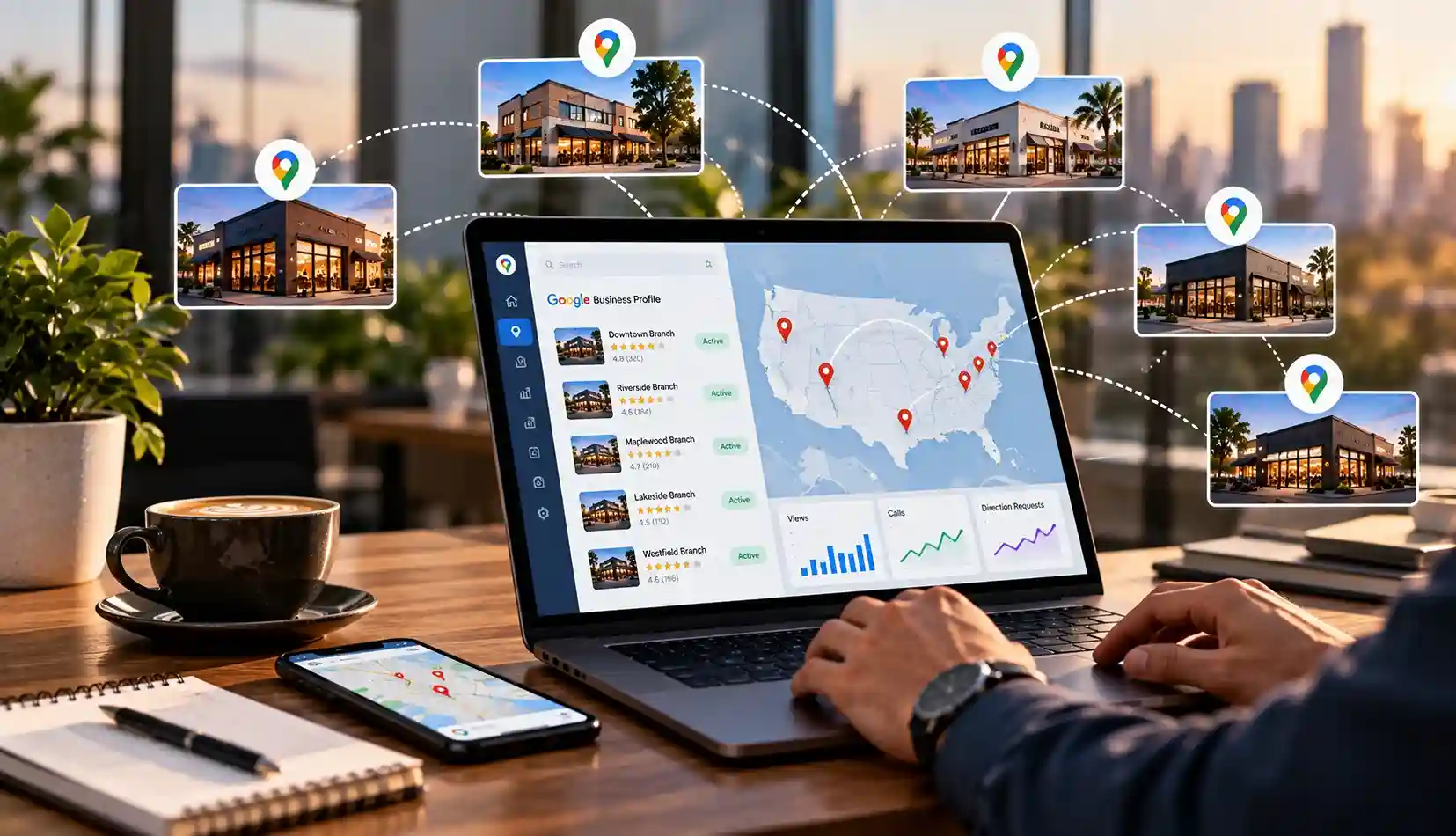
Google Business Profile Management for Multiple Locations :
Google Business Profiles are critical in discovering local businesses.
When it comes to multiple-location businesses, managing them needs much more operational discipline than a singular listing.
The business name, category, address, phone number, hours, and destination URL must be accurate at all locations.
Google has established certain Business Profile Guidelines for the representation of businesses. Such guidelines become very significant for businesses that have multiple locations as Google demands that every profile must represent a real-life business place and should not create any duplication or false information about the business.
Precision must hence take precedence over optimization.
An organization must not manufacture any false locations just because it wants to appear in more cities.
It must not add any other keywords to the business names if such keywords are not present in the actual organization’s name.
This shouldn’t include outdated phone numbers, erroneous open times, or even outdated locations, especially if you are working with a PPC marketing agency.
These problems cause frustration and may erode trust.
Where companies operate multiple locations, Google Business Profile management needs to become a set procedure.
Company marketing can regulate standards and access, while the manager at each individual location is responsible for any changes in the hours, staffing, services, or other local information.
The internal link through Google Business Profile management should be linked to the service page of the agency.
Reviews Should Be Treated as a Marketing Asset :
Reviews affect much more than just reputation.
It enables potential customers to determine the quality, reliability, and credibility of the business before getting in touch with it.
This is especially true for multi-location businesses since customers will judge the particular location they plan to visit, and not the brand as a whole.
Even if a company has great reputation and is highly aware of its national brand, there is still a possibility that a poorly performing local branch with negative reviews could cost it customers.
This means that multi-location businesses need to establish an effective strategy to get customer reviews.
What they shouldn’t do is bombard all customers with a message that asks them to give five stars.
For example, if one branch in Illinois has a reputation for receiving complaints in terms of communication but another is praised in relation to its customer service, the information has practical uses outside of SEO and can assist the PPC company.
Marketing information turns into business intelligence.
The answers to the reviews should be human too.
The standard answer that is given to all hundred reviews will make the reputation management of the company seem mechanical.
The more effective way would be to recognize the problem of the customer and the responsible team/territory.
PPC Strategy for Multi-Location Companies :
Paid search can create demand rapidly, especially when a company is targeting an Illinois market for the first time or trying to promote a valuable service or category that requires organic growth.
Multi-location paid search campaigns shouldn’t be run like a single-location campaign.
Companies make the biggest mistake in running a few markets under one campaign and basing performance on aggregated results.
The entire campaign could be showing positive profits, even though the locations are performing quite differently.
Chicago can show strong lead counts but high costs for acquiring customers; Aurora can have less leads but convert much more efficiently; Rockford can have lower demand for search but high conversion values per lead.
These variations are not visible if we just see the aggregated leads.
An advanced PPC agency must accordingly analyze performance on the basis of relevant combinations of geography, service, intent, and business result.
What matters is not the cost per click, which was lowered.
What matters is whether profitable customer acquisition was enhanced.
Assume that there are 150 leads monthly for one branch, and the lead conversion to sales ratio is 10 per cent, while another branch has 70 leads per month but a conversion to sales ratio of 25 per cent.
The latter location might be worth spending extra money even though it brings in fewer visits.
That’s why PPC reporting should link the ad spending with leads, sales, income, acquisition cost and ROI from ads wherever it is possible.
Internal linking through PPC management services should send visitors to /ppc-management/.
Match Advertising With Local Landing Pages :
Effectiveness of the advertisements is significantly determined by what happens after clicking.
Picture someone who is looking for a service in Naperville.
This service is mentioned in the ad, but after clicking on the link they are directed to a general page about services offered across Illinois.
Now the person needs to figure out whether this business offers services in their area, find the right service and the contact details.
Any extra step increases friction.
It has to reflect the intent of the searcher. Digital marketing services must ensure that the destination site verifies the service and location details with the contact details and clear conversion process.
This alignment will not only improve PPC results but also those for other forms of online marketing as well.
Social Media Marketing Needs Local Proof :
Corporate social media efforts often involve a heavy focus on brand awareness.
For multi-location businesses, there is another opportunity, which involves demonstrating activity in the local area.
This strategy can be used by combining professionally created brand content with content created from each location.
The branch office can supply photos from recent projects, staff and client news, events, local collaborations, or behind-the-scenes footage.
The corporate marketing team can turn this raw content into high-quality content while keeping the branding consistent.
This provides a scalable approach.
Corporate marketing will not need to make up stories for their local offices, while the locations will not need to become content producers.
The content can be reused.
The local project may become social media content, Google Business Profile content, local page case study content, and an image for an article about the service.
This process is much more efficient compared to treating each marketing channel as a separate content production effort.
The use of social media marketing services must be linked internally to the business’ specific service page.
Content Marketing Should Capture Real Customer Questions :
There is one powerful source of content ideas which resides within the multi-location business itself.
Salespeople, receptionists, customer service representatives and operation teams hear customer questions every day.
These questions indicate true search intent.
While starting with a list of hundreds of keywords, marketers need to also consider what questions customers ask before making their purchase decision.
A commercial cleaning firm might find out that clients often ask how often offices need professional cleaning.
A home services firm might receive repeated questions about response times in case of emergency.
A professional services firm might often get questions about pricing models, commitment to contract or geographical location.
All these questions can serve as a source of search content.
Such articles will show genuine expertise as they were written based on real customer interactions.
This approach will make the E-E-A-T more credible.
Experience can be seen through the lens of insights gained while performing a particular task.
Professional expertise is evident when the best digital marketing agency clarifies complicated decisions.
Authoritative content arises due to supporting content that speaks about the topic repeatedly.
Credibility arises out of specific and well-evidenced claims.
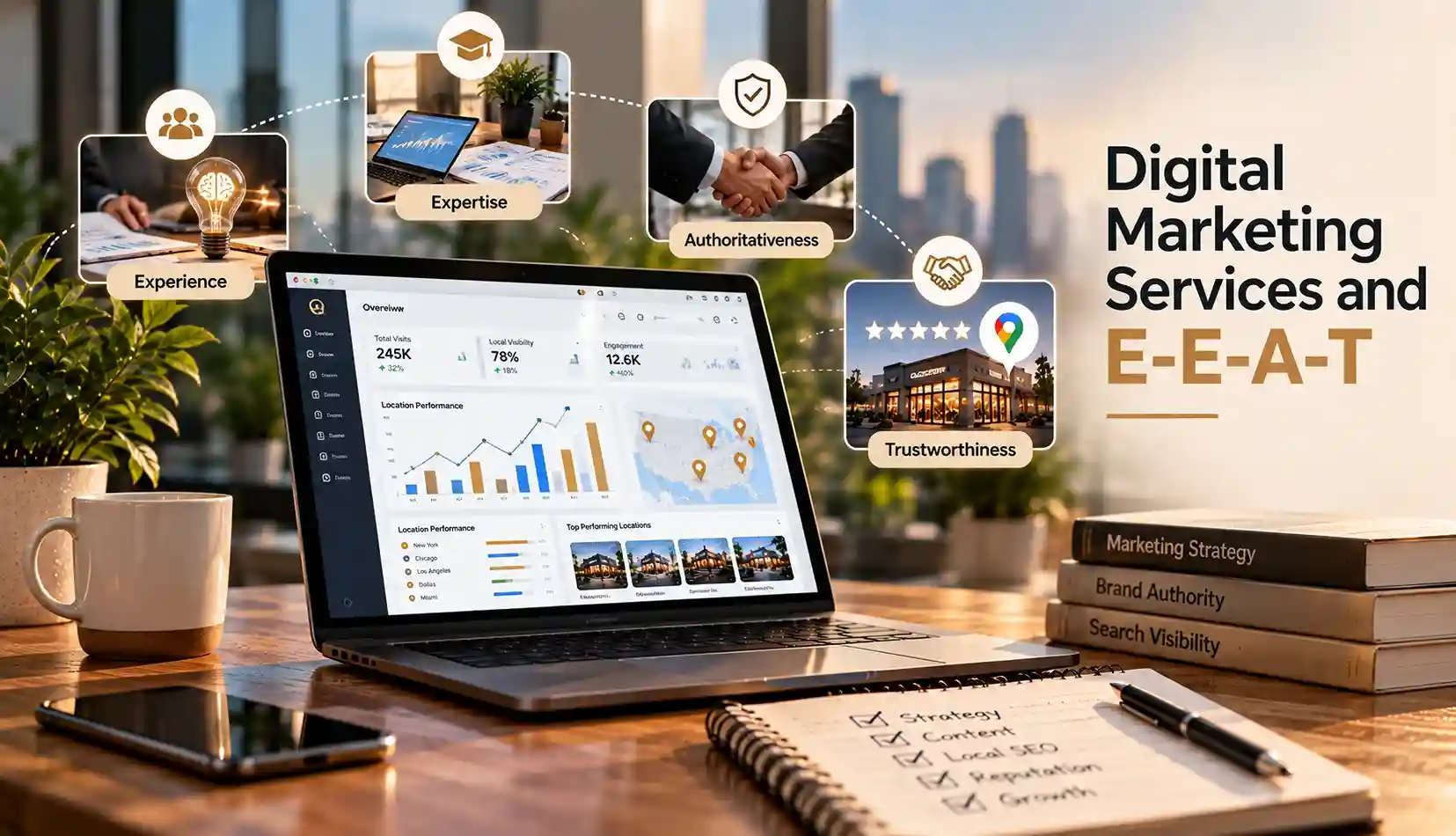
Digital Marketing Services and E-E-A-T :
E-E-A-T must not be seen as a checklist where marketers include an author’s biography and think that everything is done.
Experience, expertise, authority, and trustworthiness should affect the whole website.
Location pages should show true local experience.
Service pages should show knowledge about the service.
Case studies should show results.
Biographies of authors should make clear the reason why this author is qualified.
Information about the company should allow users to check who runs this business.
Reviews should give evidence from customers.
Sources outside the company should be used to prove the claims when independent confirmation makes more useful the provided information.
The goal is to make expertise visible.
If a company keeps saying that it is “the leading expert,” it shows less evidence than a company which proves its expertise through explanations, examples, results, and firsthand information.
Optimising for Google AI Overviews and Generative Search :
The development of AI-driven search along with the significance of SMM marketing has led many organizations to view GEO, Generative Engine Optimization, as a distinct entity altogether compared to SEO.
That approach can lead to unnecessary tactics.
Google’s official guidance on AI features and your website makes an important point: existing SEO fundamentals continue to apply to AI-powered search experiences.
The implication for business is great.
You don’t have to stop using SEO.
You must enhance your information quality.
Your pages must make it obvious who you are, what you do, where you do it, and who you want to reach.
Answers that matter must be made in clear terms and not hidden under layers of introduction.
Claims must be backed up where necessary.
Everything important about a topic must be included on related pages.
Concepts must be connected through internal links.
Original information is better than recycled commodity information.
These ideas help human readers as well as machine readers understand your information.
Answer Important Questions Directly :
The content written to appeal to both the traditional search engines and AI should contain brief responses to key questions.
Such as the following one:
How can a multi-site organization handle its local SEO?
Multi-location firms should have their local SEO managed through a centralized approach while developing accurate Google Business Profiles, beneficial location pages, appropriate internal linking, local PPC agency, local customer testimonials, and conversion funnels for each valid business location.
The above statement directly answers the question raised.
Further explanations can then be provided in the paragraphs below.
Such a format will aid in making content more easily extracted, summarized, and understood.
Avoid Thin Location Content :
An SEO misconception is that each and every variant of keywords needs its own page.
In most cases, this results in hundreds of pages offering little-to-no unique value.
Companies will go about setting up all the different combinations of service and suburb regardless of the fact that the information is exactly the same.
This is not the way forward for an effective content marketing strategy.
The question is whether the page should exist on its own merits.
Is there any search demand for the market?
Does the company actually operate in the particular area?
Does the page offer any unique information?
Is it worth the effort?
It is possible that the answer to all of the above questions is negative.
Use First-Hand Local Knowledge as a Competitive Advantage :
Big corporations with many locations, like advertising agencies, have an asset that is often underutilized: their staff.
Teams based in various locations face different customer issues, different market dynamics and similar questions.
These observations may be used to enhance digital content.
For instance, an article may be written on the maintenance of commercial properties.
However, a local expert could write about the maintenance issues faced by companies in Illinois during winter months, the areas usually overlooked by building managers and when preventive maintenance makes economic sense.
These details are less likely to be replicated since they have been gathered through actual practice.
A company with twenty locations would have twenty local experts.
Marketing team members must collect this information.
Interviews, conducted with managers, technical staff, consultants or customer service teams, can produce relevant information for location pages, blog posts, FAQ pages, social media content and case studies.
B2B Digital Marketing for Multi-Location Companies :
Multi-location strategies are not limited to consumer-facing companies.
A B2B digital marketing agency can employ a lot of the same principles while working with professional services companies, industrial firms, healthcare organizations, commercial services companies, and regional business communities.
It may take longer, but location will always be important.
A facilities manager seeking a commercial contractor will want one who really knows how to do business in the region.
A business seeking an accounting firm might only look in a particular market in Illinois.
An organization evaluating a logistics firm would like proof that the company operates in close proximity to relevant distribution centers.
The key is that in B2B, your content has to help sell a complex decision.
Location visibility means visibility.
Case studies prove capability.
Service pages prove expertise.
Thought leadership removes doubt.
Sales collateral helps internal decision makers validate the purchase.
This is why marketing and sales must be part of the same revenue process.

How Advertising Agencies Should Approach Local Growth ?
These are the things that traditional agencies have always excelled at.
They are still valid today.
On the other hand, multi-locations marketing requires closer integration with search visibility, website structure, reputation management, Facebook ads agency, and conversion tracking.
But there will come a point where the poor digital infrastructure will not be overcome by the power of advertisements.
Despite putting in all efforts into marketing the new store opening, the organization will continue failing if its Google Business profile has no complete information or its landing page has not impressed the customers at all.
The advertisement has got the attention.
But the next steps have not been able to convert that attention.
So marketing involves working with all aspects of media, SEO, website, analytics, and sales operations together.
Measuring Multi-Location Marketing Performance :
Rankings, by themselves, should never be the sole deciding factor that determines the success of a local marketing campaign.
Rankings are indicators.
Profit is the bottom line.
An effective measurement system should trace the consumer journey from visibility to business success.
Search impressions and local rankings are proof of visibility.
Website visits and Business Profile interactions are evidence that consumers are making contact with the brand.
Inquiries are proof of response.
Quality leads are a sign that the PPC company is targeting the right customers.
The sales and revenue will help measure business performance.
The cost of customer acquisition will help the management understand efficiency.
When possible, the marketing department should also conduct analysis at the location level.
The statewide report will highlight revenue increases but may ignore poor performing branches.
Location-level analysis will help in identifying the areas that need more investment.
Selecting the Best Digital Marketing Agency :
It’s impossible to have an agency that works perfectly for everyone.
The ideal agency varies based on your model, market complexity, number of locations, cost structures, and capabilities internally.
When looking for an agency for a multi-location company, it shouldn’t just have knowledge of SEO or paid ads.
It must know how to make systems work in scale.
Your agency needs to be able to articulate how it will benchmark markets, prioritize locations, maintain Google My Business accounts, generate local content, tie PPC to commercial metrics, and report performance at the location level.
How does the agency guard against duplicating local content?
How does it measure market potential?
How does it define a qualified lead?
How does reporting change with twenty locations doing differently?
As to how location managers provide input in light of digital marketing services that ensure brand consistency.
Often, the quality of responses is much more enlightening than a presentation replete with marketing jargon.
A Practical 90-Day Multi-Location Marketing Framework :
The first thirty days should be about diagnoses.
Review each property’s Business Profile, page, reviews, organic presence, search competitors, advertising, analytics, and conversions.
The goal is to build a baseline and not start a lot of campaigns right away.
In the next thirty days, concentrate on the most profitable issues.
Google’s official guidance explains how businesses with multiple locations can organise, verify and manage their Business Profiles at scale, including using business groups and bulk spreadsheets. This makes it a useful reference when building a structured 90-day multi-location marketing framework.
This could mean fixing location pages that are bad, fixing business profiles, making better use of internal linking, improving conversion tracking, reworking your paid media strategy, or creating an ongoing process for acquiring reviews.
The last thirty days should be about making successes into processes.
If your new location page template works well, standardize the process.
If some review requests bring out higher customer engagement, write down the process.
If location-level PPC segmentation is profitable, then implement it in more locations.
Multi-location marketing scalability is possible once the best digital marketing agency transforms successful decisions into systems.
Prioritise Locations Instead of Treating Them Equally :
One of the main strategic decisions that need to be made is about where to spend resources first.
All markets are not equal in terms of how much investment is needed for them.
Some markets have high demand, healthy margin, but low competition and deserve a lot of resources spent on them.
Others have tough competition, bad conversion, and low capacity.
Just spending the same amount on both markets just because every branch has its own budget does not make sense.
Rather, the factors to consider include the demand on the market, level of competition, customer value, capacity, and visibility of the market.
Marketing resources need to go to where business potential is the highest.
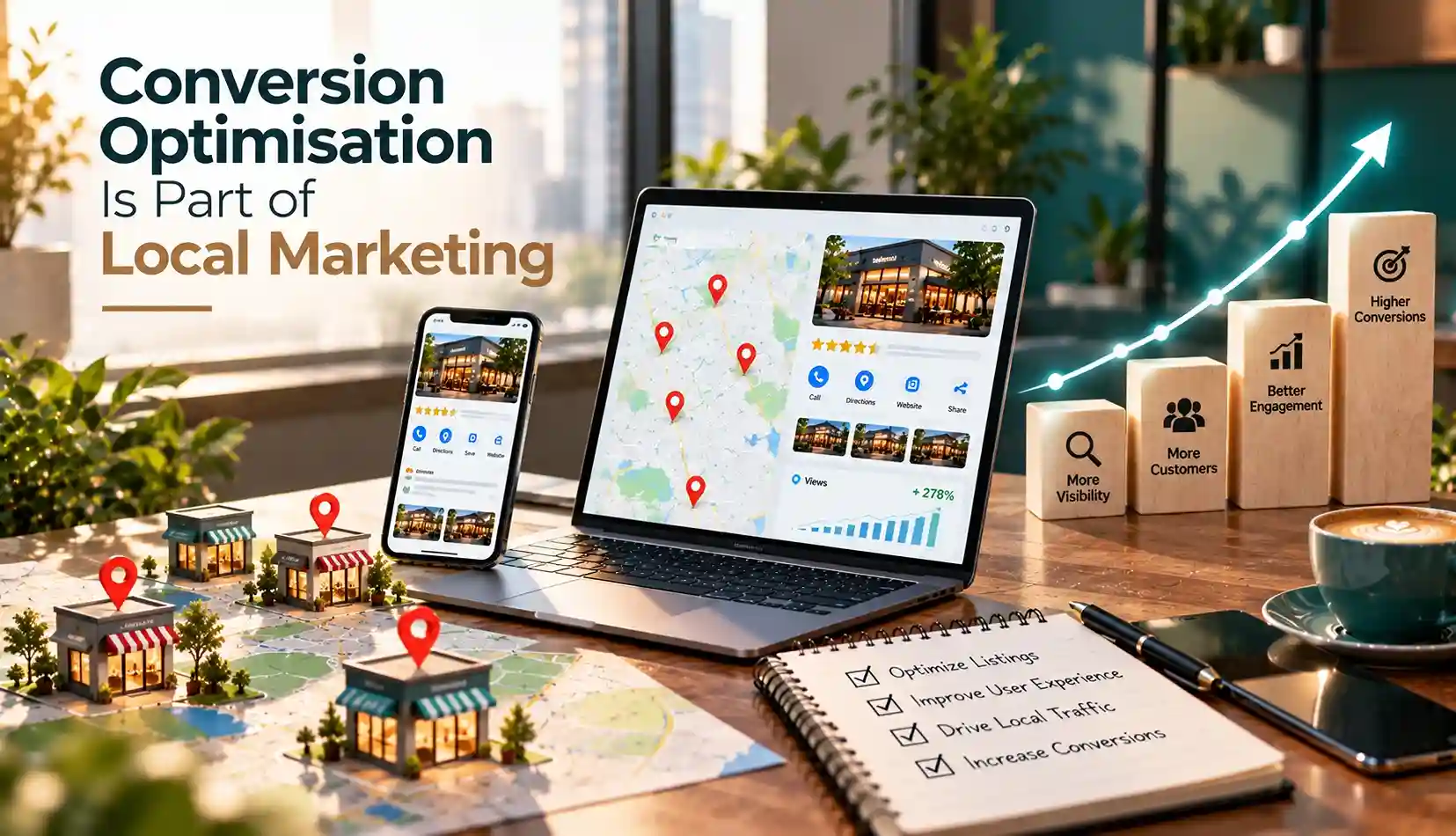
Conversion Optimisation Is Part of Local Marketing :
It’s costly driving traffic without increasing conversions.
Landing pages must reduce friction from the process.
The customer must instantly know the location involved, services offered, and what actions he can take.
Phone numbers must be easily accessible via mobile phones.
The forms must ask for relevant data only.
Calls to actions must outline an actionable step such as making an enquiry, scheduling an appointment, and utilizing social media marketing service.
The signals for trust need to be present close to key decision points.
Such enhancements can help bring commercial benefits without increasing advertising expenses.
An internal link utilizing conversion rate optimization will lead visitors to a specific CRO or website optimization services page.
Local Marketing Should Support Revenue, Not Vanity Metrics :
Digital marketing becomes significantly more valuable once reporting goes beyond traffic and impressions.
For instance, a location can see a big rise in its organic traffic due to a good ranking on informational search terms.
It’s very nice looking in SEO report.
But if there aren’t many customers out of that traffic, the commercial effect might not be that great.
A different location may have way lower traffic, but higher-intent visitors who look for costly services.
The latter location will make more money.
And that is why decision makers at the top need to judge marketing efforts based on commercial factors.
Traffic must relate to intent.
Leads must relate to quality.
Customers must relate to revenue.
Revenue must relate to acquisition cost.
The Future of Multi-Location Marketing :
The local customer journey is becoming increasingly fragmented.
The customer may learn about the company via Google Search, view its Business Profile, read reviews, navigate to its website, investigate various local business marketing, inquire from the AI assistant, and come back via branded search later.
Consistency thus needs to be maintained in the digital ecosystem as well.
The name, location, services, contact details, reputation, and credentials of the organization must be consistent across all places the customer will encounter the brand.
This is especially so when search systems based on AI start to integrate information from different sources together.
It is not just about optimizing each page but rather creating a consistent digital identity.
Both the search engines as well as the customer must know who the company is, where does it operate from, what does it offer, and why can it be trusted.
Why Multi-Location Businesses Have an SEO Advantage ?
Having multiple locations adds complexity to the situation but also adds a benefit.
Each branch is a source of possible expertise.
Each location provides customer queries.
Each team faces various situations.
Each market creates an opportunity to provide local evidence.
If used correctly, all that allows a multi-location company to develop much more topic depth than a smaller rival that uses only general content.
A single customer query can become an FAQ.
Successful local projects conducted by a PPC agency can be considered a case study.
A staff interview could bring in expert opinion.
An issue that recurs among customers may turn into an educational article.
The opening of a branch could generate local business information.
What follows is a content ecosystem that is constructed from the company’s experiences.
It is much more difficult to copy than commodity SEO content.
Conclusion :
For multiple locations in Illinois, the concept of marketing involves more than just boosting web traffic and SEO rankings. A great marketing plan will be able to bring together local SEO, Google My Business, location-specific content, Pay Per Click (PPC), social media, reviews, and conversion optimization for consistency and credibility across all locations. With each location having a robust digital presence based on local knowledge and performance data, you’ll be better off competing in conventional and artificial intelligence searches.
A good marketing partner will be one who is concerned about the bottom line rather than the superficial measures. Irrespective of whether the objective is to have a higher volume of leads or even increase revenues of individual branches, it is possible to create a scalable marketing system for each one through a B2B digital marketing agency. Businesses that are located in Illinois and wish to improve their local searchability need to carry out a marketing audit per branch.