
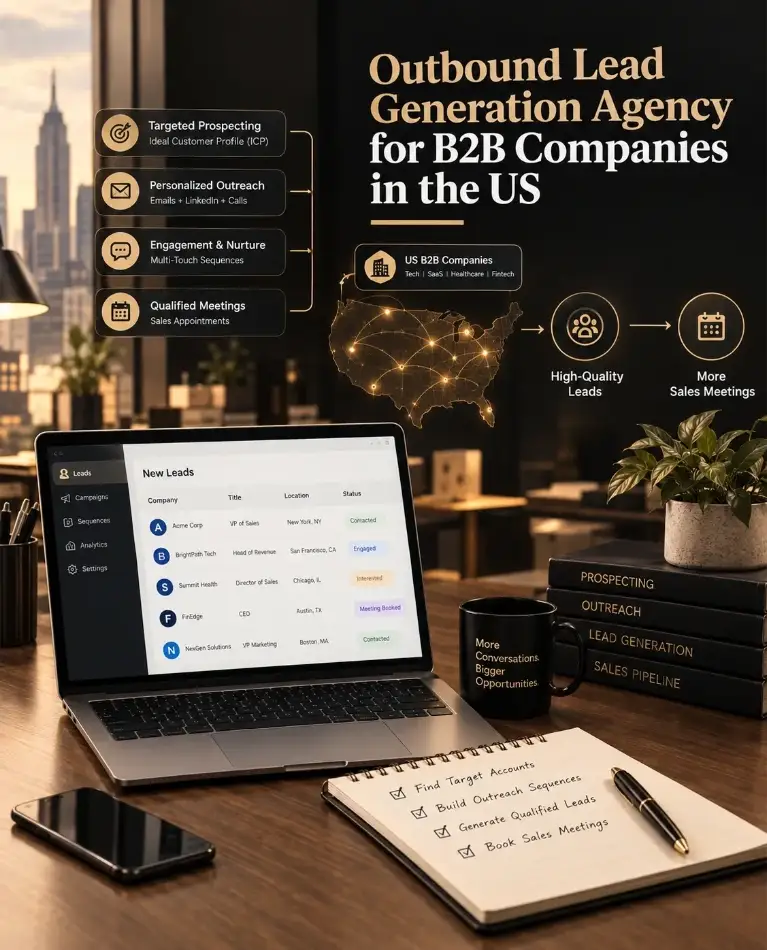
Build a predictable pipeline with outbound sales campaigns run by specialists, not guesswork:
Most B2B sales teams don’t have a lead problem. They have a consistency problem. One quarter the pipeline looks healthy, the next it’s running on fumes because outbound got deprioritised the moment inbound slowed down. Digifinity runs outbound lead generation as a standing function, not a campaign you switch on and off so your sales team spends its time closing, not chasing.That gap is exactly what a 2026 Gartner survey points to: 67% of B2B buyers now say they’d prefer a rep-free purchasing experience, which means the outbound that does land has to earn the conversation, not just start one.
We work with US-based B2B companies who need a sales engine that doesn’t depend on a single rep’s LinkedIn habits or a founder’s personal network. That’s the gap an outbound sales programme is built to close. Many partners in this space focus purely on volume: more names, more sends, more activity. We focus on the part that actually moves revenue, getting the right person, at the right account, to respond.
That distinction matters more as sales cycles lengthen and buying committees grow. A single champion is rarely enough to close an enterprise deal anymore; outbound today has to reach multiple stakeholders across a target account, in a coordinated sequence, without looking like five separate cold emails landing in five separate inboxes the same week.
Why Do Outbound Sales Still Win B2B Deals?
Outbound gets blamed for a lot it doesn’t deserve. Most of the damage comes from how badly it’s usually done: generic templates, lists nobody bothered to qualify, no real follow-up plan. Run properly, it’s still the fastest way to reach a buyer who isn’t yet out there searching for you.
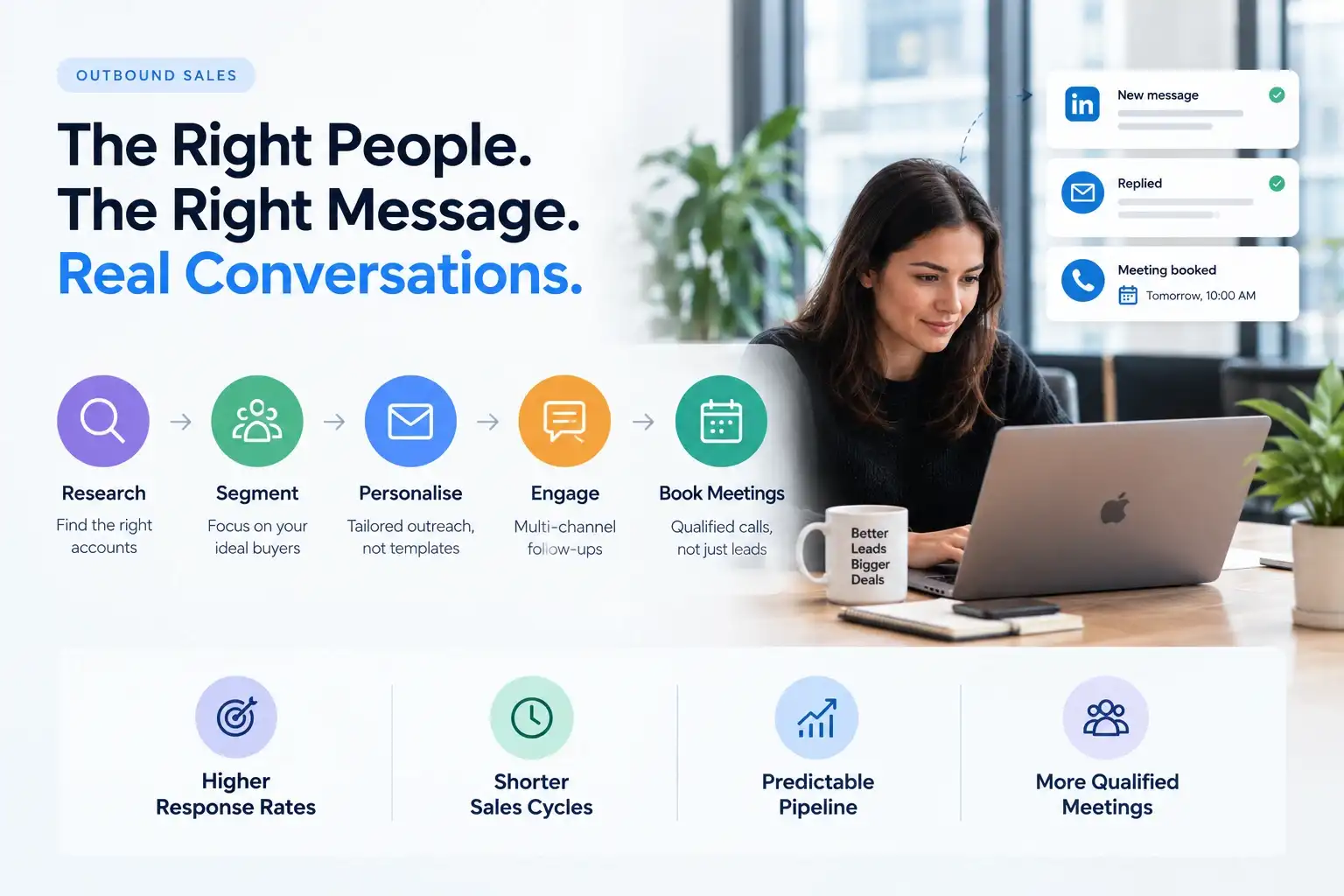
Inbound only works once someone’s already recognised they have a problem and typed it into Google. Outbound reaches the buyer earlier than the one who’s about to have that problem, or doesn’t yet know your category exists. For companies selling into narrow ICPs (specific job titles, specific company sizes, specific verticals), waiting for inbound is a slow way to build a pipeline. Outbound puts you directly in front of the account you want, on your timeline.
The businesses that get this right treat outbound as a system: research, segmentation, messaging, cadence, and handoff not a spray of emails. That’s the difference between “we tried cold email once” and a B2B sales agency running it as a repeatable motion.
That approach lines up with where buyer behaviour is actually heading. A 2026 Gartner survey found that 67% of B2B buyers now say they’d prefer a rep-free purchasing experience, and buyers in a related Gartner study reported actively avoiding suppliers whose outreach feels irrelevant which is exactly why generic, unsegmented outbound backfires while a properly researched, well-targeted campaign still gets a hearing.
It’s also worth separating outbound from advertising. Paid channels can put your brand in front of a buyer, but they can’t hold a conversation, answer an objection on the spot, or adjust the pitch when a prospect mentions a competitor by name. Outbound, run properly, does all three which is why it still outperforms other early-funnel channels on cost per qualified meeting for companies with a defined ICP and an average deal size that justifies a human touch.
Ready to Fix Your Pipeline Consistency?
See how an outbound programme built around your ICP compares to what you’re running today. No commitment, just a look at where the gaps are.
The Real Cost of DIY Outbound Sales:
Before comparing agencies, it’s worth being honest about what running outbound in-house actually costs beyond the salary line.
Wasted rep hours on list-building: A rep spending three hours a day building and verifying prospect lists is a rep not spending three hours a day selling. List-building is a data problem, not a selling skill, and most AEs are neither trained nor incentivised to do it well.
Inconsistent messaging across campaigns: When five reps each write their own sequences, you get five different value propositions, five different objection-handling approaches, and no way to tell which messaging is actually working. Testing becomes impossible without a controlled process behind it.
No accountability for pipeline numbers: Ask most sales leaders how many qualified meetings their outbound motion produced last quarter and you’ll get an estimate, not a number. Without dedicated ownership, outbound becomes the first thing that slips when reps get busy and the first thing nobody can explain when the pipeline dries up.
The stakes here are rising, too. Forrester’s State of Business Buying report found that 86% of B2B purchases now stall somewhere in the buying process, which makes a stalled or inconsistent outbound motion even more costly to leave unmanaged every gap in follow-up is another opening for a deal to go quiet.
Deliverability damage that compounds quietly: Perhaps the least visible cost: a domain sending unverified, poorly warmed-up email at volume starts landing in spam, and that reputation damage doesn’t reset overnight. By the time a sales leader notices reply rates have collapsed, the domain may need weeks of remedial warm-up before outbound work again for any team, in-house or otherwise.
Add these up and the “free” option of running outbound with existing headcount usually isn’t free at all. It’s a hidden tax on your most expensive resource, your closers’ time paid in the currency of a missed pipeline. It’s also different from what you’d get handing the problem to a generic b2b lead generation company that just supplies names. The cost isn’t only the list, it’s everything that has to happen after the list arrives.
What Our Outbound Lead Generation Service Covers?
Digifinity’s outbound service is built around three things most in-house efforts get wrong: who you’re targeting, what you’re saying, and how consistently you’re saying it.
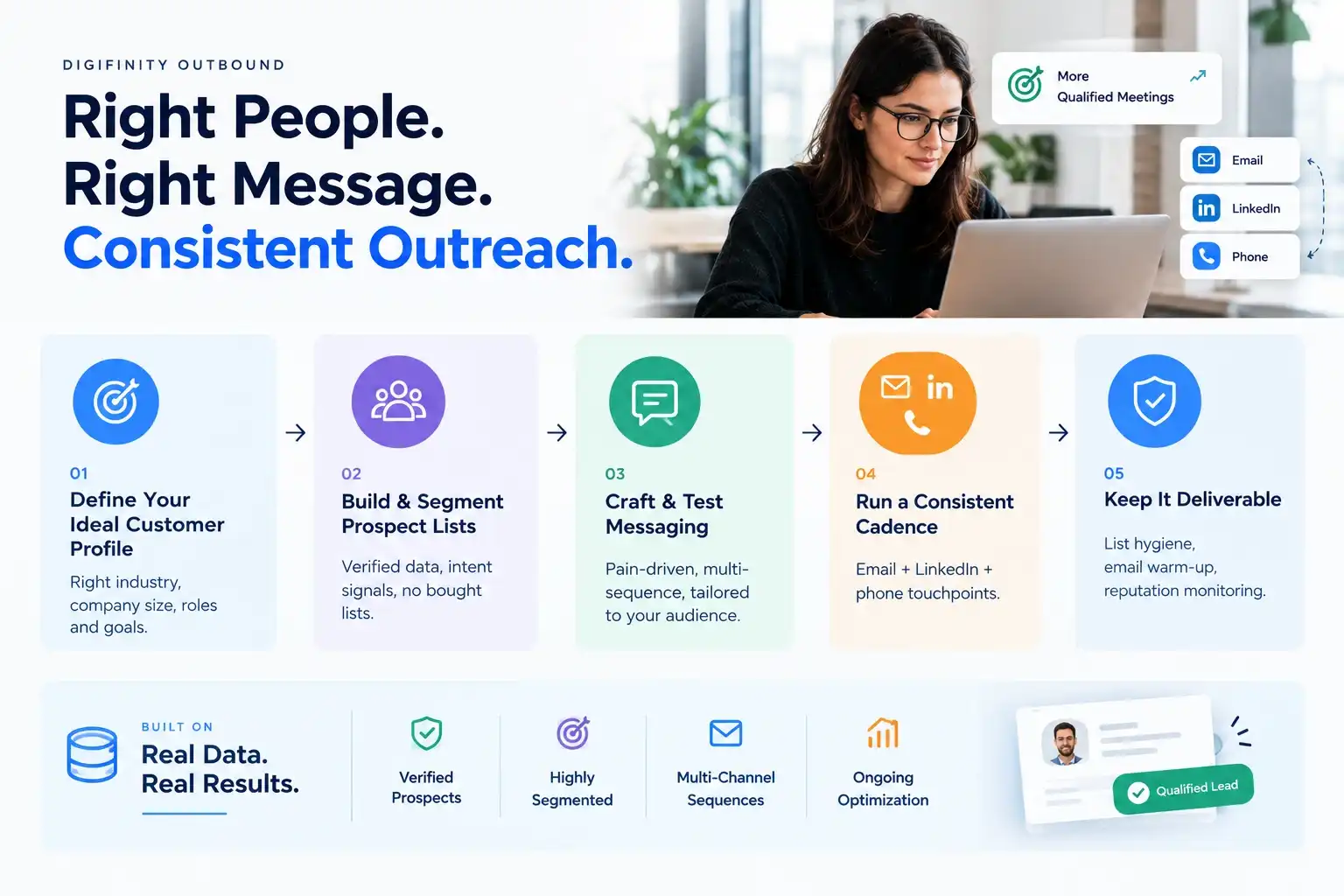
We start with your ideal customer profile. From there we build verified, segmented prospect lists using a mix of firmographic and intent data, not purchased lists that bounce and quietly burn your domain reputation. Every campaign gets messaged around a specific buyer pain, tested across sequences, and run through a cadence that mixes email, LinkedIn and phone touchpoints.
Most agencies stop there. As a working b2b data provider, we don’t: ongoing list hygiene, deliverability monitoring and domain warm-up are part of the job too, so your outreach isn’t landing in spam before a prospect even opens it.
Inside the Campaign: Core Features
Every campaign runs on the same underlying infrastructure, whether you’re a ten-person startup testing a new vertical or an established firm expanding into a new region. The features below aren’t add-ons priced separately; they’re the baseline for any campaign we run.
- ICP-based account and contact list building, verified before every send
- Multi-channel sequences (email, LinkedIn, phone) mapped to buyer stage
- A/B-tested messaging with weekly performance review
- Deliverability management: domain warm-up, inbox rotation, bounce monitoring
- CRM-ready lead handoff with call notes and qualification status
- Monthly reporting on replies, meetings booked, and pipeline value
None of these work in isolation. A perfectly verified list with weak messaging still underperforms, and strong messaging sent from a poorly warmed domain never reaches the inbox at all. That lines up with RAIN Group’s sales prospecting research, which found that most buyers accept meetings from sellers who reach out proactively, but sellers typically need five to ten touches across channels before that first connection lands. Treating list quality, messaging, and deliverability as one connected system rather than three separate line items is what separates a campaign that compounds over months from one that fizzles after the first send.
What You Get: Benefits and Business Impact?
The point of outsourcing outbound isn’t just “more leads” it’s that your sales team can actually work. Qualified meetings land directly on your AEs’ calendars, pre-briefed, so the first call is a sales conversation, not a discovery interrogation. Your reps reclaim the hours they were losing to prospecting, and that time converts into more demos run and more deals closed per rep, not just more activity logged.
There’s a compounding benefit too: because every sequence is tested and measured, the messaging that works gets sharper every month, instead of quietly going stale the way most in-house scripts do. And because you’re not hiring, training, or managing an internal SDR team, you get enterprise-grade outbound infrastructure without the fixed headcount cost which matters most for the small businesses and startups this kind of outsourcing was originally built for. It’s worth noting this isn’t a fringe channel either: HubSpot’s sales research found that the majority of sales professionals still rely on cold outreach as part of their strategy, and that most buyers accept meetings from reps who reach out proactively the issue is rarely whether to do outbound, it’s whether it’s run well.
There’s also a strategic upside that’s easy to overlook: predictability. When outbound runs as a managed, ongoing motion rather than a project you start and stop, forecasting gets easier. Sales leaders can plan hiring, budget, and quota expectations around a pipeline number they can actually trust quarter to quarter, instead of hoping inbound holds up or a founder’s network delivers one more round of introductions.
How We Run Your Outbound Sales Campaign?
There’s no black box here you’ll know exactly what stage your outbound sales campaign is at and why, from the first workshop through to your first booked meeting. The process below is the same one we run for every client, adjusted for target account complexity and sales cycle length.
| Step | What Happens | Typical Timeline |
| 1. ICP & Messaging Workshop | We align on target accounts, buyer personas, and core value propositions | Week 1 |
| 2. List Build & Verification | Prospect lists are built, enriched, and verified for deliverability | Week 1–2 |
| 3. Sequence Design | Multi-channel cadences written and set up in your CRM/outreach tool | Week 2 |
| 4. Campaign Launch | Outreach begins across email, LinkedIn, and phone | Week 3 |
| 5. Optimisation | Messaging and targeting refined weekly based on reply data | Ongoing |
| 6. Reporting & Handoff | Qualified meetings booked directly for your sales team, with monthly reporting | Ongoing |
Most clients see meaningful reply-rate data by the end of week three, though meaningful pipeline data enough to judge whether the messaging and targeting are right usually needs a full 60-day cycle. Judging a campaign after two weeks is one of the most common mistakes we see in-house teams make; outbound rewards patience through the optimisation phase.
Investment: How Pricing Works?
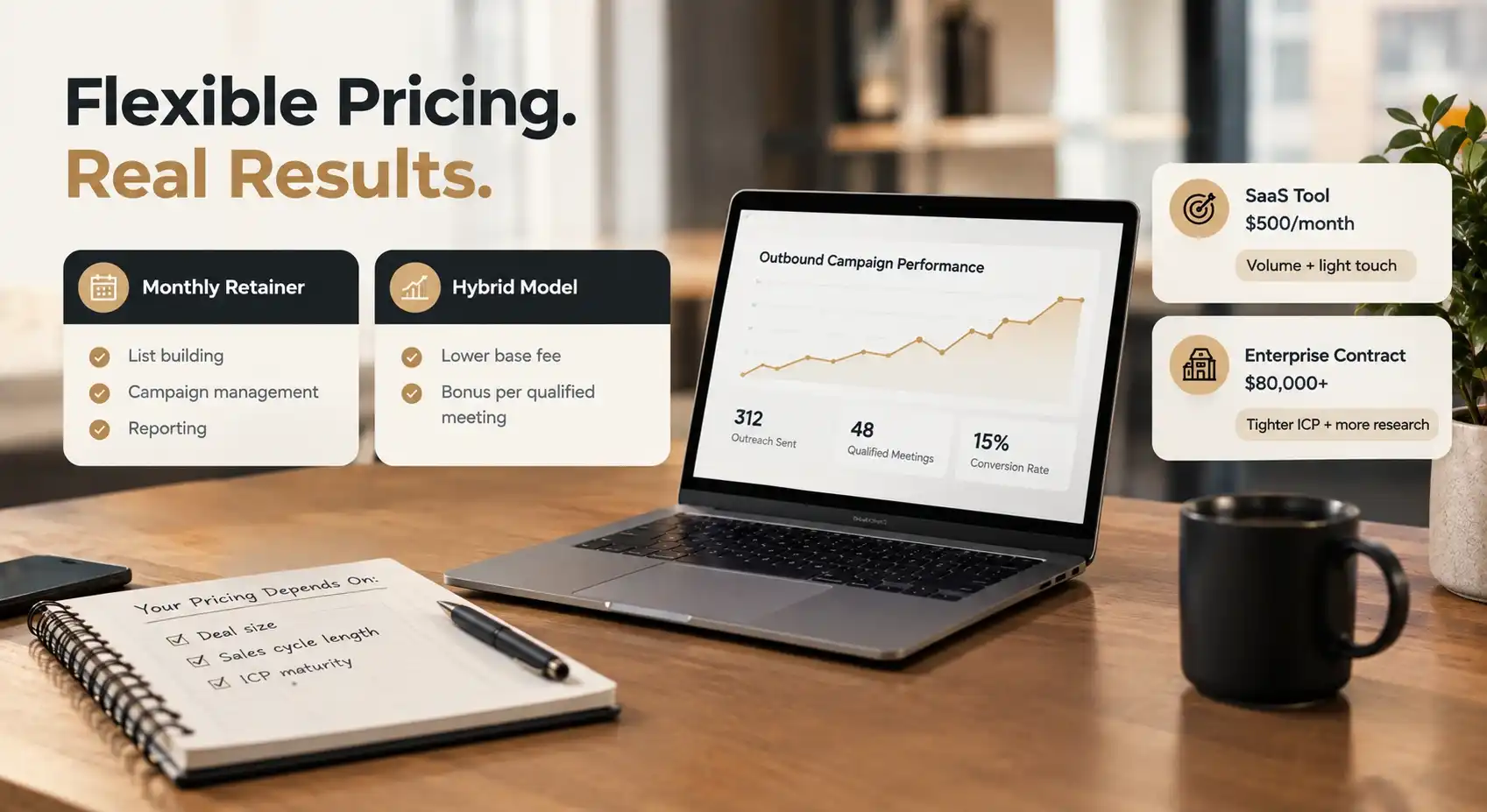
Pricing for outbound outsourcing usually comes down to two structures. Some agencies charge a flat monthly retainer that covers list-building, campaign management and reporting. Others run a hybrid: a lower base fee plus a bonus tied to qualified meetings booked. We lean toward the retainer model, and so do most sales outsourcing companies, because it keeps the team focused on quality over volume. Pay strictly per lead and quantity starts creeping ahead of qualification, often without anyone quite deciding that’s the trade-off they wanted.
How much you’ll actually pay depends on deal size, sales cycle length, and how sharp your ICP already is. Take a $500-a-month SaaS tool versus an $80,000 enterprise contract: the first can run on volume and a lighter touch, the second needs a tighter account list and considerably more research per prospect. Same channels, completely different economics.
We don’t quote a number before the workshop. Once we’ve seen your target accounts and where the pipeline gaps actually sit, pricing gets scoped properly rather than guessed at. The one thing we can say upfront: retainers scale with account and channel volume, not a flat per-company fee, so what you pay should track fairly closely with how much pipeline you need this quarter.
Why Do B2B Companies Choose Digifinity for Outbound Sales?
We’re not a call centre running scripts off a purchased list. Digifinity’s outbound team works as an extension of your sales org. We sit in on your discovery calls, learn your objection handling, and adjust messaging based on what’s actually converting in your market, not a generic B2B template.
That closeness to your sales process is deliberate. An outbound team that never hears how a deal actually gets won ends up writing sequences based on assumptions rather than reality, and the gap shows up as generic messaging that reads like every other cold email in a prospect’s inbox. Sitting in on real calls closes that gap.
That’s backed by the same data infrastructure behind our work as a best digital marketing agency for B2B clients: verified data sourcing, deliverability management, and reporting that ties activity back to pipeline value, not vanity metrics like “emails sent.”
We also don’t disappear after launch. Campaigns are reviewed weekly for the first two months and monthly after that, with every adjustment explained in plain terms what changed, why, and what we expect it to do to reply and meeting-booked rates. If a segment isn’t converting, you’ll hear that from us before you have to ask.