

It’s not often that the hiring process is an HR-only endeavor for a US startup.
A single good hire might lead to more productive product development, expanded sales capabilities, better client relationships or free up a few hours each week for the founder to focus on something else. A bad hire may do just the opposite.
This explains why full cycle recruiting has become very important to start-ups in addition to their need for candidates. Unlike the conventional approach of giving a resume to a recruiter and walking off, the full cycle recruitment partner sees through the whole process, starting from workforce planning up to after hiring activities.
The distinction matters.
The SHRM 2026 recruiting benchmarking data suggests that the median time-to-fill for non-executive jobs is 39 days. According to its 2025 findings, 69% of the companies were still facing issues while hiring for full-time jobs. In the case of
startups operating on a tight deadline or having high growth targets, filling up such an important role in just one more month could turn into a business limitation.
Recruiting process design offers entrepreneurs a single approach to hiring, one talent strategy, and a single measurable funnel for hiring people.
This guide describes how it is done, how it brings most value, and how US-based startups may benefit from using structured recruiting.
What Is Full Cycle Recruiting ?
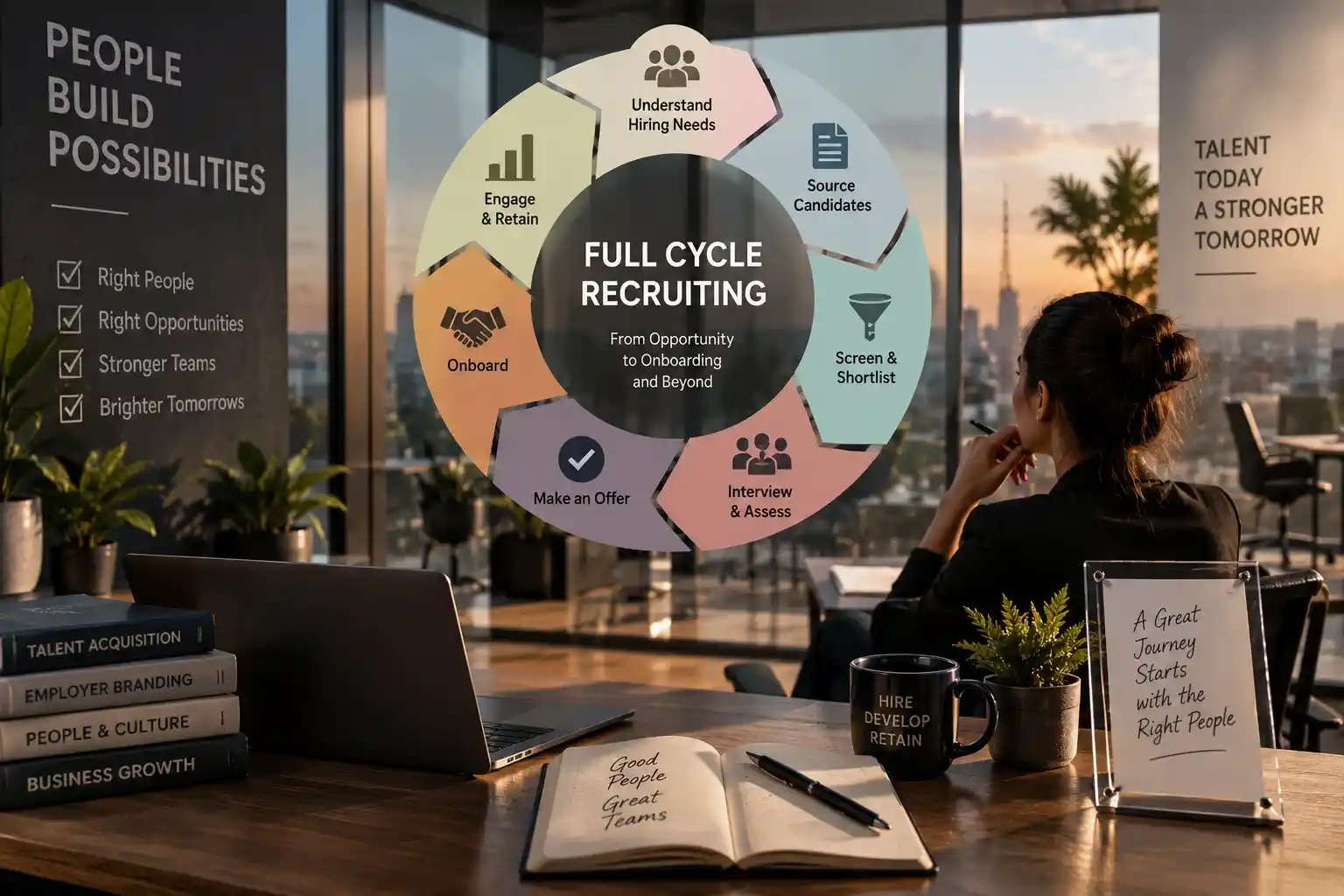
Full-cycle recruiting refers to the full hiring process where either one person or a recruitment firm takes responsibility for the entire process from start to finish for one position
Instead of treating each recruitment step in isolation, the model links each step:
Hiring strategy → job description → sourcing → screening → assessment → interviewing → offer → onboarding → evaluation after hire
As a result, a recruiter responsible for the full cycle handles the whole candidate journey from start to finish.
What matters here is accountability.
If the sourcing stage results in poor quality candidates, the recruiter evaluates the sourcing process. If candidates reject multiple offers, the recruiter reviews the compensation, positioning or candidate experience. If hiring managers have problems making their decision, the recruiter uncovers the source of the problem, instead of just presenting more CVs.
It is why full cycle recruitment is especially relevant for startups. The goal is not to drive the largest volume of applicants but to develop a repeatable system that will deliver high-quality candidates and convert them into hires.
Full cycle recruiting vs traditional recruitment :
Recruitment through conventional methods can be disjointed. Full cycle recruitment consolidates the following tasks into one process: one individual writes the job description, searches for candidates, the hiring manager interviews the candidate, and the offer is made by an HR team member.
Specialisation by itself is not bad, especially in big companies. Startups simply do not have enough mass, structure, and personnel for effective specialisation.
| Recruitment model | Primary focus | Typical weakness |
| Job-board recruitment | Applications | High volume, variable quality |
| Contingency recruitment | Candidate placement | May focus heavily on filling the vacancy |
| Internal recruiter | Hiring support | Capacity can become a constraint |
| RPO | Outsourced talent acquisition | Can require broader operational integration |
| End-to-end recruitment | End-to-end hiring outcome | Requires strong ownership and process discipline |
The key distinction lies in ownership.
A good full cycle recruiter should never ask themselves how many candidates they referred.
Rather, they should be asking whether they are continuously finding candidates that are actually qualified for the position?
Hire the Right People, Faster
Startups can’t afford slow or costly hiring mistakes. Our full-cycle recruiting team handles sourcing, screening, interviews, and onboarding so you can build a strong team and focus on growth.
The 360 Recruitment Cycle Explained :
The concept of 360 recruiting cycle means that recruiting should be viewed as one whole process of hiring, and not as various unrelated stages of this process.
A good way of analyzing the model is based on its six steps.
- Diagnosis: What does the company really need?
- Attraction: Where are the right candidates and what would make them interested in the offer?
- Assessment: Can the candidate prove his or her competence to perform?
- Conversion: Can the firm convince the right candidate to accept?
- Integration: Can the new hire be quickly productive?
- Learning: What does the outcome reveal about the next hiring process?
The learning stage is usually overlooked.
This is a mistake.
It is important for the start-up not to consider each hiring as an entirely new venture. Each hire provides learning that helps to make the next decision.
For instance, if three right hires come from employee’s recommendations while 80% of all applicants come from a general job site, the recruiting strategy should take into account this fact.
This is how recruitment turns into a talent acquisition process supported by staffing agencies Chicago.
Why Full Cycle Recruiting Matters for US Startups ?
Startups have one unique challenge: they need candidates who can function effectively in a setting that’s evolving.
The candidate could have an impressive resume but still not fit into the startup.
The startup may need a person who works in an environment with little process involved, make decisions based on partial data, be able to cross communicate and step outside their roles.
On the other hand, startups are up against companies that have larger recruitment departments and stronger employer branding and compensation packages.
And here lies the challenge for startups:
The ideal candidates do not necessarily wait for you to advertise your job position.
This means a modern full-cycle recruitment has to involve passive candidates and eliminate any friction along the way.
Hiring speed is a growth issue :
Consider a hypothetical SaaS startup preparing to launch into a new US market.
It needs:
- one sales leader;
- three account executives;
- two customer success managers;
- one demand generation specialist.
If these positions remain open for several months, the commercial consequences extend well beyond the recruitment department.
The sales capability is hindered resulting in a 360 recruitment cycle gap. There will be problems with customer onboarding. The burden of work increases for existing employees. Founders get into hiring processes.
LinkedIn’s Future of Recruiting 2025 report underscores the rising significance of recruitment efficiency and explains how streamlining the recruitment process will enable talent teams to concentrate on strategic functions, candidate engagement, and hiring manager guidance.
This is the reason why limiting recruitment measurement to “cost per hire” is too restrictive.
The better model would be:
“What is the business cost of having this job open?”
This may very well affect the evaluation of external recruiting assistance.
What a Full Cycle Recruiter Actually Does ?
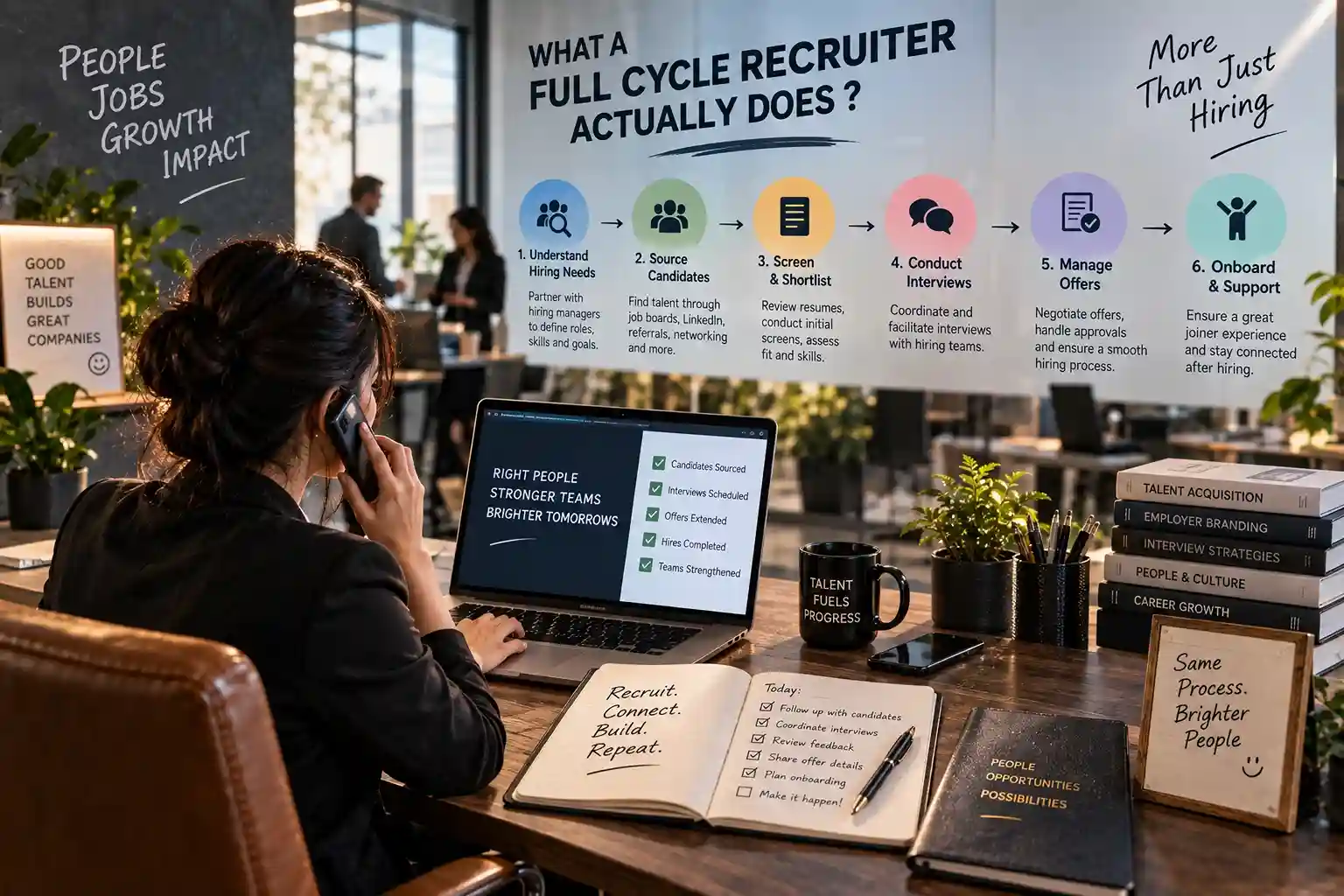
In contrast to merely delivering CVs, a talent consultant acts as an advisor for the hiring process. The duties of a talent consultant involve getting knowledge about the recruitment needs of the organization, designing a recruitment strategy tailored to meet these needs, screening candidates, interviewing them, negotiating the offers, and ensuring follow-ups after making the hiring decision.
Workforce and Role Planning :
Before embarking on sourcing, the full-cycle recruiting firm needs to have a clear understanding of the business reasons behind the job opening. This involves having clarity regarding the anticipated outcomes of the job position, setting specific goals within 30, 60 and 90 days, as well as being able to distinguish between required skills and desired ones. It also entails looking at the reasons why someone would fail at the job, who will be supervising them, how much compensation is realistic, and why would an excellent professional resign from his/her current job.
Candidate Sourcing :
A recruitment partner needs to utilize multiple sources for potential candidates. Based on the position, sourcing can involve professional networks, community sourcing, referral, targeted sourcing, talent pool, industry event, specialized job board, and direct sourcing. The optimal approach is based on where the right candidates can be sourced. For instance, an executive level product management position may require individualized executive sourcing rather than general job postings. Sourcing will allow recruiters to target relevant professionals rather than going through several unsuitable resumes.
Screening and Assessment :
Screening for full cycle recruiting must involve the examination of the candidate’s actual experience and success instead of using solely key terms from the CV. When the candidate states that they have good experience in B2B demand generation, the recruiter must inquire about the targets, tactics used, results gained, and how much the candidate contributed to that. This evidence-driven practice becomes more necessary due to the availability of technology for creating nice CVs. The task of the recruiter is to enrich the information at the disposal of the hiring committee.
Interview Management :
Interviewing procedures can be inefficient in the absence of someone managing the process of interviewing the candidate. Full-cycle recruiters organize the interview process by preparing the candidate, making sure that their expectations are clear, obtaining feedback and resolving any contradictions that arise between interviewers. Recruiters also make sure that decisions are made within the predetermined period of time. It is particularly necessary in startups, where the recruiting manager has a lot of other tasks to do. The candidate might accept another offer after waiting for two weeks.
Offer Management and Closing :
Recruitment does not end with selection by the recruiting manager of an employee. It still needs to be seen by the employee’s full-cycle recruiting process whether he feels that it fits him, particularly when he is being offered jobs from other companies too. A proper recruiting process needs to consider compensation expectations of the employee, competing offers to him, his career objectives, any reservations about the job, opinion about the organization, and his notice period. This would help in handling any objections beforehand.
Onboarding and Post-Hire Follow-Up :
Good full-cycle recruitment models go beyond the acceptance of the offer by the candidate. It is good to have a follow-up of 30, 60, or 90 days which will enable both the recruiter and the client to see if the expectations created during the recruitment process match those of the employee. This is a great way through which feedback can be created for better recruitment in the future. If the new recruits always discover that the role has more duties than those mentioned, then the JD or candidate messaging needs to be updated.
The Full Cycle Recruiting Process for Startups :
A practical full cycle recruitment process for startups can be organised into six phases.
Stage 1: Build the hiring scorecard
Prior to creating your job advertisement or reaching out to potential candidates, you should first understand what success would be for the position. Your hiring scorecard should be a guide to the core competencies and the prior performance of the individual who is capable of working within a startup atmosphere. An example would be a sales position where US B2B sales experience along with achieving sales quotas in a dynamic environment would be required.
Stage 2: Create the candidate value proposition
Once you’ve defined the role, state why the right person should join your organization. Startups should think about what would make a potential hire quit his or her job. This could involve more ownership, stock, career development, product influence, technical challenges, or building something from scratch. The point should be clear. Rather than “Join an exciting company,” say “Join us and own the US enterprise pipeline and build our outbound sales function.”
Stage 3: Build a targeted talent pipeline
A full cycle recruiter must treat their source of recruitment as an investigation into the talent market. Instead of just thinking about where people can be sourced from, recruiters must find out where qualified individuals currently work. For instance, in the case of a startup looking for a performance marketing director, recruiters can choose to source potential candidates from fast-growing SaaS firms, specialty agencies, D2C brands, and venture-backed organizations.
Stage 4: Assess for evidence
Recruitment assessments need to be aligned with the recruitment scorecard. In asking candidates whether they are commercially astute, you should instead ask them to give an example where they have turned around a weak revenue stream. This approach provides insight into what the candidate did, what their role was, and the result that followed.
Stage 5: Remove decision friction
When starting a recruitment process for a new venture, one must clearly set out how the final decision will be made and how fast feedback has to be gathered. It is also important to have set standards for moving forward with or rejecting candidates and know who gives final approval for the job offer. Sourcing services can help streamline this process and ensure a structured approach to identifying and evaluating candidates.
Stage 6: Measure the outcome
Hiring process should not stop at “candidate hired.” In addition to that, startups need to understand whether a hired individual brings in the expected performance. Key metrics in this case include time to fill, source of hire, offer acceptance rate, quality of hire and candidate experience. By measuring such metrics, startups can learn which recruiting sources work for them and make better hiring decisions going forward.
Why Startups Struggle With Recruitment ?
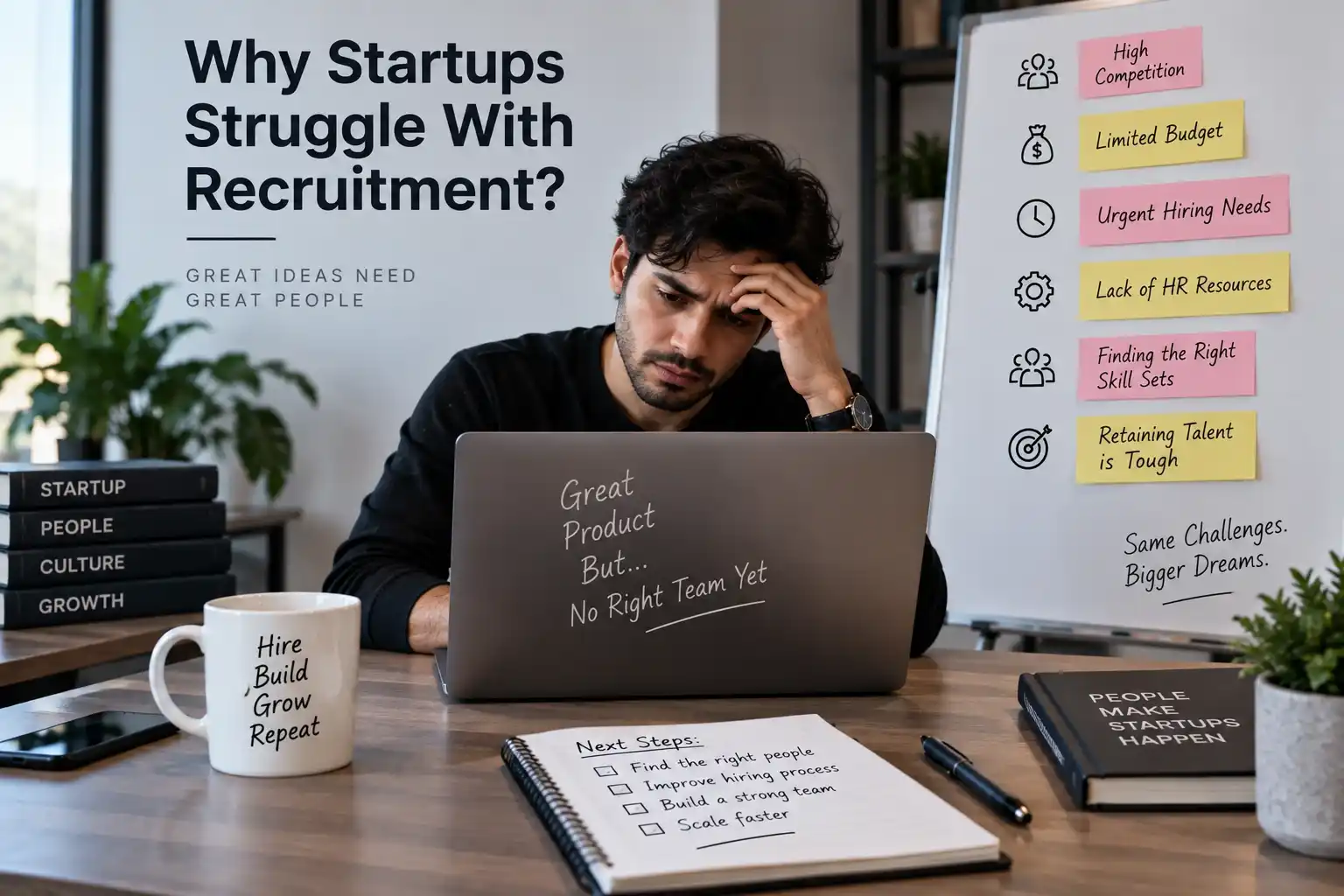
Many startup hiring challenges are not sourcing challenges.
They are process challenges.
The issue does not end there; finding people with the perfect blend of technical skill, experience, and flexibility may turn out to be even tougher. According to Deloitte’s study on the experience gap, 66% of managers and executives believed that most new hires were unprepared for their jobs.
Hiring managers do not agree on the role :
The CEO wants a strategic thinker.
The departmental head wants an operator.
The team wants someone else who’s just like me.
That’s what the job description seeks to achieve.
What ensues is an impossible task, one that a 360 recruiting cycle can help avoid.
A structured recruiting process ensures that alignment takes place before anything else.
The company searches too broadly :
There might be hundreds of applicants for a job ad but very few are suitable.
It is a case of false activity.
Strategic sourcing turns things around.
The aim is to get fewer but well-matched applicants.
The process is too slow :
Hiring managers are responsible for the operations, which means that the recruitment activities take second priority. Quality candidates do not wait indefinitely.
The full cycle recruiting method ensures that there is ownership in the process.
The employer brand is underdeveloped :
A startup cannot always compete with a multinational corporation on salary, brand recognition or perceived stability.
It can compete on relevance.
Candidates may be attracted by:
- ownership;
- learning;
- mission;
- autonomy;
- proximity to decision-makers;
- equity;
- product impact;
- career acceleration.
The recruiter needs to translate these advantages into candidate-facing messaging.
The startup hires for experience instead of capability :
“10 years of experience,” for example, might screen out people who have all the qualifications that a full cycle recruiting firm could help the business to find.
The skills-first approach offers a better question:
Does this individual actually do the job?
This issue becomes particularly important with dynamic jobs where the previous career may no longer indicate future abilities.
Full Cycle Recruiting vs In-House Hiring vs Recruitment Agencies :
There is no universally correct hiring model.
The right choice depends on hiring volume, internal capability and business stage.
| Factor | In-house recruiter | Traditional agency | Full cycle recruiting partner |
| Role strategy | Usually strong | Variable | Strong |
| Candidate sourcing | Strong | Strong | Strong |
| Hiring process ownership | Strong | Variable | Strong |
| Employer brand alignment | Strong | Variable | Strong when embedded properly |
| Scalability | Depends on team size | High | High |
| Flexibility | Medium | High | High |
| Post-hire feedback | Variable | Often limited | Can be built into process |
| Best suited to | Consistent hiring volume | Individual specialist searches | Startups scaling hiring capability |
An internal recruiter would perhaps not be justified in such an organization that does not hire frequently.
Where there is heavy hiring for a startup organization, using only ad hoc agencies would lead to inconsistency.
A full-cycle recruiting firm bridges the gap between the two models since it offers specialized recruitment services while owning the entire recruitment process.
How a 360 Recruiting Cycle Improves Quality of Hire ?
Quality is what really makes the case for full-cycle recruiting.
That is the difference that counts.
When recruiters get compensated solely for producing candidates, then the alignment between their motivations and performance can get disrupted.
Full-cycle recruiting opens up more room for such alignment.
Imagine a startup looking to hire five account executives.
After six months, the company discovers:
- referred candidates have the strongest retention;
- candidates with previous startup experience ramp faster;
- candidates with enterprise sales backgrounds outperform candidates from smaller accounts;
- candidates who demonstrated structured discovery skills during interviews consistently outperform those selected primarily on CV pedigree.
The recruitment strategy can now evolve.
This is the importance of the 360 recruitment cycle: every hiring process is an intelligence for the next one.
The Startup Recruitment Metrics That Actually Matter :
Recruitment dashboards often contain too many numbers and too little insight.
A startup should prioritise metrics connected to commercial outcomes.
| Metric | What it tells you | Strategic use |
| Time to fill | How long vacancies remain open | Identify process bottlenecks |
| Time to hire | Speed from candidate entry to acceptance | Improve candidate conversion |
| Source of hire | Which channels produce hires | Allocate sourcing investment |
| Offer acceptance | Whether offers convert | Diagnose competitiveness |
| Quality of hire | Whether hires perform and remain | Measure true recruitment impact |
| Candidate experience | How candidates perceive the process | Protect employer reputation |
| Cost per hire | Recruitment investment | Assess economic efficiency |
Speed should not be prioritised over quality.
An employee who is hired in 20 days, but does not work well, may not have been more efficient than a person who takes 35 days but works successfully for years.
What you need to use is:
Speed × Quality × Retention × Impact
That is certainly a far more significant measurement of administrative support effectiveness.

A Practical Full Cycle Recruiting Scorecard :
For startups, a simple scorecard can prevent recruitment from becoming subjective.
Score candidates across five dimensions:
| Dimension | Weight |
| Technical / functional capability | 25% |
| Evidence of measurable performance | 25% |
| Problem-solving ability | 20% |
| Communication and collaboration | 15% |
| Startup operating fit | 15% |
The weighting must vary based on the position.
For a technical role, functional ability might be weighted more heavily.
For a sales founder, business results and toughness might carry more importance.
The critical point here is consistency.
Each of the final candidates must be judged using the same criteria for success.
When Should a US Startup Outsource Full Cycle Recruiting ?
It may be necessary to outsource in case there is a need to hire more people than what an organization can handle. According to SHRM, in its RPO guidelines, RPO can help with the effectiveness of the recruiting process. This is very important in the US for startups.
Some of the common signs include:
There are multiple job openings at once.
The hiring manager spends too much time recruiting and vetting.
Difficult-to-fill roles are not closing fast enough.
The recruitment team is out of easy candidate pool ideas.
The business is venturing into a new US market.
Full-cycle recruiting is necessary since you require candidates familiar with the local market and the competitor landscape.
The quality of recruitment is inconsistent.
Each of the hiring managers has their way of doing things, interviews, and evaluations.
Recruiting is now a founder bottleneck.
The founders need to be part of the decision-making, but they shouldn’t be sourcing each candidate themselves.
How to Choose a Full-Cycle Recruiting Firm ?
Selecting the right recruitment partner must go beyond asking for the fee percentage.
Assess the recruitment partner on five criteria.
Do they understand your hiring market?
A recruiter who specialises in healthcare might not be the ideal partner for a venture-backed SaaS company.
Find out what functions, seniority levels, and geographies they tend to recruit for.
Do they own the entire process?
Decide if the firm focuses on only sourcing or actually manages the recruiting process.
A complete recruiting cycle needs to have proper accountability starting from job description until after the hiring process.
How do they measure quality?
As for what occurs once the recruitment process is completed, do they keep records on retention? Hiring manager feedback? Performance? An organization that only discusses their number of resumes might not be as developed with their quality model.
A 360 recruitment cycle gauges success beyond CV numbers.
How do they use technology?
The productivity of recruitment can be enhanced by AI and automation.
Therefore, the correct question is not:
“Do you use AI?”
But:
“Where does technology enhance the process and where does human judgement take over?”
Can they explain their process?
A credible recruitment partner should be able to show you its methodology.
You should understand:
- how roles are calibrated;
- how candidates are sourced;
- how candidates are assessed;
- how hiring managers receive feedback;
- how offers are managed;
- how performance is reviewed after hiring.
If the process cannot be explained clearly, it is difficult to manage or improve.
The Future of Full Cycle Recruiting: Human Expertise + AI :
Recruitment is developing rapidly, yet the advent of AI doesn’t necessarily make recruitment professionals any less relevant. Rather, AI is redefining recruitment teams’ working methods by automating tedious activities like sourcing candidates, resume screening, personalized communication, scheduling interviews, recruitment analytics, and administration.
The future of full cycle recruitment thus relies on integrating technology and human skill. A competent full cycle recruiter is able to analyze talent market trends, question exaggerated hiring criteria, provide guidance to hiring managers, know the psychology of candidates, negotiate the offer and generally provide an improved candidate experience. Technology can make all these faster and easier, but it is impossible for technology alone to have the ability to assess if a candidate fits the goals, culture and stage of growth of the organization. The best recruitment strategy will not be a choice between human beings and technology but an integration where automation makes tasks easier for recruiting.

Full Cycle Recruitment for Different Startup Hiring Needs :
The model can be adapted according to the company’s growth stage.
Seed-stage startups
The priority is usually foundational hiring.
Typical requirements include:
- first sales hires;
- product leadership;
- engineering;
- growth marketing;
- operations.
The recruiter needs to understand founder vision and identify people who can tolerate ambiguity.
Series A startups
Recruitment becomes more specialized.
There might be a need for forming teams on the basis of functions rather than recruiting individual generalists.
Here comes the role of a full-cycle recruiter and the process of recruitment.
Series B and growth-stage startups
Importance is placed on volume and speed.
The organization could be recruiting for multiple departments at once.
This is where the recruitment process requires standardized scorecards and reporting, pipelines and hiring manager processes.
Later-stage startups
The difficulty may be one of organisational scale.
Recruitment will encompass the hiring of leaders, specialisms, and dispersed teams.
A full recruitment outsourcing partner provides additional capacity without having the organization form an expansive internal recruitment function from the outset.
Mini Case Study: Turning a Slow Search Into a Hiring System
Imagine a fictional US-based start-up specializing in marketing technology and employing 80 people.
It requires a Vice President of Sales.
Their first try results in 140 applications, 12 interviews and no offers made.
On the surface, the reason is a shortage of candidates.
However, a full cycle recruitment audit reveals otherwise.
Job description includes sales leadership for enterprises, sales operations, direct prospecting and channels management. Compensation package is not specified. Interview process includes 6 stages. Feedback is given in 4 days on average.
The recruitment campaign is redesigned.
The firm has identified three non-negotiable skills for candidates, narrowed the recruitment process down to four steps, created an appropriate compensation structure, and used candidate sourcing to recruit sales leaders with comparable go-to-market strategy firms.
This is not just about having more applicants.
The organization gets fewer applicants, but better qualified ones and makes its decision quicker.
The key lesson here is that:
Recruitment success can be enhanced much more by a better system than by more recruiting.
How Full Cycle Recruiting Supports Sustainable Growth ?
The greatest advantage of full-cycle recruitment is cumulative.
Recruitment agencies can provide support for filling one vacancy.
A fully developed full-cycle approach can assist a startup in establishing an effective talent engine.
Over time, the organisation develops:
- clearer role definitions;
- stronger candidate messaging;
- reusable talent pools;
- better interview frameworks;
- more reliable recruitment data;
- stronger employer positioning;
- improved hiring-manager discipline;
- better understanding of candidate motivations.
Institutional memory accumulates.
There is no need for the company to start from scratch each time it hires someone.
They have a hiring process in place.
Conclusion: Build a Smarter Hiring Engine
Full cycle recruitment for US-based start-ups is much more than simply filling open roles; rather, it is a strategy aimed at creating a consistent stream of talent as well as ensuring sustainable growth of the company. The entire process from role specification to sourcing, interviewing, offer negotiation, and assessment ensures more accountability on the part of recruiters as well as better decision making. It allows for a seamless recruitment process and thus ensures timely hiring.
The ideal recruitment partner can turn recruitment into a business strength rather than a time-consuming task. If your startup faces difficulty in sourcing specific talent or is planning for its future growth stage, then it can opt for end-to-end recruiting solutions that can provide you with all the knowledge and processes required for successful recruiting. You can engage an experienced recruiting company that can help you create a powerful talent strategy for your business.