

How Verified, Real-Time Data Turns Enterprise Prospecting Into Predictable Pipeline:
Ask any enterprise sales leader what’s actually slowing down their pipeline, and “not enough leads” is rarely the honest answer. The real problem is usually sitting inside the CRM: contacts who changed jobs eight months ago, phone numbers that ring a desk nobody sits at anymore, titles that no longer match the org chart. As a b2b lead generation agency, we hear this from enterprise teams constantly reps burning hours chasing accounts that were never going to convert, simply because the data pointed them there. Industry research backs this up: Apollo’s analysis of B2B data decay puts the average monthly decay rate at roughly 2.1%, which compounds into a substantial chunk of any database going stale within a year.
This is precisely the gap that B2B data research services exist to close. Instead of static lists and guesswork, enterprise organizations are turning to research partners who deliver verified, enriched, and genuinely current intelligence, the kind that lets a rep open a conversation already knowing something true about the account. For anyone comparing a b2b lead generation agency against building this capability in-house, it helps to understand exactly what good data research looks like, and where it actually moves the needle on revenue.
Why Is “Good Enough” Data Isn’t Good Enough Anymore?
Most sales orgs have, at some point, bought a database subscription and called it prospecting. It works, until it doesn’t. Contact records don’t fail all at once; they erode quietly, a few percentage points a month, until a rep realizes half their target list no longer exists in the form they were given it.
Here’s roughly what that erosion looks like when modeled over a year, using a commonly cited compounding decay rate:
| Time Elapsed | Contacts Still Accurate (of 1,000) | Approx. Records Lost |
| At list purchase | 1,000 | 0 |
| 3 months | 937 | 63 |
| 6 months | 878 | 122 |
| 9 months | 823 | 177 |
| 12 months | 772 | 228 |
That’s not a rounding error, it’s roughly a quarter of a list going bad in a single year, and the real number can run higher in fast-moving industries like SaaS and tech, where people change roles more often. For an enterprise team working seven-figure deals, every one of those dead records represents a rep’s time spent on a dead end instead of a live conversation.

This kind of decay hits outbound lead generation hardest of all, since the whole motion depends on reaching the right person, at the right time, with something worth saying. Stale data doesn’t just waste a rep’s morning it quietly caps how much volume an outbound program can ever realistically produce.
There’s a relevance problem on top of the accuracy problem, and it’s the one people notice first. A generic list will tell a rep who holds the VP of Procurement title. Fine. It won’t tell them the company just closed a funding round, or is opening a new region, or swapped ERP vendors last quarter, the stuff that actually gives a rep something worth saying. And buyers can tell the difference in about one sentence. A message that shows real understanding of what’s happening at their company reads completely differently than one that was clearly built from a template and dropped into a mail merge. They respond to the first kind. They ignore the second, or worse, mark it as spam.
The two problems compound each other in a way that’s easy to underestimate. Stale contact data means a rep is often reaching the wrong person entirely; irrelevant context means that even when the message does land in the right inbox, it doesn’t earn a reply. Fixing one without the other only gets a sales team halfway there. A verified contact who receives a generic message performs barely better than an unverified one, and a perfectly timed, well-researched message that bounces never gets read at all. Enterprise data research exists specifically to solve both problems at once, rather than treating accuracy and relevance as separate workstreams handled by different tools.
Tired of Chasing Bad Leads
Stop losing rep hours to contacts that no longer exist. Our team builds verified, enriched account lists mapped directly to your ideal customer profile, so every outbound motion starts with data your team can actually trust.
What B2B Data Research Services Actually Include?
A research partner worth paying for hands you a lot more than a spreadsheet of names. Good B2B data research breaks down into a few distinct layers, and skipping any one of them tends to cause a different, specific kind of problem down the line.
Start with firmographic and technographic profiling: company size, revenue band, industry, tech stack, org structure. Boring stuff, maybe, but it’s the layer that decides whether an account fits your ideal customer profile at all. Get this wrong and everything downstream, from list-building to messaging, is aimed at the wrong companies no matter how well it’s executed.
Then there’s contact-level enrichment and verification: which is more than just a name and an email address. It’s a direct line that’s actually current, an inbox that still exists, and a role that’s still relevant to the buying decision. This is the layer where most wasted outreach gets stopped before it happens before a rep ever picks up the phone to call someone who left eight months ago.
Intent and trigger-event monitoring: covers funding announcements, leadership changes, job postings, new tech adoption, the signals that separate “this account might buy someday” from “this account is actually shopping right now.”
Buying committee mapping: matters because enterprise deals rarely close on one signature. Committee sizes have grown considerably in recent years, research compiled by Komo’s buying committee analysis points to Gartner figures of 6 to 10 core decision-makers on a typical enterprise deal, with Forrester’s broader stakeholder count running even higher once external influencers are included. Mapping the economic buyer, technical evaluator, end users, and procurement gives a rep a realistic view of who actually needs to be in the room, instead of pitching to a single champion and hoping the message travels.
Teams that treat this as ongoing infrastructure working with a specialized b2b data provider rather than a one-time list purchase tend to see the compounding benefit show up fastest, since the data stays current instead of decaying the moment it’s delivered.
The Direct Line Between Data Quality and Sales Performance:
It’s worth spelling out why this matters in dollar terms, not just operational ones. Bad data shows up at every stage of the funnel higher bounce rates, weaker connect rates, longer research time per rep, and eventually, missed quota. Enterprise cycles are long enough on their own without adding friction from data nobody trusts.
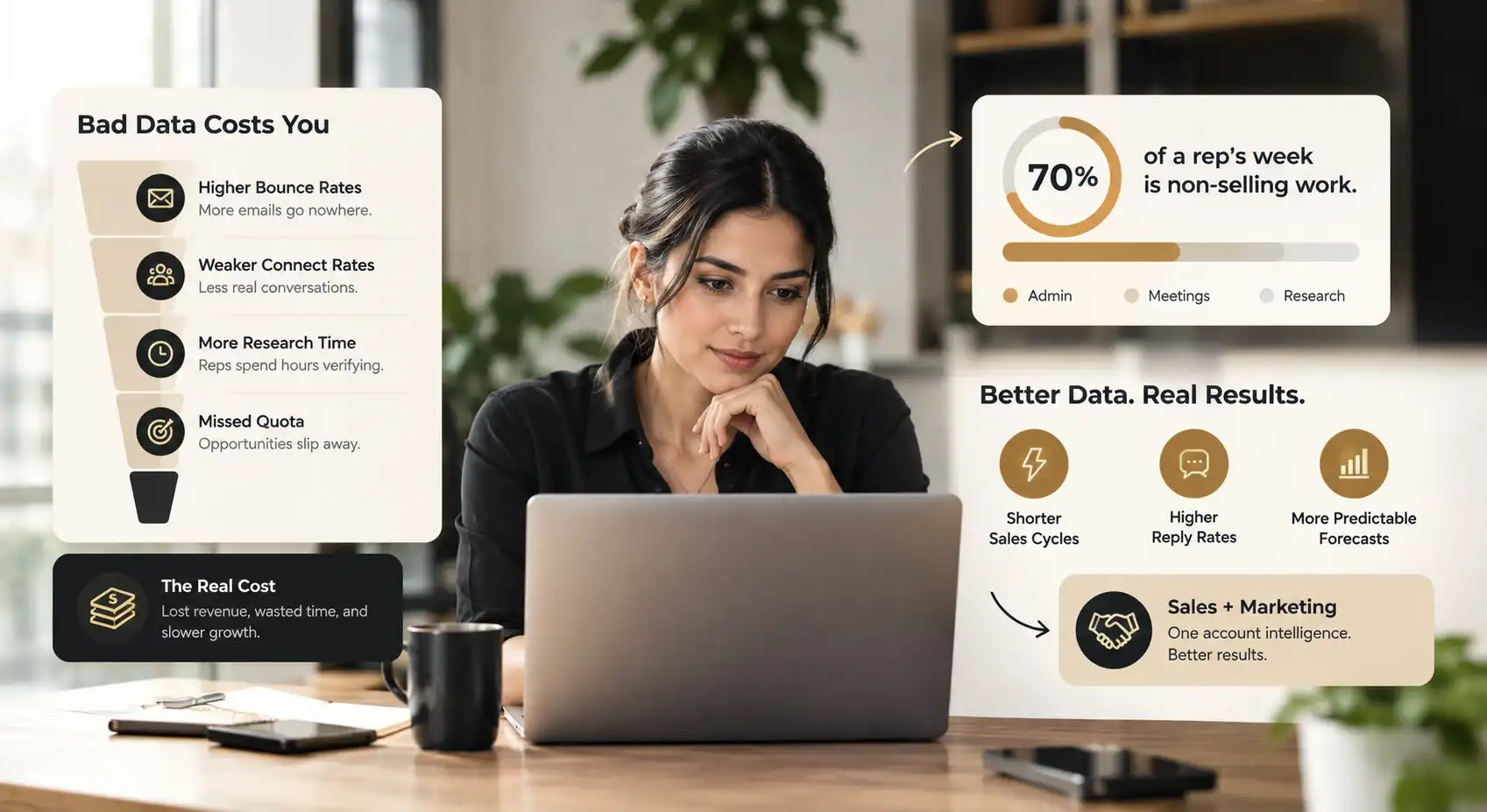
The scale of the problem is bigger than most sales leaders assume. Reports compiled by Landbase on sales rep productivity cite Salesforce’s State of Sales research showing reps spend roughly 70% of their week on non-selling tasks admin, internal meetings, and manual prospect research, a pattern that has held steady for years despite heavy investment in sales tools. Manual research is one of the biggest single contributors to that gap, and it’s also the piece that a good data partner removes almost entirely.
Good research compresses the sales cycle in three concrete ways. It cuts down the hours reps spend manually verifying who’s who, freeing that time for actual selling. It sharpens message relevance, since outreach is built on real context instead of assumptions, which shows up directly in reply rates. And it tightens forecast accuracy, because pipeline built on verified, well-qualified accounts behaves far more predictably than pipeline built on volume alone.
This is also where research bumps up against broader marketing strategy services, and it’s worth pausing on. Sales and marketing alignment sounds like a soft, culture-y goal until you realize it’s really about one thing: are both teams working off the same account intelligence? When marketing’s target list and sales’ outreach list come from two different, outdated snapshots of the market, the two teams end up quietly working against each other in the same market, on different maps.
Build It In-House, or Bring in a Partner?
Enterprise teams generally land on one of two paths: build a research function internally, or work with a specialized outside partner. Both can work, but the tradeoffs are different enough to think through deliberately, and the right answer often depends less on budget than on how quickly the team needs to move.
Building internally gets you control, and your team ends up knowing the product cold. Fair trade-off? Depends. You’re also signing up for ongoing spend tools, data licensing, training, headcount and that team is slow to scale up or down when pipeline demand shifts. Here’s the part most orgs get wrong: they badly underestimate how much manual research capacity an aggressive outbound motion actually eats once it’s running across several territories and segments at once. It’s a lot more than the org chart suggests.
Go with a partner instead, and you get immediate access to verification processes that already work, plus analysts who do nothing but this all day. There’s also a flexibility angle people underrate: ramp up volume around a product launch or a new market push, then scale it back down, no headcount added or cut either way. It’s the same reasoning behind why a company brings in an outside b2b seo company for inbound instead of building that muscle from zero internally. Some things are just cheaper to rent expertise for than to grow in-house, particularly when demand for it swings hard from one quarter to the next.
So which is right? For a lot of mid-market and enterprise teams, honestly, it’s both. A lean internal team stays focused on the handful of strategic named accounts that matter most, while an external partner handles volume research and keeps data hygiene up across everything else. Neither approach wins outright; it comes down to matching the setup to how fast your targets are actually moving.
What to Look for in a Research Partner?
Not every provider operates at the same standard, and enterprise buyers should vet a data research partner with the same rigor they’d apply to any strategic vendor. A few things worth checking before signing anything:

- Verification method: Ask specifically how contact data gets verified automated matching alone doesn’t cut it at enterprise scale. The strongest providers pair automation with human review on high-value accounts.
- Industry specialization: Look for coverage that actually matches your industry or segment. A generalist vendor working across every vertical rarely goes as deep as one that knows your space.
- CRM and tool integration: Confirm the output integrates cleanly with your CRM and sales engagement tools research that needs manual reformatting before a rep can use it defeats half the purpose.
- Turnaround time: Enterprise pipelines don’t wait. A partner needs to deliver on a timeline that matches your campaign launches, not weeks after the window’s closed.
This matters just as much for organizations selling through b2b ecommerce solutions alongside a direct sales motion, where account and buyer data needs to stay consistent across both self-service and sales-assisted paths, or the two channels end up working from contradictory pictures of the same customer.
One evaluation step that’s easy to skip is asking a prospective partner for a small sample engagement before signing anything long-term. A short pilot on a limited account listing a few hundred contacts rather than the full target universe reveals more about actual accuracy and turnaround than any sales deck will. It also surfaces integration friction early, before the relationship is locked into an annual contract. Enterprise buyers who skip this step tend to discover mismatches between promised and delivered data quality only after several months of outreach built on it, which is a far more expensive place to find out.
For many enterprise teams, this ends up being exactly the role a b2b lead generation company plays, pairing the research itself with the outreach execution that follows it, rather than handing off a clean list and leaving the rest to be figured out separately.
Connecting Data Research to the Rest of Go-to-Market:
Data research works best when it’s plugged into the rest of the stack rather than sitting off to the side. Teams running a saas marketing strategy program, for instance, get real value from research that flags technology-stack overlaps and renewal timing signals that matter a lot when you’re positioning against an incumbent tool a prospect already uses. Inbound and outbound stop working in isolation once account-level intent data is shared across both.
The same logic extends to sales-adjacent content and campaign work research on buyer intent and technographics can shape which topics and angles actually land with in-market accounts, instead of guessing at what a segment cares about. Teams that skip this step often end up running two separate go-to-market efforts under one roof: an inbound engine and an outbound engine, each working from a different definition of who the ideal customer actually is.
Getting Started Without Overhauling Everything:
You don’t need to rip out your whole stack to see value here. Start smaller than that.
Start with the CRM. Not a five-minute scroll through it actually dig in and find out where the accuracy gaps really are. Most teams never do this part, so they end up guessing at how bad things are instead of knowing the real number. That guess is usually optimistic, for what it’s worth.
Once there’s a baseline, get specific about the ideal customer profile. And “specific” doesn’t mean “mid-market SaaS companies” ; a research partner can’t do much with that. Give them industry, headcount range, tech stack, the actual triggers that signal someone’s ready to buy. Then pick one segment, or one territory, and run the pilot there first. Everyone wants to go company-wide on day one. Don’t. A small test is where integration problems show up while they’re still cheap to fix, not after the whole team’s already relying on the data.
Here’s the part people miss: if that pilot happens to overlap with anything customer-facing a landing page rebuild through a web development services company, say, aimed at improving lead capture, make sure the two workstreams are actually talking to each other. It sounds obvious written down. It happens constantly anyway. Marketing designs the new page around one version of the target segment; sales is out there prospecting against a slightly different version of it; nobody catches the gap until the conversion numbers come in soft and everyone’s stuck guessing why.
Measuring Whether It’s Actually Working?
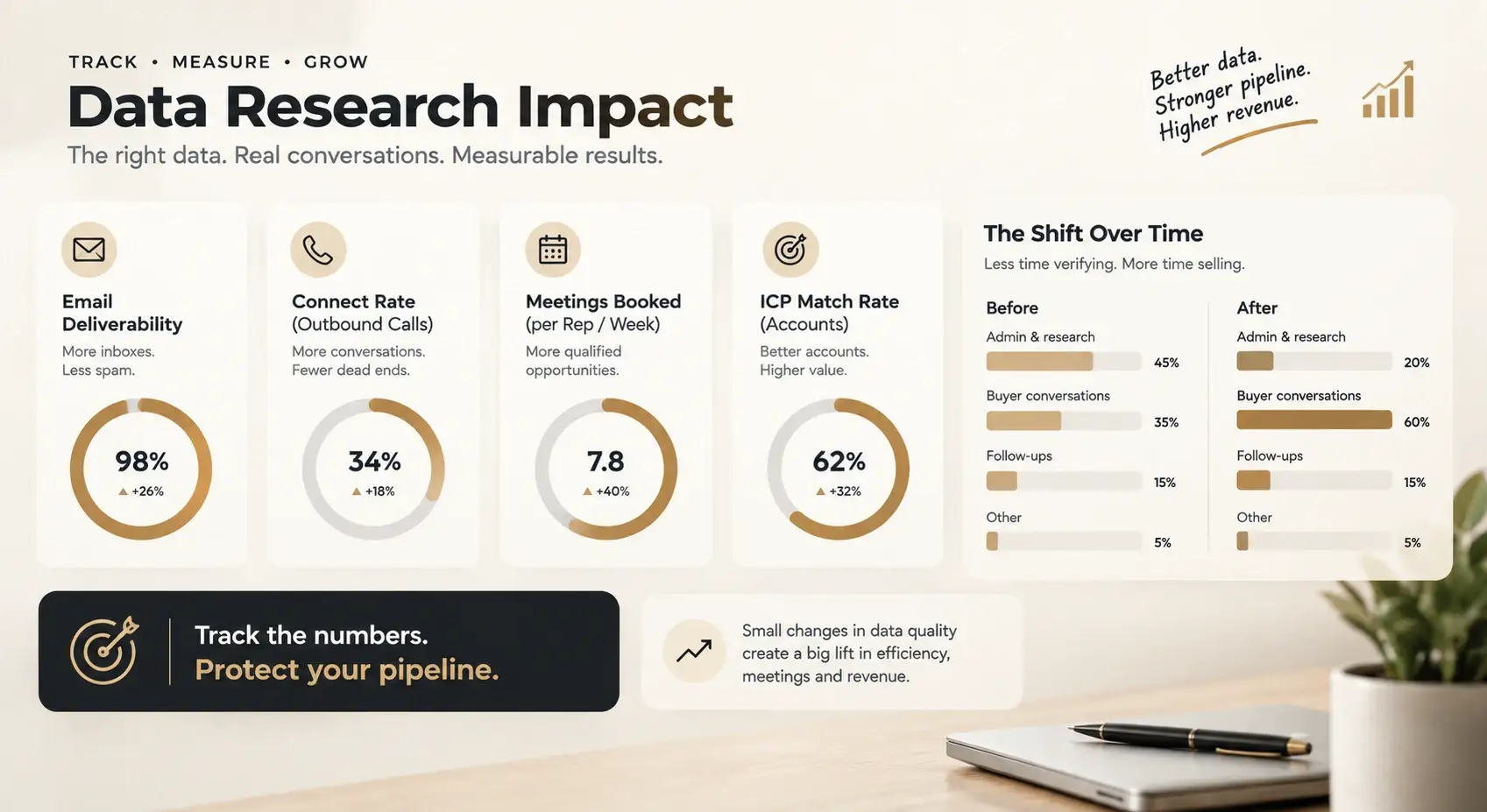
Hold data research to the same accountability bar as any other revenue investment. Track a small set of numbers before and after: email deliverability and bounce rate, connect rate on outbound calls, meetings booked per rep per week, and the one that matters most is what share of pipeline is sourced from accounts that actually matched the defined ideal customer profile.
The biggest gains usually aren’t in raw activity volume. They show up in efficiency reps spending less time verifying whether a contact still holds their role, more time in actual buyer conversations. Over a full quarter, that shift compounds into real quota movement, without adding a single headcount. It’s worth reviewing these numbers on a set cadence rather than only when pipeline feels thin, since data quality tends to erode gradually and the warning signs a rising bounce rate, a dip in connect rate are easy to miss until they’ve already cost a quarter’s worth of momentum.
Final Thoughts
Prospecting off a static, generic database just doesn’t work for US enterprise teams anymore that ship has sailed. The companies pulling ahead aren’t doing anything mysterious. They treat data research like a revenue function, full stop: verified contact intelligence, live trigger events, buying-committee visibility, all feeding into outbound information that starts from something actually true instead of a guess.
Doesn’t much matter whether that’s built in-house, handed to an outsourced partner, or split between the two. The principle’s the same either way better data doesn’t just support selling, it speeds the whole thing up. And for enterprise teams fighting for pipelines in a crowded US market, that’s not optional anymore. It’s just what competing looks like now.