
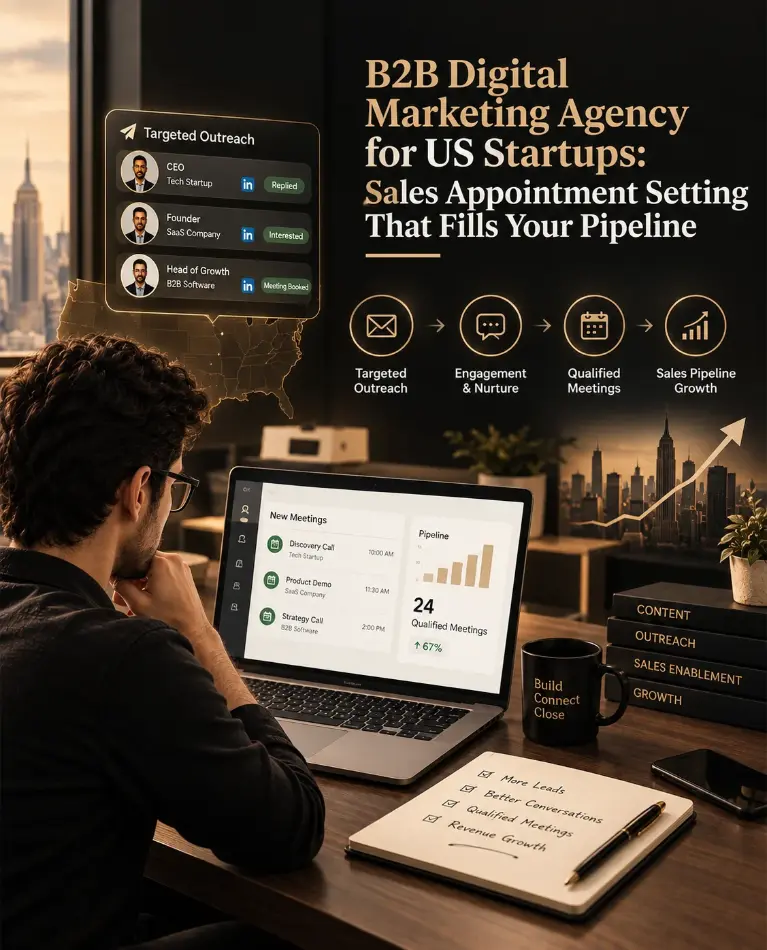
Turn Founder-Led Outreach Into a Predictable Pipeline:
Most early-stage founders don’t lose deals because their product is weak. They lose momentum because nobody is consistently getting them in front of the right buyer. That’s the gap a genuinely capable b2b digital marketing agency exists to close not by generating more noise, but by putting qualified prospects on your calendar, week after week. It matters more than it used to: recent Gartner research shows a majority of B2B buyers now prefer to work through much of the purchase process on their own, which means the meetings your team does book need to land with the right person, at the right stage, or they simply won’t convert.
We work with US startups who’ve hit the same wall: a founder-led sales motion that worked at ten customers and started falling apart at fifty. This page walks through exactly how our appointment setting service works, what it costs, how it compares to hiring in-house, and why it consistently outperforms building an SDR function from scratch on a tight runway.
The Real Reason Startup Founders Stop Prospecting:
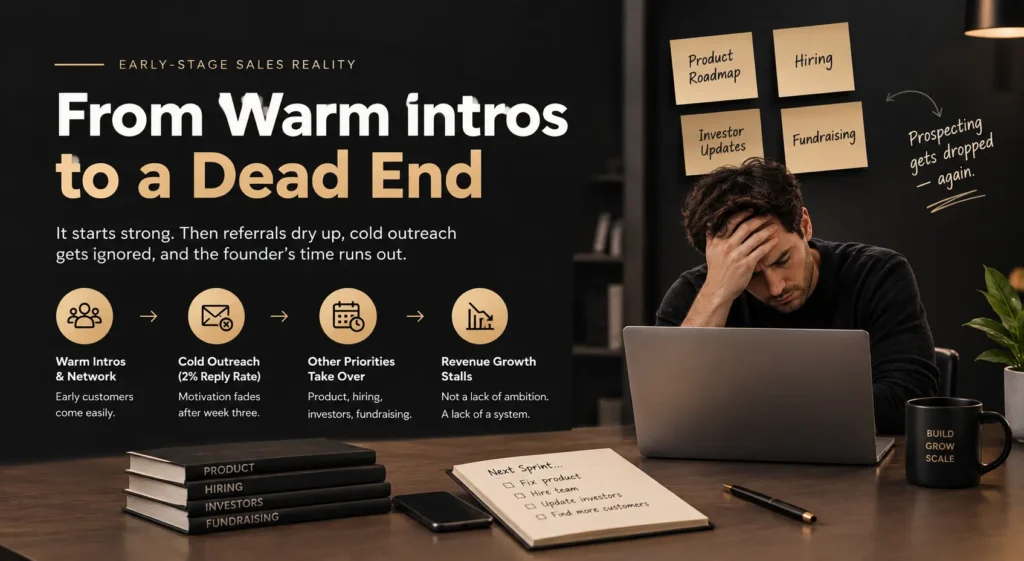
Here’s what usually happens. A founder closes the first handful of customers through their own network of warm intros, old colleagues, and a well-timed LinkedIn post. It works, right up until it doesn’t. Referrals dry up. They try cold email outreach themselves, get a 2% reply rate, and quietly give up somewhere around week three, telling themselves they’ll “get back to it after the next sprint.”
Meanwhile, the product roadmap, hiring, investor updates, and fundraising are all competing for the same sixty-hour week. Prospecting doesn’t stop because it isn’t valuable. Every founder knows it’s the single biggest lever on revenue. It stops because it’s the first thing to get dropped when everything else is on fire, and it’s rarely the thing that gets picked back up voluntarily.
This is the quiet failure mode of early-stage sales: not a lack of ambition, but a lack of a system that runs whether or not the founder has three free hours this week.
Why Booking Qualified Sales Meetings Gets Harder as You Grow?
Founders can’t be closers and prospectors at once:
Closing a deal and finding the next ten prospects require entirely different rhythms. Closing is reactive, relationship-led, and rewards patience. Prospecting is systematic, repetitive, and rewards volume and consistency. Trying to run both disciplines in the same calendar week, using the same brain, usually means both suffer deals slip because follow-up gets delayed, and the pipeline behind them dries up because nobody was filling it.
In-house SDR hiring is slow, risky, and expensive:
A US-based SDR typically costs $60,000–$80,000 in base salary before commission, tools, training, and management time are added and even a strong hire usually takes three to six months before they’re reliably booking meetings on their own. For a seed or Series A startup with twelve to eighteen months of runway, that’s a meaningful chunk of your operating budget spent on an unproven hire, with no guarantee they stay past their first year. HubSpot’s research points to the same pattern: industry-wide sales teams are under growing pressure to prove ROI faster, with far less tolerance for long ramp periods than there was even two or three years ago.
Generic outreach burns your best-fit accounts:
Mass-blasted, poorly targeted sequences don’t just fail to convert; they actively damage domain reputation, trip spam filters, and burn through accounts that were genuinely a good fit before a properly researched, well-sequenced campaign ever gets a chance to reach them. Once a prospect has been hit with a generic “quick question” email from your domain, re-engaging them months later with a better-crafted message is far harder than starting cold.
Cold outreach still works but only when it’s done properly:
There’s a persistent myth in startup circles that cold outreach is dead. It isn’t. HubSpot’s 2025 report found that cold calling remains a core part of the daily workload for a significant share of sales professionals, and that it continues to produce results when it’s structured, targeted, and paired with other channels rather than run as a standalone, undifferentiated activity.
See What Fits Your Sales Motion?
From ICP research to calendar-ready meetings, explore how our appointment setting service is built around your specific buyer, not a generic playbook.
Explore Our ServiceWhat Our B2B Digital Marketing Agency Actually Delivers?
We run sales appointment setting services as a specialised function, not a side effect of broader marketing spend. That means dedicated researchers building and maintaining your ideal customer profile, copywriters who understand B2B buying psychology and objection patterns, and outreach specialists who manage sequencing across email, LinkedIn, and phone all reporting against one metric that actually matters: qualified meetings booked.
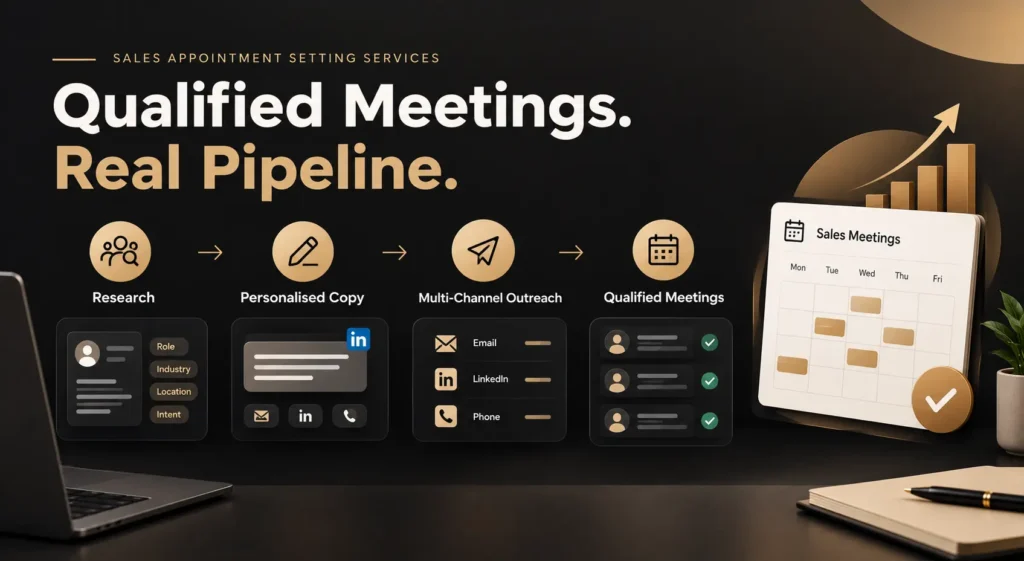
This isn’t lead generation in the loose sense of “more contacts added to a spreadsheet.” It’s a pipeline function built to hand your sales team, or you as founder, a calendar of conversations with people who match your buyer criteria and have shown genuine intent to solve the problem your product solves.
Core Appointment Setting Features:
- Ideal customer profile (ICP) development and verified account list building
- Multi-channel outreach across email, LinkedIn, and cold calling
- Custom messaging sequences written specifically for your value proposition, not a generic template
- Lead qualification against your defined criteria (BANT or a custom framework built around your sales motion)
- Direct calendar booking into your sales team’s diary, with no back-and-forth scheduling on your end
- Weekly reporting on outreach volume, reply rates, and meetings booked
- CRM integration so every touchpoint is logged and visible to your team in real time
In-House SDR vs Outsourced Appointment Setting: A Direct Comparison:
Founders usually ask the same question at some point: build the function in-house, or bring in a specialist agency? There’s no universally right answer, but the trade-offs are consistent across most early-stage startups we work with.
| Factor | In-House SDR Hire | Outsourced Appointment Setting |
| Upfront cost | $60,000–$80,000+ base salary, plus tools and benefits | Monthly retainer or per-meeting fee, typically a fraction of full-time cost |
| Time to first meeting | 3–6 months ramp-up before consistent output | 2–4 weeks to first qualified meetings |
| Hiring risk | Full recruitment cycle, with no guarantee of fit | No recruitment risk the team is already trained and operating |
| Scalability | Requires a new hire and new ramp time to scale up | Campaign volume can flex up or down within weeks |
| Messaging refinement | Learns from a single account’s worth of data | Refined continuously across multiple B2B accounts and industries |
| Management overhead | Requires direct coaching, QA, and performance management | Managed by the agency; you review results, not day-to-day activity |
Neither model is inherently superior to a startup with a very long runway and a highly technical, niche buyer sometimes does need an in-house specialist who lives inside the product. But for most early-stage teams trying to build a predictable pipeline without burning six months of runway on a hiring bet, outsourcing wins on speed, cost, and risk.
The Business Impact of Outsourcing Your Pipeline:
Startups that move appointment setting outside the founder’s own task list tend to see two things happen almost immediately: sales cycles shorten because founders reclaim time for closing rather than splitting attention with prospecting, and pipeline becomes predictable instead of feast-or-famine.
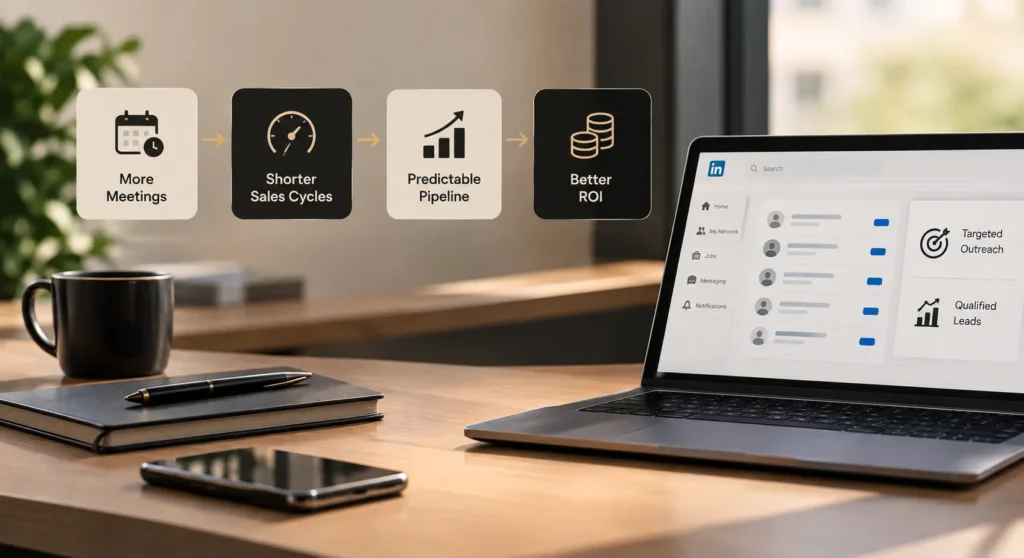
There’s a cost-efficiency argument too. Outsourcing typically runs at a fraction of a fully-loaded SDR hire, without the ramp-up period, the recruiting cost, or the risk of a bad fit surfacing six months in. You’re paying for booked meetings and pipeline momentum, not for headcount sitting mid-training on your payroll.
And because the work is handled by specialists who run this process across multiple B2B accounts simultaneously, the messaging, targeting, and objection-handling tend to improve faster than a single in-house hire working in relative isolation could realistically manage alone in their first year.
Social channels compound this further. Sales teams that build a genuine presence on LinkedIn alongside direct outreach consistently see stronger response rates, and Highspot’s research confirms that a large share of sales reps now treat social engagement as a core part of their weekly workflow rather than an optional extra which is exactly why we pair our outbound campaigns with a dedicated LinkedIn lead generation agency approach rather than relying on a single channel.
Inside Our Process: How We Book Meetings on Your Calendar?
Ideal customer profiling and list building:
We start by defining exactly who your best customers look like, industry, company size, tech stack, buying triggers, and the internal role most likely to champion your product then build a verified, targeted contact list against that profile. No generic industry-wide blasts, and no buying lists off the shelf that haven’t been checked against your actual ICP.
Multi-channel outreach sequencing:
Each prospect moves through a coordinated sequence across email, LinkedIn, and phone, with messaging tailored to where they sit in the buying journey rather than a single templated pitch repeated indefinitely. Sequences are adjusted based on engagement signals; an opened email gets a different follow-up than one that was ignored entirely.
Qualification and calendar handoff:
Every reply is manually reviewed against your qualification criteria before a meeting is booked. You don’t get a flood of unqualified calls clogging your calendar, you get a shorter, higher-quality list of conversations that are actually worth your time.
The Tools and Channels Behind the Work:
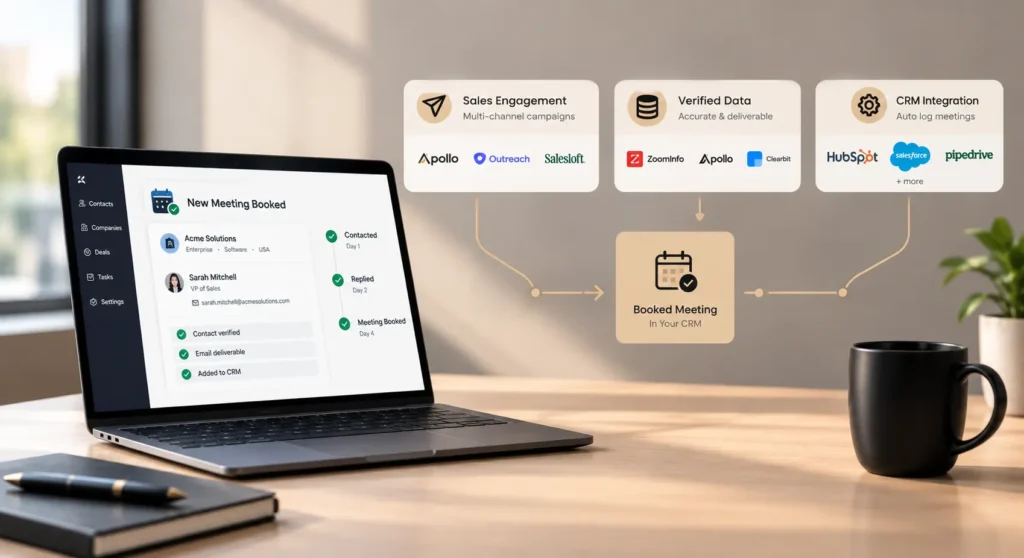
We run campaigns through enterprise-grade sales engagement platforms, verified data providers for contact accuracy and email deliverability, and CRM integrations HubSpot, Salesforce, Pipedrive, and others so every meeting booked is already logged against the right account in your system before your sales team even sits down for the call.
What Appointment Setting Costs and What Drives the Price?
Pricing generally falls into three models: a flat monthly retainer, a per-meeting-booked fee, or a hybrid of both. For most early-stage startups, a hybrid model works best; it keeps costs predictable month to month while tying part of the spend directly to results, so you’re never paying purely for activity with no output attached to it.
The number that actually moves the price isn’t the headline fee, it’s your ICP’s addressable market size and deal complexity. A tightly defined enterprise buyer persona costs more to research and reach per contact than a broad SMB target, but it typically converts at a materially higher rate per meeting, which usually balances out the higher per-lead cost over a full quarter.
Why Startups Choose Us Over Other B2B Lead Generation Agencies?
Most agencies that call themselves a b2b lead generation agency measure success in leads delivered. We measure it in meetings that actually happen and convert into pipeline because a spreadsheet of contacts was never the deliverable a startup actually needed in the first place.
We also work in small, dedicated pods rather than spreading account managers across dozens of clients at once, which means messaging stays sharp and campaigns get adjusted quickly when something isn’t converting, instead of waiting for a monthly review call to catch a problem that’s been quietly costing you meetings for weeks.