Video creation is entering a new phase. For years, editing software has required editors to manually manage every step of production, selecting clips, arranging timelines, adding visuals, improving audio, and making countless small adjustments before a video is ready.
Artificial intelligence changed the first stage of video creation by helping users generate scripts, visuals, and complete video drafts. However, editors still needed more flexibility when it came to editing and refining content.
With the launch of invideo Editor, invideo is introducing a new approach to video editing. Built around agentic workflows, where AI agents can understand instructions and assist editors throughout the editing process.
Instead of simply automating individual tasks, agentic video editing focuses on creating a collaborative workflow between the editor and AI.
From AI Generation to Agentic Video Editing
Traditional AI video tools are often designed around generation. Users provide a prompt, and the system creates a video based on that input.
While this approach helps with speed, professional video creation requires continuous refinement.
editors often need to make changes such as:
- Removing unnecessary sections
- Improving pacing
- Adjusting scenes
- Adding supporting visuals
- Changing the structure of a video
- Preparing different versions for different audiences
This is where agentic AI workflows introduce a different approach.
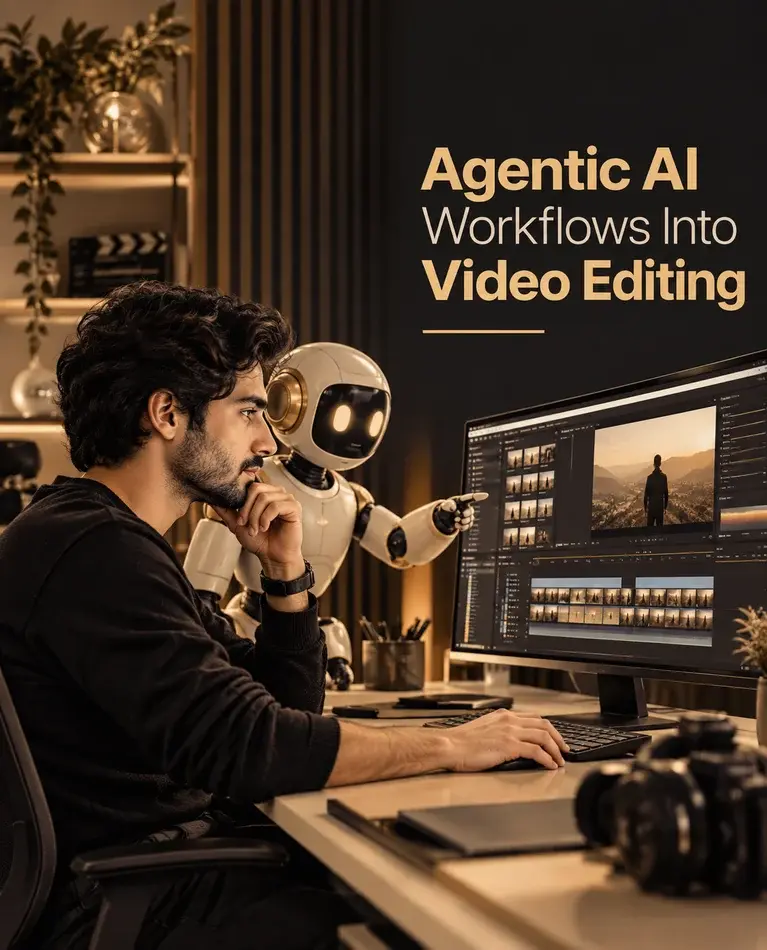
Instead of performing only one automated action, AI agents can receive instructions, understand the objective, and assist with multiple parts of the editing process.
Invideo Editor brings this concept into a video editing environment, allowing editors to work with AI assistance while maintaining control over their final content.
What Makes an Agentic Video Editing Workflow Different?
The difference between traditional automation and agentic workflows is the ability to work through instructions.
In a traditional editing process, an editor may need to manually complete every step:
- Find a specific section
- Cut the clip
- Adjust timing
- Add elements
- Review the output
With an agentic workflow, editors can communicate what they want to achieve through instructions.
For example, an editor working on a product video could provide instructions such as:
“Remove repetitive sections, improve the pacing, add supporting visuals, and make the video suitable for social media.”
The AI agent can then assist with the editing process based on the given direction.
This changes the role of AI from a simple feature into a collaborative editing assistant.
How AI Agents Assist Inside invideo Editor
Invideo Editor has AI agents that can support editors during the editing workflow.
Rather than replacing the editor’s decisions, AI agents help handle time-consuming editing tasks.
Editors can use instructions to guide AI agents toward specific outcomes, such as:
- Refining video structure
- Improving flow
- Making content adjustments
- Supporting visual changes
- Color grading
- Match Cuts
- Masking
- Dubbing
- Captions
This approach is especially useful for businesses and editors who produce large amounts of video content and need faster ways to manage editing.
Making Enterprise Video Creation More Efficient
Businesses today create videos for many different purposes:
- Marketing campaigns
- Product demonstrations
- Customer education
- Internal training
- Social media communication
The challenge is maintaining a consistent content pipeline.
An agentic video editing workflow can help teams reduce the time spent on repetitive production tasks.
For example, a company producing weekly product videos can use AI assistance to speed up parts of the editing process while keeping creative teams involved in important decisions.
The result is a workflow where humans provide direction and AI helps execute parts of the production process.
Instructions Become the New Way of Editing
One of the biggest changes introduced by agentic AI is how users interact with software.
Traditional editing tools require users to learn where every feature is located and manually perform each action.
Agentic systems introduce a more natural interaction model.
Instead of asking:
“Where is the tool for this adjustment?”
Editors can communicate:
“Make this video shorter, improve the transitions, and highlight the main points.”
This instruction-based workflow makes complex editing processes more accessible, especially for users who understand video goals but may not have advanced technical editing skills.
Combining Human Creativity With AI Agents
Although AI agents can assist with editing tasks, creative decisions remain central to video production.
A successful video still depends on:
- The message being communicated
- The audience being targeted
- The story structure
- The brand style
AI agents help editors move faster, but humans continue to define the creative direction.
This combination creates a new type of workflow:
Human creativity + AI assistance + agentic execution
editors decide what they want to achieve, provide instructions, and use AI support to accelerate the production process.
The Future of Video Editing Is Agentic
The introduction of agentic workflows represents a broader change in how people interact with software.
Instead of using applications only through menus and controls, users are beginning to work with intelligent systems that understand goals and assist with execution.
In video editing, this means future workflows may involve:
- AI agents managing repetitive editing tasks
- Instruction-based content refinement
- Faster video production cycles
- More personalized creative workflows
Invideo Editor represents this shift toward a more collaborative relationship between editors and AI.
Conclusion
The launch of invideo Editor highlights a new direction in video editing, moving from simple automation toward agentic workflows powered by AI agents.
By allowing editors to provide instructions and receive AI assistance throughout the editing process, invideo Editor helps bridge the gap between AI-generated content and professional video refinement.
As video continues becoming a critical communication format for businesses and editors, agentic AI workflows will play an increasingly important role in making production faster, more flexible, and easier to manage.