
Growth leads to a hiring challenge that businesses typically do not understand in time.
To begin with, hiring appears easy enough. The founder puts up a job description, people share it via LinkedIn, some candidates apply, interviews take place, and the offer is made. But as soon as the business starts building teams, entering new markets, and hiring specialized staff, the process becomes more difficult.
Positions stay open for weeks. Recruitment managers spend hours analyzing resumes. Good candidates vanish in the middle of the interviews. And recruiters think about hiring the current vacancy rather than planning the next recruitment cycle.
This is where full cycle recruiting becomes strategic.
In contrast to the independent nature of sourcing, screening, interviewing, offer management and onboarding, full cycle recruitment ties them all together in one process.
This is important for expanding US companies since SHRM’s 2025 benchmarking studies have found that the median time to fill was about one and a half months for executive and non-executive jobs. However, the US Bureau of Labor Statistics indicates that more and more companies are increasingly utilizing external organizations for recruiting and placement activities while employment of HR specialists is expected to increase by 6% until 2035.
In other words, it is clear that recruitment is now getting too significant for the company to be a series of unrelated administration activities.
A good recruitment process will allow you to build hiring as a scalable business competency for the organization.
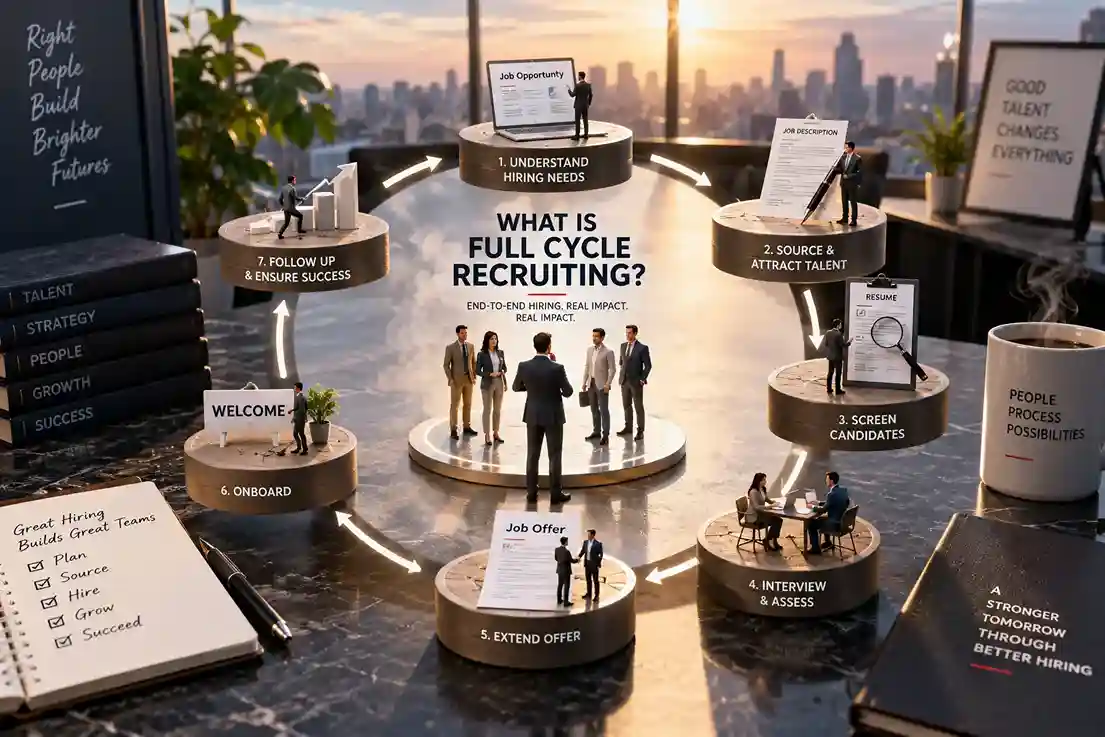
What Is Full Cycle Recruiting ?
An end-to-end recruitment process involves a scenario whereby the recruiter, recruitment team, or hiring manager handles the entire hiring process from defining the position to sourcing the candidates, evaluating them, and onboarding the hired employee after hiring.
In simpler words, full-cycle recruiting is when the recruiter handles the complete recruiting process and not just one stage of it.
A typical full cycle recruitment process includes:
| Stage | Primary activity | Business outcome |
| 1 | Workforce and role planning | Clear hiring requirement |
| 2 | Recruitment strategy | Defined talent market and sourcing plan |
| 3 | Candidate sourcing | Qualified candidate pipeline |
| 4 | Screening | Shortlist aligned with requirements |
| 5 | Interview management | Efficient decision-making |
| 6 | Offer management | Higher acceptance probability |
| 7 | Onboarding and follow-up | Better transition and quality-of-hire insight |
The words may differ. However, various expressions may be applied to refer to the same overall approach to recruiting.
What matters here is not the term.
What matters here is the question of responsibility.
In the fragmented recruiting approach, one person may identify the candidates, another may screen them, the hiring manager may conduct the interviews and HR may make the offer.
In the full-cycle approach, everything is done in a single channel.
This approach gives an obvious benefit: when anything is going wrong, it will be easy to determine the reason.
Need Full-Cycle Recruiting Support for Your Growing Team?
From sourcing and screening to interviews and onboarding, we manage the whole hiring process so your team can focus on running the business. See how our recruiting services help US companies hire people who fit and stay.
The seven stages of full cycle recruiting :
A well developed full cycle recruiter usually possesses seven distinct phases:
- Role definition.
Define responsibilities, objectives, skills required, level of seniority, salary expectations and conditions of success.
- Develop recruiting strategy.
Understand who would make good candidates for this role and how this employer could best present itself.
- Source candidates.
This involves advertising the job using different sources of recruitment.
- Screen & Qualify.
Screen technical skills, relevant experience, communication, motivation, salary expectations and suitability for the role.
- Coordinate the interviews.
Get candidates ready for interviews, interviewers on board and coordinate the process.
- Manage the offer.
Negotiate between the employer and the candidate and uncover objections to avoid rejections.
- Post-acceptance support.
Be available after the acceptance of the offer to discover problems and apply lessons learned to the recruiting process.
The latter is often missed.
It shouldn’t be.
Recruiting process can’t be optimised without knowing what’s going on after the offer is accepted.
Why Growing US Companies Struggle With Hiring ?
“Finding Candidates” Is Not Usually the Most Critical Recruitment Problem for an Expanding Firm.
It is about achieving quality and efficiency through full-cycle recruitment when hiring volume, complexity, and expectations keep rising.
An organization that hires five people per year is able to have a flawed recruitment system. An organization that needs to hire 50 people annually in various departments can’t.
Three main issues arise.
Hiring volume increases faster than internal capacity :
An organisation’s recruitment effort does not necessarily go up simply due to increased hiring.
The other cause for the same could be specialisation of roles.
Recruiting a sales executive with general capabilities would be different from recruiting a performance marketing manager, who has experience in paid search, enterprise account executive with an industry network or a marketing operations expert, familiar with technology stacks.
All these are specialisations that require market understanding, specific sourcing and better qualifications.
That is why just increasing job postings will not do.
The company needs a talent acquisition system rather than increasing the job postings.
Specialist roles require specialist sourcing :
The best candidates are not always going for all the available positions.
Most are already employed.
This implies that a recruitment approach relying solely on inbound applicants may be systematically excluding a portion of the market.
A good full-cycle recruiting company would combine both inbound and outbound sourcing.
The difference can be substantial.
Consider two approaches:
| Applicant-led recruitment | Full cycle recruitment |
| Post vacancy | Define target candidate profile |
| Wait for applications | Build proactive talent pipeline |
| Review CVs | Source and qualify candidates |
| Schedule interviews | Manage the complete candidate journey |
| Send offer | Manage offer expectations |
| Close requisition | Analyse quality and improve process |
The second approach treats recruitment as a market-facing business function.
Slow hiring creates business costs :
The cost of an open position goes beyond recruitment costs.
An unfilled marketing position delays campaigns.
An unfilled sales position means less pipeline coverage.
An unfilled operations management position means management bottlenecks.
An unfilled technical position means delayed product delivery.
Why is the time-to-fill measure never isolated?
It is because a good measurement process considers:
Recruitment costs + Management time + Lost productivity + Opportunity cost + Drop-off risks.
This is the true cost of a vacancy.
The Full Cycle Recruiting Process :
Recruitment process that is highly effective begins before a job vacancy is announced. It integrates role planning, sourcing, screening, interviewing, offering and staffing agencies Chicago into one process, after which comes post-hiring evaluation.
1. Workforce Planning and Role Definition
First of all, the requirements of the company must be defined properly rather than just using a vague job description. In other words, it is important to understand what the objective of the position is, what skills are required, what results should be achieved. For instance, the objectives of a marketing position can include boosting of organic traffic in six months.
2. Recruitment Strategy and Job Marketing
After deciding the role, find out how and from where the right people can be approached. The things to be kept in mind include experience, location, pay scale, skill set, knowledge in the field, work from home option, etc. An effective job description must have all information about the purpose, ownership, and success criteria of the role.
3. Candidate Sourcing
The recruitment process should involve various sources and not just rely on job boards alone. Inbound applicants may be supplemented by LinkedIn, networking opportunities, referrals, as well as candidates within databases and other relevant communities. The aim here is not only to generate a list of candidates but to look for individuals who will fit the position.
4. Screening and Qualification
Screening is more than just checking keywords on the resume. 360 recruitment cycle methods enable recruiters to gauge the level of experience of a candidate, their skills, results, and commitment to the needs of the business. For instance, rather than just looking for a demand generation manager with at least five years of experience, one can measure their impact on the pipeline and results achieved.
5. Interview Management
This can be achieved through a structured interview process. Define clearly the various steps involved in the interview process, their responsibilities, evaluation criteria and deadlines for feedback. The recruiter needs to brief the candidates and the hiring managers on what is expected.
U.S. Office of Personnel Management (OPM) provides guidance on structured interviews, explaining how consistent questions, defined evaluation criteria and standardised scoring can improve the reliability, fairness and consistency of candidate assessments.
6. Offer Management
The offer phase is usually the one when issues of compensation, flexibility, career development, management, workload, and organizational stability come to light. The skilled recruiter recognizes these issues early on and sets proper expectations before offering the final package. As it is with a full-cycle recruiting process where there is no disruption of continuity, the recruiter knows all about the candidate’s needs.
7. Onboarding and Post-Hire Follow-Up
Recruitment efforts need to go beyond the offer acceptance stage. The first 30 to 90 days are critical in determining whether there has been proper role definition, communication of expectations, and suitability of the candidate. This process allows for an important feedback process to take place.
The 360 Recruitment Cycle: Connecting Every Hiring Stage
The term helps in formulating a helpful model for viewing the process of recruitment as a holistic process.
Think of recruitment as a circle instead of a linear process:
Job Description → Sourcing → Screening → Interviews → Offer → Onboarding → Performance Feedback → Job Description.
Performance feedback helps in improving the job description.
Why disconnected recruitment creates leakage ?
Recruitment loss happens when candidates or information is lost from one stage to another.
For instance:
A recruiter sources a very qualified candidate.
The candidate waits for five days to be interviewed.
The hiring manager asks irrelevant questions with regards to the agreed scorecard.
It takes four more days to provide feedback.
The candidate goes on to accept the other offer.
The company realises that “there aren’t enough qualified candidates.”
The real issue, however, was process velocity.
The 360 recruiting cycle highlights those differences.
The recruiter can measure where candidates leave the funnel and why.
| Funnel stage | Metric | What it reveals |
| Sourcing | Qualified candidates per week | Talent-market effectiveness |
| Screening | Screen-to-interview rate | Candidate quality |
| Interviews | Interview-to-offer rate | Assessment effectiveness |
| Offer | Offer acceptance rate | Employer/offer competitiveness |
| Hiring | 90-day retention | Quality of hire |
| Post-hire | Performance against objectives | Recruitment accuracy |
This turns recruitment data into business intelligence.
What Does a Full Cycle Recruiter Actually Do ?
The recruiter takes responsibility for handling the entire recruitment cycle, from the initial planning of the workforce and sourcing of candidates through screening, interviews, and the process of extending and accepting offers.
Recruiters do more than fill vacant roles; they are strategists who question irrelevant needs, find alternative candidates, and make sound recruitment decisions. Even as technology facilitates faster recruitment cycles, human judgment and candidate relations will continue to be important.
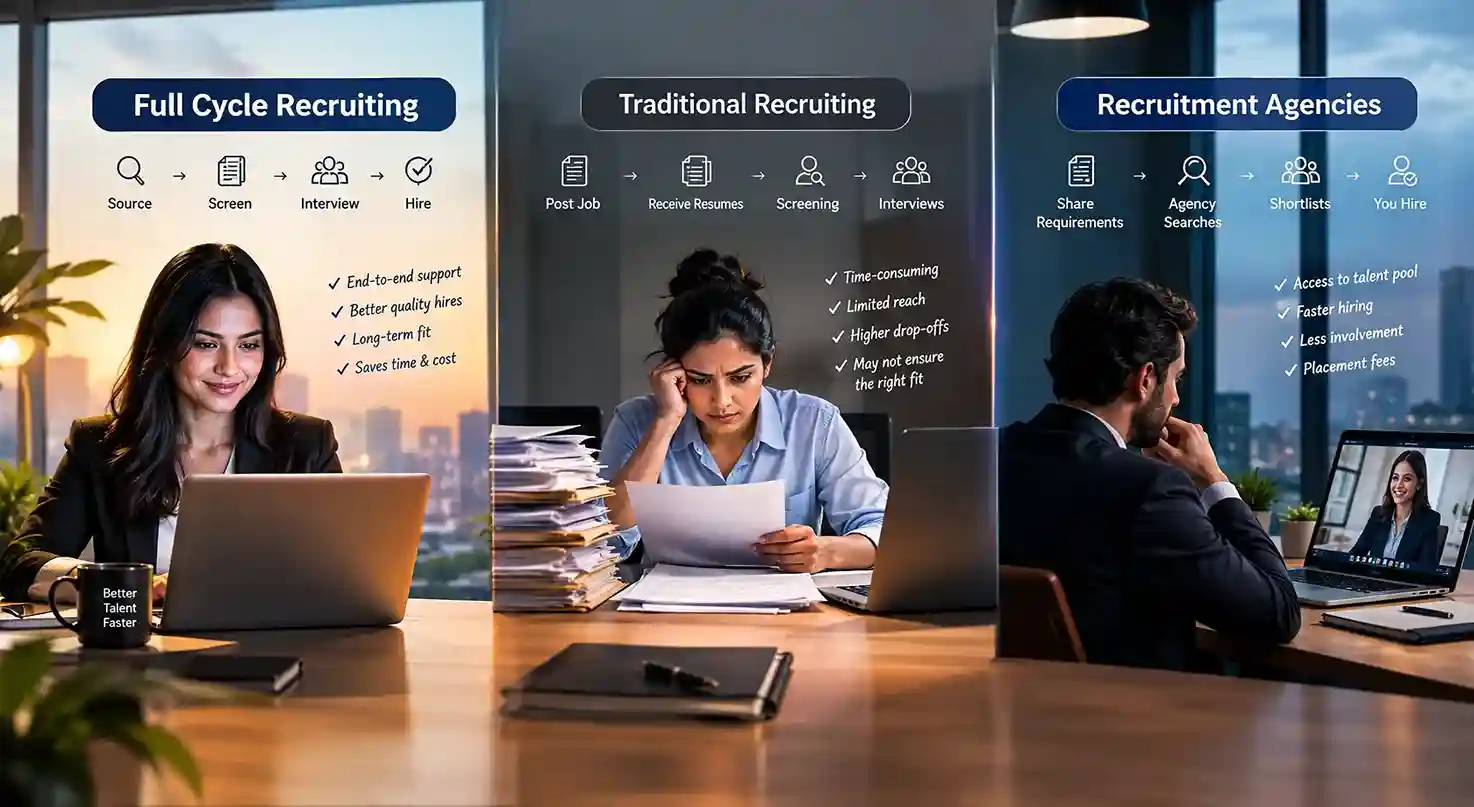
Full Cycle Recruiting vs Traditional Recruiting vs Recruitment Agencies :
The terms can overlap, but the operating models are different.
| Model | Primary focus | Best suited for |
| Traditional internal recruiting | Managing vacancies within the company | Established organisations with internal TA teams |
| Full cycle recruiting | End-to-end ownership of each recruitment process | Growing companies seeking accountability |
| Contingency recruitment agency | Candidate sourcing and placement | Specific or urgent vacancies |
| Executive search | Senior and highly specialised positions | Leadership and niche talent |
| Recruitment outsourcing | External management of recruitment function | Companies without sufficient internal TA capacity |
A full cycle recruiting can combine elements of several models.
What sets it apart is that the entire recruitment cycle is taken care of instead of just one process.
It may be possible that in a developing organization, all recruiting processes for various positions are taken care of by one partner without losing out on process consistency and communication.
The Business Case for Full Cycle Recruiting :
The most compelling case for end-to-end recruitment has nothing to do with “more candidates”.
It is a more controlled process.
Speed
An owner of the entire process will be able to see any delays immediately.
If the source of candidates is effective but interviews slow, it will become obvious.
If the interviews are quick but offers are turned down, the situation will become clear.
If the offers are accepted but early drop-off rate is high, an organization will be able to examine the fit between candidate and role.
This approach is better than just measuring the number of CVs received.
The median time-to-fill in SHRM 2025 recruitment benchmarking was about a month and a half.
Quality of hire
The real test of recruitment is what happens after the employee joins.
The full cycle recruiter must concentrate on making sure that an excellent hire leads to business results.
That means recruitment teams should eventually connect hiring data with:
- retention
- performance
- productivity
- manager satisfaction
- promotion
- revenue contribution where measurable
LinkedIn’s research found that 89% of surveyed talent acquisition professionals believe measuring quality of hire will become increasingly important, yet only 25% reported high confidence in their organisation’s ability to measure it effectively.
That gap is an opportunity for companies to improve.
Candidate experience
Candidate experience affects employer reputation and offer acceptance.
Candidates notice:
- slow responses
- unclear expectations
- repetitive interviews
- inconsistent communication
- poor preparation
- unexplained delays
Since a full-cycle recruiter is responsible for the process throughout, there is a motivation for maintaining continuity.
Hiring manager productivity
Among the most ignored advantages is freeing up management time.
Let us imagine a senior marketing director who spends three hours each week screening unqualified resumes, organizing interviews and follow-up.
This is roughly 150 hours annually.
From the perspective of a senior executive, this time is much more valuable than just being a mere administrative hassle.
The right recruitment partner would eliminate the unimportant activities while keeping the important decision-making for the hiring manager.
Scalability
The worth of outsourcing/recruitment of a full cycle recruitment model is enhanced with fluctuating hiring practices.
A company might need:
- two hires this month
- eight next quarter
- three specialist hires afterwards
Building a permanent internal recruitment team for every possible hiring scenario may not be efficient.
A flexible recruitment partner can provide capacity when the business needs it.
A Practical Full Cycle Recruiting Framework for Growing Companies :
Developing organizations require an effective recruitment strategy which can be consistent, measurable and scalable. One such strategy is RACE: Requirements, Attract, Convert and Evaluate. The RACE model will assist organizations in determining the appropriate recruiting requirements, reaching out to the right individuals, managing the recruiting process for them and finally using data for making future recruiting decisions.
R — Requirements
Prior to establishing a position opening, organizations must clearly specify their objectives, goals and expectations from the position, necessary and developable competencies, salary range, location, accountability, and evaluation criteria. With these parameters in mind, sourcing services may be tailored accordingly, and a common vision will be developed between recruiters and hiring managers regarding the organizational needs.
A — Attract
Now that we understand the requirements for the position, the next phase is to figure out the methods of connecting with the right candidates. These could range from using LinkedIn or any special communities, referrals, networking, recruitment databases, or direct sourcing, depending on the nature of the job position. An effective recruiting process centers on the quality of the candidates.
C — Convert
Conversion of the candidate is dependent upon the efficiency with which the recruiting process transforms a potential applicant from the first contact through the process of acceptance. The recruiters must track the process from the stage of initial contact and response right through the stages of screening, interviewing, offering and accepting to see where the candidates drop out.
E — Evaluate
Every time the hiring process is completed, organizations must examine whether or not the candidate fulfilled the original criteria, worked as planned, stayed in the company, and the hiring process was efficient. Such lessons can then be applied to future recruitment efforts. In such a way, full cycle recruiting will turn into a learning mechanism that gets better after each cycle.
How AI Is Changing Full Cycle Recruitment ?
AI is revolutionising recruiting by cutting down mundane activities and letting recruiters concentrate on strategy and relationships with candidates. LinkedIn’s Future of Recruiting 2025 report noted that 37% of talent acquisition teams surveyed are using or testing generative AI for recruitment purposes, such as researching candidates, CV summaries, recruitment, scheduling interviews, assessing skills, and reporting.
AI must not substitute human judgment when it comes to hiring decisions. Hiring is associated with a lot of private information and critical decisions that require proper accuracy, transparency, and compliance. The most efficient way to go is to simply automate routine, use AI for analysis, and hold humans responsible for decisions.

How to Choose a Full-Cycle Recruiting Firm ?
Every recruiting company that claims to offer “end-to-end recruitment” does not necessarily offer end-to-end control.
Inquire about the service process before selecting a recruiting company.
Question 1: Who owns the recruitment process?
You need a clear response.
When five separate people own five separate stages, the firm may just be outsourcing the process of recruiting, rather than getting a 360 recruitment cycle.
Question 2: How do you measure quality?
Do not accept “number of CVs sent” as the primary answer.
Ask about:
- qualified candidate rate
- interview conversion
- offer acceptance
- time-to-fill
- retention
- hiring manager satisfaction
- quality of hire
Question 3: How do you source passive candidates?
If the answer is simply “we post jobs on LinkedIn”, ask what differentiates the firm’s sourcing strategy.
Question 4: How do you understand our business?
A strong recruiter should understand:
- business model
- customers
- competitors
- company culture
- growth strategy
- role expectations
- employer proposition
Question 5: What happens when candidates reject offers?
An advanced recruiting firm will review the reasons for the rejection and not just replace the candidate right away.
Question 6: What happens after the hire?
Follow-up after hiring can serve as an important measure of whether the company values quality or sheer numbers.
Question 7: How do you use AI?
Determine which tasks are being automated, what types of data are being analyzed, how human beings evaluate the output, and how candidate data is secured.
Google recommends developing unique, people-first content for recruitment web sites. Administrative support may assist in keeping processes running efficiently while producing relevant content and solid SEO.
Mini Case Study: Scaling a Marketing Team Without Scaling HR Overhead
An expanding American firm in the SaaS sector requires six marketing specialists, although it employs a fragmented hiring process that brings forth unrelated applications, lengthy interview sessions, and poor communication between candidates. In addition, the management of the firm is not able to clearly understand the recruitment channels that are working well.
Through structured recruiting, this firm develops a structured hiring process that involves targeted sourcing, assessment of candidates, interviewing and offering a job. The firm evaluates the performance and retention of candidates after hiring in order to build a recruitment system.
Full Cycle Recruiting for Marketing Agencies and Growth Companies :
Marketing agencies have an interesting situation where they market their expertise but constantly have to hire the very experts who are in high demand. As the marketing agencies grow in size, they will be required to hire SEO experts, paid media experts, content strategists, account managers, creative directors, social media managers, marketing analysts, marketing operations experts, business development experts, and client success experts. 360 recruiting cycle processes can help address the diverse requirements, as each of these positions calls for unique combinations of skills.
For instance, although a well-trained SEO strategist might not necessarily be competent when working with clients, a well-experienced paid media strategist will have good technical knowledge, though without much experience presenting enterprise clients. Likewise, a good content writer might lack business understanding needed to practice content marketing. For these reasons, there should be a recruiting process where both technical competence and business context should be taken into consideration.
This is because a recruiting agency that operates in a full cycle recruiting manner would provide the best assistance by having scorecards per each job, which will take into account technical competence, commercial awareness, communication skills, client and stakeholder management skills, problem solving skills, and team work skills.
What Should You Measure ?
A well-developed recruitment process will be assessed using time to fill, quality candidates, conversion rates, acceptance rate, sourcing efficiency, 90 days retention, hiring manager satisfaction, and quality of hire. The measurements are used to determine which part of the recruitment process is working well and which requires improvement.
The objective is not to have endless amounts of information but rather to find out the metrics which will help in making good hires. A full-cycle recruiting firm will help in measuring those metrics for hiring purposes. For instance, a channel which produces 200 applicants but has one good applicant will be relatively less useful compared to another channel which produces 25 applicants but five good applicants.
This guide from Indeed provides an overview of important recruitment metrics that organisations can use to evaluate and improve their hiring process. It covers measures such as time to hire, cost per hire, quality of hire, applicant-to-interview conversion, offer acceptance rate, employee retention and hiring manager satisfaction.
What Makes Full Cycle Recruiting Different ?
There’s no easier way to explain the model than to contrast mindsets.
Conventional recruitment tends to ask:
“How fast can we fill that position?”
Full cycle recruitment would rather ask:
“By what means can we ensure that we continually find, attract and retain those who will thrive in this position?”
That is a far broader question.
It links recruiting to workforce planning, employer brand, candidate experience, business performance and retention.
And, it redefines what recruiters need to be.
Recruiters aren’t just resume screeners anymore.
They’re now:
talent researcher + market adviser + candidate manager + hiring project manager + recruitment analyst.
This is the reason why the model will suit well for growing organizations, particularly those that use candidate sourcing.

Why Full Cycle Recruiting Is Becoming a Strategic Advantage ?
Often recruitment is regarded as an HR function.
But for a growing company it is a growth function.
Each recruit is an expense of salary, management effort, technology, training, and opportunity costs. A poor recruit may slow down a team. A good recruit will help build capabilities that were never there before.
This is how the recruiting should be assessed – in business results, not resumes.
The best formula includes:
Business strategy → workforce needs → talent pool → recruiting experience → hire → employee performance.
It completes the circle.
And this is precisely what is required by growing American companies.
They need not just applicants.
They need a reliable recruiting machine.
Conclusion: Build a Hiring Engine, Not a Hiring Fire Drill
Growth should not increase chaos in the recruitment process.
And that is exactly what occurs when organizations recruit more people without developing an efficient recruitment process.
The full-cycle recruiting gives another perspective.
By integrating all recruitment activities into an accountable process including role creation, sourcing, screening, interviewing, offer and post-hire communication.
From the perspective of US growing firms, there are numerous strategic benefits, such as increased visibility, improved candidate experience, effective hiring managers’ workflow and clear link between the recruitment process and its results.
Therefore, the best recruiting firm is not the one that generates the most CVs.
Instead, it is the partner who understands your business, knows the local talent market, criticizes flawed hiring assumptions, manages candidates, measures results and constantly improves the recruitment process.
As new AI technology transforms the way recruiting teams operate, human strategic layer gets increasingly important. Google itself advises to focus on unique and valuable people-first content for modern Search and generative AI instead of manipulating AI through artificial optimization strategies.
The same rule is true for recruiting.
Do not optimize for more activity.
Optimize for better results.
Once recruitment turns into a repeatable, measurable and improving process, hiring stops being a fire drill and becomes a competitive advantage.