Introduction
Creating a professional video has traditionally required multiple stages, from developing an idea and writing a script to recording footage, editing scenes, adding visuals, and preparing the final version for publishing.
For years, creators relied on traditional editing software where every step required manual input. Editors had to organize timelines, select clips, adjust transitions, improve audio, and make detailed changes before a video was ready.
However, the growing demand for video content has changed the way creators approach production. Businesses need marketing videos, educators need course content, and creators need regular content for multiple platforms. Producing this volume of video manually can be time-consuming.
Artificial intelligence is introducing a new approach.
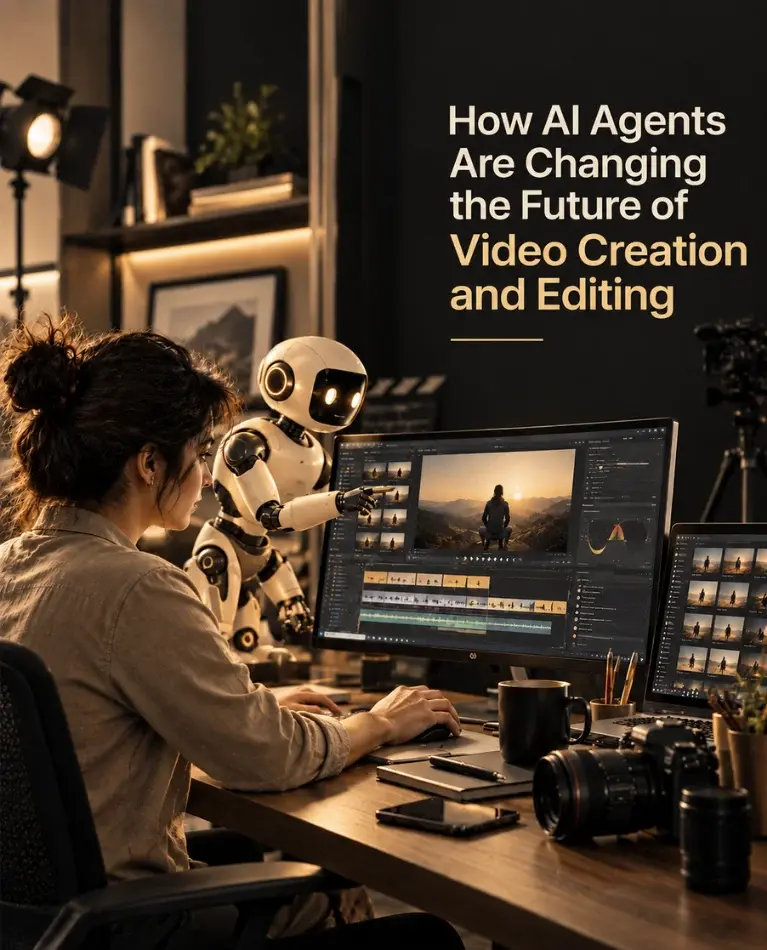
The future of video creation is moving from simple automation toward agentic workflows, where AI agents can understand instructions, assist with creative decisions, and support creators throughout different stages of production.
With tools like invideo, creators can experience a more connected AI-powered workflow, from generating videos and assets to editing and refining the final content.
From Automation to Agentic AI in Video Creation:
Traditional automation works by completing predefined tasks. For example, a system may automatically generate captions, apply a template, or export a video in a specific format.
While useful, these workflows still require creators to manually control most parts of the production process.
Invideo introduces a different approach.
Invideo is designed to understand instructions and assist users in achieving a broader goal. Instead of requiring creators to perform every individual step, it can help interpret the desired outcome and support the workflow.
For video creation, this means creators can focus more on what they want to communicate rather than only thinking about how to operate editing software.
The Role of invideo Agent in AI-Powered Video Generation:
The first stage of video creation is often turning an idea into a structured concept.
Creators need to decide:
- What story should the video tell?
- What scenes are needed?
- What visuals should be included?
- How should the information be presented?
This planning stage can often take as much time as editing itself.
Invideo Agent focuses on the generation side of the workflow. It helps creators move from an initial idea or instruction toward a complete video concept.
By providing instructions, creators can guide the AI to help develop:
- Video ideas
- Scripts
- Scene structures
- Visual directions
- Generated video content
For example, a business creating a product introduction video can provide instructions about the product, audience, and purpose. Invideo agents can then help develop a structured video concept.
This makes the initial creation stage faster and more accessible, especially for users who have ideas but may not have extensive video production experience.
Moving From Generation to Editing With Video Editor:
Generating a video is only one part of the creative process.
Most professional videos require additional editing and refinement to match specific goals, audiences, and brand requirements.
This is where invideo Editor plays an important role.
While invideo Agent focuses on generating video concepts and content, invideo Editor focuses on the editing stage, allowing creators to refine, customize, and improve their videos.
Creators can use the editing workflow to:
Adjust video structure
Modify scenes
Refine timing
Add additional visual elements
Improve the overall presentation
This creates a complete workflow where AI helps generate content and creators maintain control over the final output.
Why the Combination Creates an Agentic Video Workflow?
The biggest change in AI-powered video creation is not only faster production. It is the connection between different stages of the creative process.
Previously, creators often had to use separate workflows for:
- Planning
- Generating content
- Finding visuals
- Editing footage
- Preparing final versions
An agentic workflow connects these stages.
With invideo Agent and invideo Editor, the process becomes:
Idea and instructions → agent assisted generation → AI Editing and refinement → Final video
This allows creators to move faster while still making creative decisions throughout the process.
How AI Agents Are Changing the Role of Video Creators?
AI agents are changing what it means to create videos.
In traditional workflows, creators often spend significant time managing technical tasks.
They may spend hours:
- Searching for footage
- Organizing clips
- Making repetitive adjustments
- Preparing multiple versions
AI-assisted workflows allow creators to focus more on:
- Storytelling
- Audience engagement
- Creative direction
- Brand communication
The creator becomes less focused on operating every tool manually and more focused on guiding the creative process.
AI-Powered Video Workflows for Businesses:
Businesses are among the biggest users of video content today.
Companies create videos for:
- Product demonstrations
- Marketing campaigns
- Customer education
- Internal training
- Social media communication
The challenge is producing enough content while maintaining quality and consistency.
An agentic workflow can help businesses create content more efficiently.
For example, a company launching a new service may need:
- An introduction video
- Social media clips
- Customer education content
- Training materials
Using AI-assisted workflows, teams can move from an initial concept to multiple content formats more efficiently.
The Future of Instruction-Based Video Creation:
One of the biggest changes introduced by AI agents is how users communicate with software.
Traditional software requires users to learn features and understand technical processes.
Agentic systems move toward instruction-based interaction.
Instead of asking:
“Which tool should I use?”
Creators can communicate:
“Create a product video explaining this feature for new customers.”
This makes video creation more intuitive because users can focus on their goals rather than software complexity.
Human Creativity and AI Collaboration:
Although AI agents can support many parts of video production, human creativity remains essential.
AI can assist with:
- Generating ideas
- Creating video structures
- Supporting editing workflows
- Reducing repetitive tasks
However, humans continue to control:
- The message
- The creative direction
- The audience connection
- The final decisions
The future of video creation is not about replacing creators. It is about giving them intelligent systems that help them create more efficiently.
Why Agentic AI Represents the Future of Video Creation?
The next generation of creative software will focus less on individual tools and more on intelligent collaboration.
AI agents will continue becoming better at understanding instructions, supporting workflows, and helping creators achieve specific outcomes.
For video production, this means the process will become more accessible to a wider range of users.
A person with a strong idea but limited editing experience can use AI assistance to create professional content, while experienced creators can use AI to speed up complex workflows.
Conclusion:
AI agents are changing video creation by introducing a new way of working with creative software.
The invideo Agent and invideo Editor represent two connected parts of this evolution. invideo Agent helps creators move from ideas and instructions to generated video content, while invideo Editor helps refine and customize the final output through an editing workflow.
Together, they represent a shift toward agentic video creation where creators guide AI systems, maintain creative control, and produce content more efficiently.
As video becomes increasingly important for businesses, education, and digital communication, AI-assisted workflows will continue shaping the future of how videos are created.