

Choosing the right candidate is not just about looking for someone who fits certain keywords in their resume.
The best hiring process should address an issue that is far more important than that: whether or not this person is able to do the job.
This is where professional sourcing services really make a difference.
It is not only about collecting CVs and forwarding them to the recruiting manager. It is about recognizing potential candidates, assessing their experience, holding preliminary interviews, verifying important criteria, assessing suitability, and sending only those candidates who fit the hiring criteria as set out in advance.
There are slight differences in the process depending on the job position, industry, and staffing agency. Nevertheless, the most effective candidate selection involves such steps as CV review, recruiter interview, skills evaluation, motivation verification, availability check, eligibility check, and sometimes reference/background checking.
It is essential since the usefulness of the staffing service is not evaluated by the number of CVs produced. The usefulness of such a service lies in its ability to shorten the distance between vacancy and employment.
Recruitment in the modern era is also becoming more and more skill-focused. According to the LinkedIn 2025 Future of Recruiting study, over 90 percent of talent acquisition specialists feel that skill assessment is necessary to achieve better quality of hire. In addition, their platform data show that firms conducting more skills-oriented searches were 12 percent more likely to have a quality hire.
In other words, successful sourcing agency are evolving from mere keyword matching to evidence-based assessment of candidates.

What Is Candidate Screening in Staffing ?
Candidate screening is the process of evaluating whether or not the candidate or source candidate possesses the required criteria for a specific job opening prior to meeting the employer.
It is located in between candidate sourcing and employer selection.
The recruitment funnel can be depicted as follows:
Sourcing → Screening → Assessment → Shortlisting → Employer Interview → Selection → Offer
Each of these stages serves a specific purpose.
| Recruitment stage | Primary objective |
| Candidate sourcing | Find potentially suitable people |
| CV/profile review | Establish initial relevance |
| Recruiter screening | Test basic suitability |
| Skills assessment | Validate capability |
| Qualification checks | Confirm important claims |
| Compliance checks | Establish eligibility where required |
| Shortlisting | Select the strongest candidates |
| Employer interview | Make the final hiring decision |
It is crucial to note that sourcing is not the same as screening.
The sourcing firm can come up with 100 candidates who might fit into the bill. However, a good screening service can cut that number to just 10.
The employer then selects from those candidates who have been sourced by the sourcing companies.
Sourcing vs screening vs selection :
However, although they can be considered synonymous, each refers to a unique function.
Sourcing is concerned with the search for talent.
Screening is concerned with establishing if that talent fits the predetermined criteria.
Selection, on the other hand, is the employer’s choice of the appropriate hire.
The professional service provider thus requires two attributes; reach and discernment. The former will be useful, but not enough.
How Staffing Agencies Screen Candidates: The 8-Step Process
There is not one screening process for all openings. Recruiting a software engineer would be vastly different from recruiting a sales executive, financial manager, or warehouse operator.
Still, seasoned recruitment firms usually stick to a certain process order.
1. Define the employer’s hiring requirements
This decision actually occurs prior to any contact being made with the candidate.
It is important that the agency knows why the employer is hiring.
A poorly written recruiting brief for full cycle recruiting would be:
“We need an experienced marketing manager.”
A stronger brief identifies:
- required technical or professional skills
- years and type of relevant experience
- industry exposure
- essential qualifications
- location requirements
- working pattern
- salary range
- notice period
- seniority
- measurable performance expectations
- desirable rather than essential criteria
- behavioural or communication requirements
The difference between essential and desirable requirements is very crucial.
Failure to understand the differences may lead recruiters to overlook potentially great hires simply because they don’t fit all the lines in an overly restrictive job description.
This is one reason why modern sourcing is moving towards becoming more skill-focused than merely CV-focused.
As per LinkedIn’s 2025 report, 93% of talent acquisition specialists see the importance of right assessment of skills in improving quality of hire.
This is why a great agency should begin with translating a job description to a screening scorecard.
For example:
| Requirement | Weight | Screening question |
| Paid search experience | 25% | Has the candidate managed PPC campaigns directly? |
| B2B experience | 20% | Have they worked in a B2B environment? |
| Team management | 15% | Have they managed marketers or agencies? |
| Analytics | 15% | Can they demonstrate measurable reporting experience? |
| Communication | 10% | Can they communicate strategy clearly? |
| Industry knowledge | 10% | Do they understand the relevant market? |
| Availability | 5% | Can they start within the required timeframe? |
It varies depending on one’s role and the sourcing company.
This rule does not.
Screen for things that predict success, not just those that are easy to spot on a CV.
2. Source and identify suitable candidates
Once the criteria for employment have been determined, the process of sourcing the candidates takes place.
The sources can vary, ranging from professional networking, job portals, databases, referrals, talent communities, outreach, and specialist networks.
With the use of technology by a contemporary service provider, individuals can be sourced whose experience matches even if they are not applying to jobs.
This becomes very important when recruiting for difficult positions.
Let us take an example of an employer looking for a B2B SaaS demand generation manager.
A traditional job posting would generate applicants whose resumes mention phrases like “digital marketing” and “lead generation.”
A specialist sourcing approach might instead look for evidence of:
- account-based marketing
- marketing-qualified lead generation
- CRM ownership
- paid acquisition
- pipeline attribution
- sales and marketing alignment
- B2B SaaS experience
- measurable revenue contribution
That produces a fundamentally different talent pool.
It is not the goal of a candidate sourcing company to identify the largest number of candidates possible.
It is to find the maximum number of potentially relevant candidates.
3. Review CVs and professional profiles
Following the process of sourcing the candidates, recruiters evaluate their resumes and profiles based on their experience, skill set, qualifications, career history, industry knowledge, and accomplishments. This evaluation serves as the first step to find out if the candidate fulfills the requirements of the employer or not.
The CIPD resource highlights the process whereby employers use structured and objective means to screen and evaluate applicants. This is a justification for the statement that the process of evaluating an applicant should be done based on the criteria of the job and not just CVs.
It is true, however, that a CV does not constitute evidence of competency. Many recruiters will check claims when conducting preliminary interviews. As an example, instead of taking the applicant at their word about managing a “high-performing sales team,” they would confirm whether or not the person managed eight account executives, raised quarterly sales by 22%, and shortened the sales cycle from 61 to 47 days. This enables candidate screening services to evaluate competency based on factual information.
4. Conduct an initial recruiter screening
This can often be the crucial step prior to a candidate meeting the employer.
This is when the agency gets to see how much of what the candidate writes down reflects the truth.
Recruiters will ask questions like:
Experience
“Tell me about your responsibilities in your current job.”
Technical skills
“What CRM platforms have you used personally?”
Achievements
“What were the results for the marketing campaign that you mentioned in your resume?”
Motivation
“Why do you think about changing jobs?”
Position fit
“What attracts you to this position?”
Availability
“When could you actually start?”
Salary expectations
“How much money do you expect?”
Workplace conditions and location
“Do you feel comfortable with the office or home-based working requirements?”
Not to interview the candidate for the employer.
To determine if the candidate is suitable enough to get an employer’s interview.
5. Validate skills and experience
This is where advanced candidate sourcing service differ from basic resume submission services. Recruiters do not only analyze the jobs and titles but dig deeper and find out whether the candidate really possesses the required skills and experience. For instance, if the candidate says he/she has excellent SEO experience, then the recruiter will find out which sites he/she has been working on, what responsibilities he/she had there, whether he/she dealt with technical SEO or content strategy, what analytical tools he/she used and whether his/her efforts yielded commercial results.
When it comes to recruitment for jobs that require certain specific skills, agencies could use skills test, samples of work, coding test, writing test, case study, role specific questionnaires or practical tests. The choice of the testing method must be related to the specifics of the position. The same applies to structured interviews that will allow comparing responses and make the process more systematic. This method of evaluation is aimed at finding out who really possesses the required skill set and not who knows the right keywords for a resume.
6. Assess motivation, availability and job fit
Technical proficiency and experience does not necessarily ensure a good match. The staffing agencies Chicago realize that although the candidate is highly qualified, he might not be suitable for the job owing to dissimilarities in their working style, salary demands, professional ambitions, or availability. The experienced recruiters gauge the level of motivation of the candidate along with the overall fit with the organization.
At this stage, the recruiter can verify whether the candidate is satisfied with the mode of employment, salary band, job grade, contract length and commencement date. The recruiter can also find out any problems such as the desire to manage even though the job is not one of management, notice period that does not fit into the hiring time frame of the employer. This helps in the recruitment process by ensuring that there are no undesirable interviews and placing of wrong persons.
7. Complete relevant compliance and background checks
The checks performed at this stage depend heavily on the role, employer and jurisdiction.
Possible checks include:
- right to work
- professional qualifications
- employment history
- references
- DBS checks where appropriate
- professional registrations
- identity verification
- criminal record checks where legally justified
- other role-specific compliance checks
In the UK, employers must establish that a person has the right to work before employing them. GOV.UK provides prescribed methods including online checks, manual document checks and appropriate identity verification routes.
Sourcing companies have to be consistent regarding compliance issues.
Guidance from the Home Office suggests that there must be no discrimination during right-to-work checks, which should be done uniformly for all potential employees.
There is a need to ensure that background checking complies with data protection regulations as well.
According to the Information Commissioner’s Office (ICO), recruitment agencies and employers process large amounts of candidate information and have to comply with UK data protection laws.
Thus, an ethical vendor regards the processing of candidate information as its obligation rather than a simple database operation.
8. Prepare and present a candidate shortlist
The profile must only be shown to the employer after the candidate passes the agreed screening process with the agency.
The candidate submission should be more than:
“Please find attached CV.”
The agency should state why this is the right fit.
Here’s an example:
Candidate: Senior Performance Marketing Manager
Experience: 7 years
Match: B2B SaaS, Paid Acquisition, Demand Generation
Proof: Responsible for £1.2 million annual paid media budget and increased qualified pipeline by 31%.
Leadership: Managed five-person acquisition team.
Motivation: Looking for broader ownership of demand generation strategy.
Availability: Eight weeks
Salary expectations: £75,000-£80,000
Possible issue: Lacks experience in specific vertical of the employer.
This will provide useful information for the hiring manager ahead of the interview.
This is the actual business worth of good candidate screening services.
Explore more ways to grow your brand with Digifinity.
Let’s turn your vision into digital growth.
Explore Our ServiceWhat Do Staffing Agencies Look for When Screening Candidates?
The answer depends on the vacancy, but most professional screening processes evaluate five broad dimensions.
| Screening dimension | What the recruiter wants to establish |
| Capability | Can the candidate perform the core duties? |
| Experience | Have they solved similar problems before? |
| Motivation | Do they genuinely want this opportunity? |
| Practical fit | Do salary, location and availability align? |
| Risk/compliance | Are relevant requirements and checks satisfied? |
The top agencies go on to include a sixth element:
Evidence.
Evidence transforms screening from being judgmental to being evaluative.
Examples:
“Great communicator.”
vs.
“Facilitated monthly commercial presentations to C-level executives and renegotiated a £400,000 per year contract.”
The latter can be verified and debated.
This is the benchmark set by employers.
How Candidate Screening Services Improve Hiring Quality ?
Screening does not exist just to save time for the recruiters.
When done right, it improves the quality of the entire recruiting process.
Better skills matching
There are some skills that a specialized agency can detect better than general sourcing services.
For instance, a candidate who may have never been a Growth Marketing Manager before may very well have the exact skills needed for the job because of his past experiences in performance marketing, demand generation, and lifecycle marketing.
This would be overlooked by a keyword system.
Not an experienced recruiter.
Fewer unsuitable interviews
Every interview takes up time.
The hiring manager that spends 45 minutes interviewing the wrong candidate has done more than waste 45 minutes. The manager has also missed the chance to interview a more appropriate candidate.
Good screening preserves the company’s interview capability.
Faster hiring decisions
Decision-making is simplified when employers get concise, relevant, and valid candidate data.
This is especially significant for competitive positions where good candidates will get more than one chance.
Better candidate experience
Candidates’ experience is also included in recruitment quality.
A candidate who is approached regarding a position that obviously does not fit his or her salary requirements, geographic needs, or career plans will hardly find the recruiter credible.
Quality screening ensures relevance from both sides.
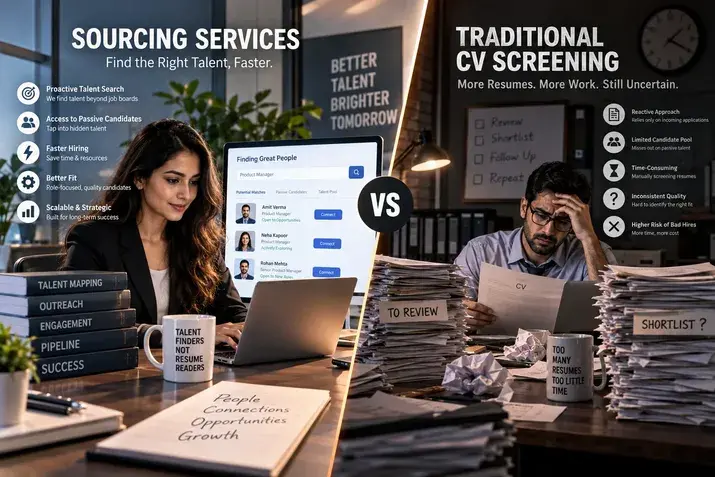
Sourcing Services vs Traditional CV Screening
It is critical to note the difference between the sourcing company that merely relays the CVs and the recruitment partner who runs a proper screening process.
| Traditional CV forwarding | Professional sourcing and screening |
| Searches for keywords | Searches for skills and evidence |
| Measures CV volume | Measures candidate relevance |
| Limited candidate conversation | Structured screening conversation |
| CV-led | Competency-led |
| Little validation | Claims are investigated |
| Employer does most filtering | Agency performs meaningful pre-screening |
| Short-term activity focus | Quality-of-hire focus |
The distinction becomes especially important in specialist jobs.
With 300 applications coming in, it is not enough to merely select 40 resumes and send them to the HR manager.
Selecting five resumes out of 300 that have high relevance to the position, is.
How Technology Is Changing Candidate Screening ?
Technology has redefined the processes used by modern organisations to recruit and evaluate candidates.
Applicant tracking software is able to structure data about candidates. Technology search will speed up the process of talent identification. Artificial Intelligence will help in the summarization of CVs and other related activities.
According to LinkedIn’s 2025 Future of Recruiting study, 37% of organisations were exploring or implementing generative AI in recruiting. In addition, there were those talent acquisition experts who were using or exploring generative AI and had redirected their efforts saved from automation towards candidate screening and skills assessment.
However, automation has not made human judgement unnecessary when it comes to administrative support.
AI-Assisted Sourcing
The use of artificial intelligence is growing in assisting recruitment managers find potential candidates, analyze their skills mentioned in their CVs, evaluate the candidate profile according to the job specifications, and summarize the candidate’s data. The automation of repetitive processes helps save time and allows managers to focus on communication with the candidates. Nonetheless, it is crucial to note the difference between using artificial intelligence for screening purposes and giving an automated system too much power in making hiring decisions without adequate monitoring.
Applicant Tracking Systems
An ATS assists recruiting agencies to organize and manage candidate data during the recruitment process. This can include application tracking, notes by recruiters, interview stage, candidate communication, employment history, skill set, documentations, and placement results. Though an ATS can enhance efficiency and give a comprehensive overview of the recruitment funnel, it needs to be considered as a system of record rather than an alternative to the recruiters’ experience and sourcing agency. After all, human judgment is very important in determining if a candidate is really fit for the job or not.
Automated Screening and Its Limitations
The advantage of using an automated screening process lies in its ability to analyze the vast number of profiles within a very short span of time and to find patterns which would otherwise remain unnoticed. Unfortunately, such tools can be responsible for perpetuating false beliefs, neglecting the presence of transferable skills, or generating a biased result. That is why recruitment companies need to utilize technology wisely and monitor their effect on the decision-making process.
How Good Sourcing Companies Reduce Hiring Risk ?
A good sourcing company would not only be able to present the recommended candidates, but also justify why they would fit into the position. There is a method called MATCH that examines the potential employees in five different aspects – must-have, ability, track record, compatibility and hurdles. In other words, the recruiter will have to find out what criteria are really necessary for the position, whether the candidate could prove his ability to do the job, analyze his results, motivation and practical expectations, and check whether there are any risks at all.
The recruitment and selection guidance from the ICO describes how recruiters and organizations should treat candidate information during the recruitment process. This includes candidate selection, verification and pre-employment vetting, candidate sourcing company. This serves as a great source for understanding how the recruitment process is conducted.
This framework will also ensure that the recruiting process is not focused on giving equal weight to all requirements stated in a job posting. For instance, when an employer is looking for a digital marketing manager, he may come across a job seeker with 8 years of experience in marketing, good B2B knowledge, paid media experience, great analytics and team management skills, but lacking experience in the particular industry of the employer. It does not necessarily mean that this person should be disqualified. First, the recruiter needs to establish if the industry experience is critical or just preferable.
A Practical Candidate Screening Framework for Employers :
Employers who evaluate recruitment agencies should search for a systematic screening approach. The proper approach is supposed to analyze four aspects: qualifications, capabilities, motivation and risk, and candidate sourcing. In this way, recruiters will be able to ensure that applicants possess all required qualifications, have appropriate expertise and experience, are motivated and do not have any problems in terms of availability, remuneration, and eligibility.
With a scoring method being used, it would become possible to evaluate candidates objectively with regards to various factors such as technical proficiency, experience, accomplishments, communication abilities, motivation, fit for the position, and availability. The scoring method should differ from vacancy to vacancy so that the recruiters can give specific reasons as to why the particular candidate was shortlisted.

What Employers Should Ask a Sourcing Agency Before Partnering With Them ?
All sourcing agencies do not operate on the same plane.
Before selecting an agency, consider asking the following questions:
What is your definition of a qualified candidate?
If it’s not clearly defined, probe some more.
What is your screening process?
It shouldn’t just be about collecting CVs.
Are there live screening sessions with recruiters?
For many positions, it’s a key quality control process.
How do you test skills?
This should depend on the demands of the job as well as the candidate sourcing company..
How do you differentiate between essential and desirable requirements?
This shows how strategic the agency is in dealing with hiring briefs.
What kind of data do you share with your candidates?
Always look for proof and not just a resume.
What happens to the candidate’s data?
The agency should be able to answer this question.
How do you gauge quality?
Good agencies should be interested in metrics such as interview-to-submission ratio, offer-to-acceptance ratio, retention and finally quality of hire – not just the number of CVs you submit.
This is especially important because recruiting today is moving from activity-based measurement to outcome-based measurement.
According to LinkedIn’s 2025 research, 89% of talent acquisition professionals expect quality of hire to become more and more important, yet only 25% said they were very confident in their organization’s ability to measure it.
Real-World Example: Turning 50 Profiles into Five Strong Candidates
Think about a situation where there is a tech company that hires a senior content strategist.
This firm comes across 50 candidate profiles who could qualify.
A bad recruitment agency will send 20 profiles.
Candidate Sourcing Service should conduct research on the pool.
First, it removes candidates without the required level of strategic experience.
Next, recruiters speak with the strongest candidates.
They discover that:
- 12 have limited strategic ownership;
- 8 have mostly agency-side execution experience;
- 10 lack relevant B2B experience;
- 7 have salary expectations outside the approved range;
- 3 cannot meet the required start date;
- 5 demonstrate strong strategic experience, relevant industry knowledge and measurable content performance.
In this case, the employer gets only five applicants, not 20.
However, the crucial issue is that the employer gets five candidates whose selection has a justification behind it.
This is the distinction between quantity and quality of candidates.
Conclusion: The Real Value of Professional Sourcing Services
The best recruiting firms are those that not only provide more candidates.
The best recruiting firms are those that provide better-qualified candidates.
This becomes especially critical when dealing with large numbers of applicants and changing skill requirements.
Competent sourcing services consist of talent identification, candidate screening, skills evaluation, recruiter’s discretion, proper fit evaluation, and the relevant compliance process.
While technology can certainly speed up the process, it must not substitute for human responsibility. The current recommendations and research from various bodies like LinkedIn, CIPD, the ICO and GOV.UK all suggest that the future of recruitment lies in skilled and responsible assessment processes and technologies.
So when looking for the right recruitment partner, the employer should consider not:
“How many candidates can you give us?”
But rather ask:
“How do you select the candidates that deserve the attention of our hiring team?”
Asking these questions makes the difference between quantity and quality in recruiting.
When an organization needs to have access to skilled people but doesn’t want to put the whole responsibility for finding and assessing them on the shoulders of its in-house team, then the recruitment partner becomes an extension of the organization’s recruitment team – developing talent pools, assessing and delivering the shortlists of candidates for hire.