

Candidate Sourcing Services for US Startups That Need to Hire Fast, Not Fast-and-Loose:
Most startup founders don’t lose good candidates because their offer is weak. They lose them because nobody found the candidate in time. That’s the quiet problem sitting behind almost every “we can’t hire fast enough” conversation happening in Slack right now across early-stage companies. Candidate sourcing is the part of recruiting that fixes this. Building a steady pipeline of qualified, contactable talent before a role gets urgent, instead of scrambling once it already has. Established teams treat it as a real discipline, and for good reason: research from SHRM has repeatedly linked structured sourcing to shorter time-to-fill and stronger candidate quality.
For a lean startup team, sourcing is usually the first recruiting function that gets dropped. No dedicated recruiter. No sourcing tool budget. No time to scroll through hundreds of profiles between product sprints. That’s the gap Digifinity fills, as a sourcing company built specifically around the pace and budget constraints of US startups.
The Hiring Problem Every Growing Startup Runs Into:
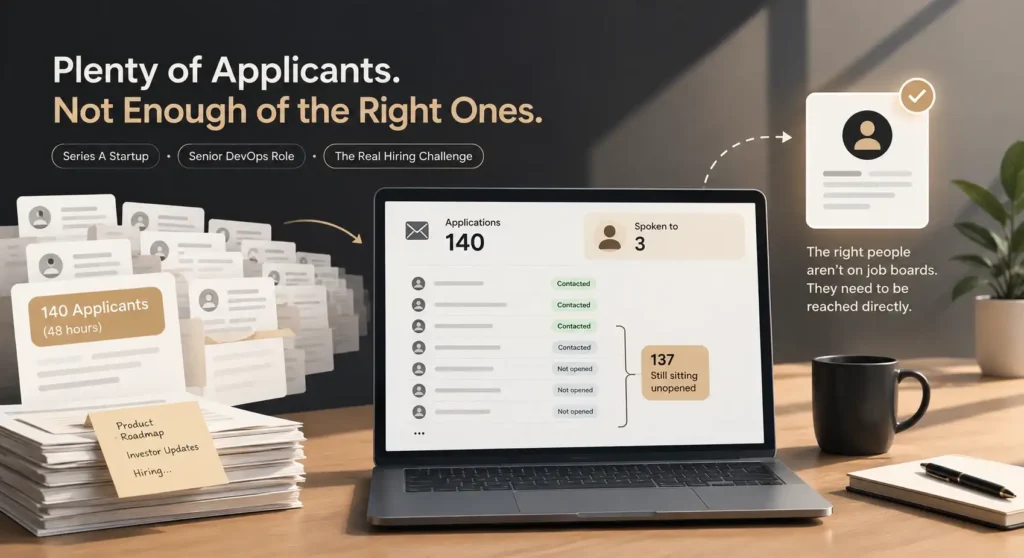
Take a Series A startup trying to fill a senior DevOps role. The listing goes live Monday morning, and within 48 hours there are already 140 applicants sitting in the inbox. A week later, the hiring manager has actually spoken to three of them. None are right. The other 137 resumes are still sitting there unopened, not because anyone’s being lazy about it, but because nobody’s had the time to work through them properly on top of everything else on their plate. That’s what “flood of applicants” hiring actually looks like once you’re inside it: a founder posts a job, gets buried in volume, and still can’t find the right person. The strongest engineers, product managers, and technical specialists rarely go anywhere near a job board in the first place. They’re already employed, busy, and they only move when someone reaches out directly, with something worth actually leaving for.
That’s the real tension in modern hiring: plenty of applicants, not enough of the right ones. A founder trying to fill a senior backend role while also running product roadmaps and investor updates doesn’t have the bandwidth to hunt for passive candidates, write outreach sequences, and keep a pipeline warm on top of everything else. That’s not a failure of effort on their part. It’s a resourcing problem, plain and simple, and it’s why dedicated sourcing exists as its own function within recruitment rather than something a founder bolts onto an already full week.
Ready to Build a Pipeline That Actually Delivers Candidates?
See exactly how our sourcing and staffing services work together to fill technical roles faster. Explore what’s included before your next search.
Explore Our ServiceWhy Traditional Hiring Slows Startups Down?

Small teams, big hiring workload: A ten-person startup filling three roles at once is effectively running a mini talent acquisition function, minus the infrastructure a larger company would have behind it. No applicant tracking system tuned for sourcing. No headcount dedicated to outreach. No database of past candidates to fall back on. Every search starts from zero, every time.
The passive-candidate blind spot: Roughly seven in ten professionals count as passive talent: not actively job hunting, but open to the right conversation if someone bothers to have it. LinkedIn’s Talent Solutions research has reinforced this figure repeatedly over the years. Startups relying only on inbound applications are fishing in the smallest possible pond, and the candidates most likely to move the needle for an early-stage company (people with proven execution experience under pressure) tend to be the hardest to reach through a job posting alone.
Then there’s the labour market itself. Unemployment for skilled technical roles in the US remains historically tight, according to Bureau of Labor Statistics figures, and that makes the maths even harder. Competing for the same shrinking pool of active candidates as every other funded startup isn’t much of a hiring strategy on its own. It’s a bidding war, and most early-stage companies simply can’t win it alone, which is exactly the gap a dedicated sourcing company exists to close.
What Candidate Sourcing Actually Solves?
Candidate sourcing isn’t posting a job and waiting for the right person to stumble across it. It’s deliberate, research-led identification of people who match a role’s requirements technically, culturally, and in terms of where they’re heading in their career. Then it’s direct, personalised outreach that gauges interest before any formal process begins.
Done well, it builds three things a startup badly needs. Speed, because a warm pipeline means a role doesn’t sit open for eleven weeks while a founder tries to figure out Boolean search strings between meetings. Choice, because sourcing surfaces people who were never going to apply on their own, so the pool isn’t limited to whoever happened to see the listing that week. Quality, because targeted candidate screening filters for fit before the interview stage rather than after it, once the mis-hire is already three weeks into onboarding.
We differ from a typical staffing vendor here. We don’t send over a stack of resumes and call it a day. Our sourcing services are built around actually understanding a startup’s stage, culture, and technical stack well enough to identify people who would thrive there, not just candidates who tick the boxes on a job description.
The wider hiring market backs this up too. Gartner’s research on talent acquisition has flagged, more than once, that organisations relying mainly on inbound applications see longer time-to-fill and weaker role fit than those running structured, outbound sourcing programmes. Startups competing against much larger companies with recognisable names and bigger compensation budgets don’t really have a choice here; outbound sourcing is often the only realistic way to reach strong candidates before a bigger name does.
Core Features of Our Candidate Sourcing Services:
A few things set our process apart from a typical vendor that just drops off a stack of resumes.
- We build a shortlist through targeted talent mapping, working across the specific niche, tech stack, and seniority level a role demands, rather than running a generic keyword search.
- Outreach to passive candidates gets written by hand for each engagement. Most InMail templates get scrolled past without a second look; ours are built to actually earn a reply.
- Before anyone reaches the interview stage, candidates go through technical and cultural pre-screening: checking hard-skill fit, but also whether someone’s actually going to work well inside how the startup operates day to day.
On top of that, you get full pipeline transparency. A live, shared view of who’s been contacted, what stage they’re at, and how they’re responding, so nobody’s left guessing what’s happening behind the scenes. Engagements stay flexible too, running as a one-off project for a single urgent role or as an ongoing arrangement for teams hiring continuously. And because this work touches real candidate data, everything stays aligned with US employment and privacy standards throughout. Not bolted on afterwards as a compliance checkbox.
Startups frequently pair this with our broader IT staffing services when a role needs full-cycle support, from sourcing all the way through offer negotiation, rather than sourcing on its own.
Benefits and Business Impact:
The most immediate benefit is time. Founders and hiring managers get their week back instead of spending it manually searching profiles and drafting cold outreach that goes unanswered. That time goes straight back into product, revenue, and the parts of the business only they can actually run.

Then there’s the quality of hire. Candidates sourced this way tend to show up more engaged from the first conversation, because outreach was tailored to them rather than mass-blasted to a list. That shows up as stronger interview performance, better offer acceptance rates, and (this one matters more than people expect) lower early-tenure attrition. People joined for the right reasons, not because they simply happened to be available that month.
Cost matters here too. Every week a technical role that sits vacant has a real, calculable cost in lost output, delayed roadmaps, and strain on whoever’s covering the gap. Cutting even two to three weeks off time-to-fill, which sourcing done properly routinely manages, has a measurable effect on a startup’s runway efficiency. Not just a hiring metric on a dashboard somewhere.
Sourcing also compounds over time. A well-managed pipeline doesn’t disappear the moment a role is filled. Candidates who weren’t right for one opening often turn out to be the ideal fit for the next one, so the second and third hires in a growth phase get progressively faster and cheaper to make.
Retention deserves a mention too, even though it usually gets less attention than time-to-fill. Candidates who join after a genuine, well-informed conversation about the role tend to arrive with realistic expectations about the pace and ambiguity of early-stage work. That alignment matters more at a startup than almost anywhere else. A senior engineer who expects a polished, well-resourced environment and instead finds a lean team wearing five hats is going to disengage fast, often within the first few months. Sourcing done with real context about the company filters for this before an offer goes out, not after someone’s already handed in notice at their last job with nowhere else lined up.
How Our Sourcing Process Works?
- Discovery call: we learn the role, the team, the must-haves versus nice-to-haves, and what’s realistically caused past hiring attempts to stall
- Talent mapping: our sourcing specialists identify and shortlist candidates who match on skills, experience level, and likely motivation to move
- Outreach and engagement: personalised messaging goes out to shortlisted candidates, with follow-up sequencing for those who don’t respond right away
- Pre-screening: interested candidates get checked for technical fit and role alignment before being handed off
- Warm handoff: a shortlist of engaged, qualified, interview-ready candidates lands in the founder or hiring manager’s inbox, with context on each one
- Pipeline maintenance: for ongoing engagements, we keep building and nurturing the pipeline so the next open role isn’t starting from zero either
Tools and Sourcing Technology We Use:
Our sourcing specialists lean on Boolean search and professional network databases day to day, but a lot of the real work happens outside the automated tools. Niche or highly specialised technical roles (a particular flavour of embedded systems engineer, say, or someone with a specific compliance background in fintech) tend to need manual digging that no platform search handles well on its own. We keep an eye on response rates and pipeline health as we go, and we’ll shift messaging or targeting mid-engagement if the data says something isn’t landing, rather than sticking to one script regardless of how it’s performing. If a startup’s already running an ATS like Greenhouse or Lever, sourced candidates go straight into that system rather than sitting in a spreadsheet someone has to reconcile by hand later.
What Does It Cost to Work With a Sourcing Company?
There are really two ways this gets priced. A flat project fee works for a single urgent role that needs filling now. A monthly retainer makes more sense once a startup’s hiring across several roles at once, mostly because the pipeline built for the first role usually feeds the second one too, so the retainer ends up doing more with the same spend over time. We won’t quote a number until we understand the role itself. A niche, senior technical hire takes more sourcing effort than a mid-level generalist role, and pricing should reflect that rather than a flat rate applied across the board regardless of difficulty. Startups that want the entire hiring process owned end to end, including onboarding and compliance rather than just search, typically move to a full cycle recruiting engagement instead of a standalone sourcing sprint. For context, contingency IT staffing companies typically charge 20-30% of first-year salary per placement. A sourcing retainer tends to land at a more predictable monthly cost instead, which matters a lot when three or four roles are open at the same time and nobody wants pricing that swings with every hire.
Here’s how the main routes compare side by side:
| Hiring Route | Typical Cost Structure | Time-to-Fill | Passive Candidate Reach | Best Suited For |
| DIY / in-house hiring | No vendor fee, but high hidden cost in founder/manager time | Slow, often 6-10+ weeks | Low, limited to job boards and personal network | Startups with spare internal bandwidth and non-urgent roles |
| Contingency staffing agency | 20-30% of first-year salary, paid only on placement | Moderate, 4-6 weeks | Moderate, depends on agency’s existing database | One-off hires with flexible timelines |
| Digifinity sourcing services | Flat project fee or monthly retainer, scoped upfront | Fast, typically 1-2 weeks to first shortlist | High, dedicated outbound outreach to passive talent | Startups hiring urgently or hiring repeatedly across roles |
The predictability of the retainer model is usually what tips the decision for startups hiring more than one role a quarter. Costs are known upfront instead of shifting with every placement, and the pipeline built for role one keeps paying off when role two opens.
Why Do US Startups Choose Digifinity?

We’ve built our sourcing process around the one thing that matters more to startups than almost anything else: speed, without sacrificing candidate quality. Founders don’t need a vendor who fires off fifty resumes and hopes one sticks. They need a partner who understands that a mis-hire at the ten-person stage can set a team back months, and who treats every sourced candidate with that in mind.
Our specialists work exclusively within technical and startup-relevant talent pools, so there’s less time spent explaining basic role requirements and more time actually spent finding people who fit. Every engagement stays transparent from start to finish. No black-box process, no going quiet for two weeks with nothing to show for it. And because we work with startups at different growth stages, we know a Series A company’s sourcing needs look nothing like a bootstrapped ten-person team’s, and we scope each engagement accordingly instead of forcing everyone through the same template.
We also know a startup’s employer brand rarely wins on name recognition against an established enterprise, so our outreach leans on what a startup can genuinely offer instead: real ownership, faster pace, direct impact on the product. Candidates respond to authenticity far more than polish, and our sourcing specialists write and adapt every message for the specific role rather than reusing the same script across every client.
Beyond the sourcing itself, founders tell us again and again that the biggest value is peace of mind. Knowing a role is actively being worked, rather than sitting stagnant on a job board waiting to be noticed, changes how it feels to hire. That shift from passive waiting to active, managed pipeline-building is often the whole difference between a hire that happens in three weeks and one that drags on for three months.