

Amazon PPC Management Measured on Total Sales, Not ACoS

A falling ACoS often means you stopped buying the customers you needed.

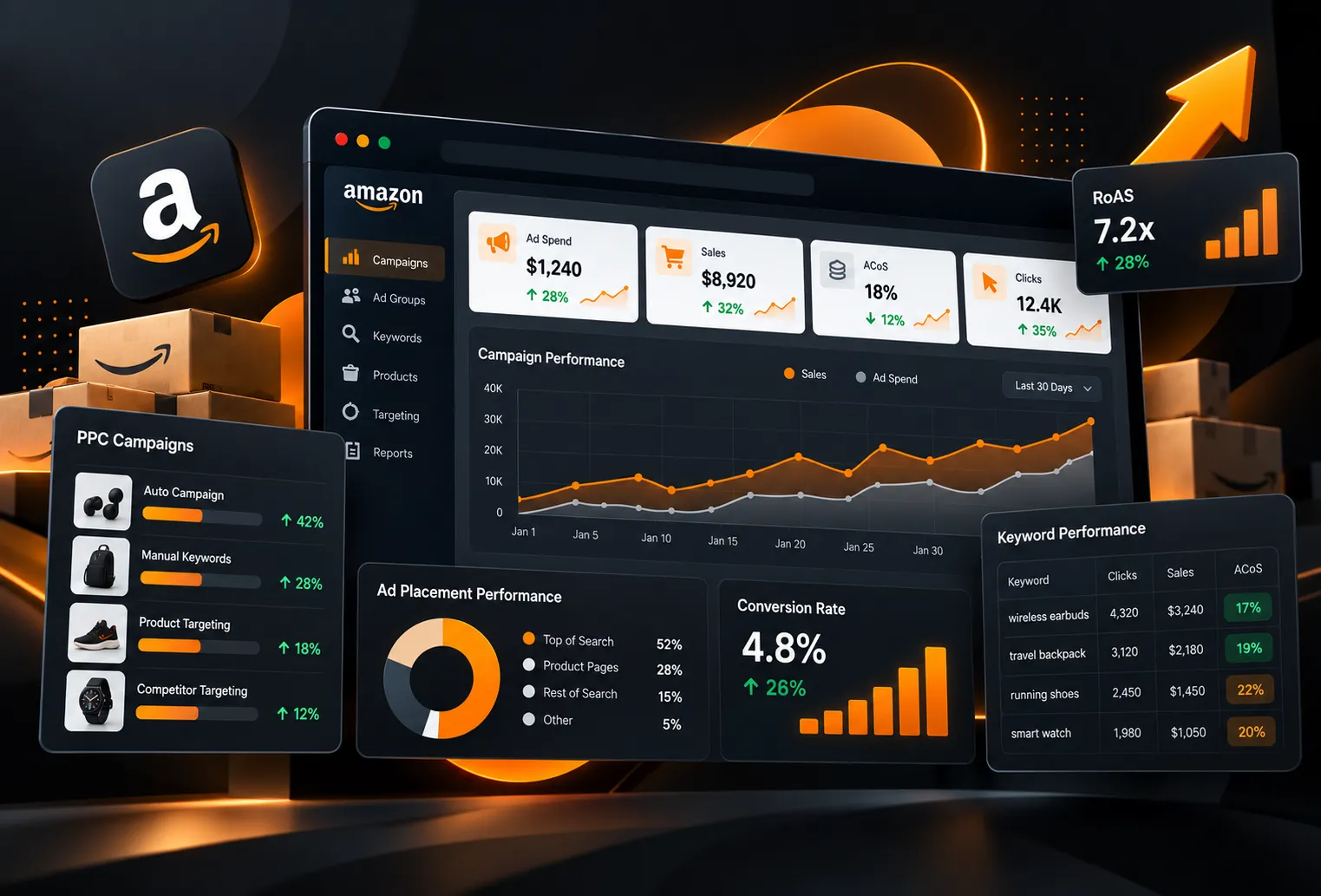
Cut spend to branded and bestselling ASINs and ACoS improves immediately. Total revenue doesn’t. That’s why we manage Amazon PPC against TACoS, ad spend as a share of all sales, including organic, with branded and non-branded reports separately. It’s a less flattering number and a far more useful one, particularly when someone above you is asking whether advertising is actually growing the business.

clients

+50 Clients

multitudes of brands have already trusted us

services included

Seven areas across campaign types and measurement. The order matters, advertising amplifies whatever the listing already does, so we check conversion before we touch a bid.

Account & Listing Readiness Sponsored Products Sponsored Brands & Display Search Term & Negative Management Product & Competitor Targeting Bid & Budget Strategy Reporting & TACoS

Account & Listing Readiness

Conversion rate checked per ASIN before spend scales. Advertising a listing that converts poorly buys expensive data, not revenue. Where the listing is the constraint, we say so rather than optimising bids around a problem bids can't fix.

get a quote

Sponsored Products

Auto campaigns run for discovery, with converting search terms harvested into exact-match targets and negated from the source. The structure that makes this work is unglamorous and it's what separates accounts that compound from accounts that plateau.

get a quote

Sponsored Brands & Display

Headline, video and display placements built for brand visibility and retargeting, measured on new-to-brand orders rather than blended return. These formats justify a higher acceptable ACoS because they're buying customers, not harvesting existing intent.

get a quote

Search Term & Negative Management

Search term reports reviewed weekly with negatives applied at the right match type. Wasted spend accumulates quietly here, a single broad-match term can absorb a meaningful share of budget for months before anyone opens the report.

Get a Quote

Product & Competitor Targeting

ASIN targeting to defend your own detail pages and appear on competitors'. Defensive placements come first, since losing your own page to a competitor's ad costs more than winning theirs gains.

Get a Quote

Bid & Budget Strategy

Dynamic bidding, placement modifiers and budget pacing set per campaign objective rather than account-wide. Seasonal planning built ahead of Q4, when CPCs rise sharply and accounts without a plan simply run out of budget mid-month.

Get a Quote

Reporting & TACoS

Branded and non-branded reported apart, TACoS tracked alongside ACoS, and new-to-brand orders shown separately. You see what advertising created versus what it harvested from demand you already had.

Get a Quote

// Tools & Technologies Section

//How We Run Your Ad Account ?

Separated
Branded and non-branded reported apart, always. Blending them makes existing demand look like acquisition, and almost every Amazon account benefits from that confusion going unexamined.
Total
TACoS tracked alongside ACoS, because ad spend as a share of total sales is what tells you whether advertising is growing the business or just moving revenue between columns.
Honest
We'll tell you when the constraint is the listing rather than the bidding. Recommending listing work over a bigger ad budget costs us revenue and saves yours.

work

One sequence from campaign audit to scaled spend, with listing conversion checked before any budget moves.

process

1

Campaign audit

Structure, wasted spend and branded overlap measured first.

2

Listing check

Conversion rate reviewed per ASIN before scaling anything.

3

Structure rebuild

Campaigns segmented by objective, match type and profitability.

4

Harvest negate

Search terms mined weekly, negatives applied at correct match type.

5

Scale review

Budget raised only where TACoS and margin hold.

Why ACoS Is the Wrong Number to Optimize Against

ACoS measures efficiency within advertising. TACoS measures advertising against the whole business. An account can improve one while damaging the other, and that gap is where most Amazon ad budgets quietly underperform.

// testimonials

4.9 / 5.0 clients review

What Our Clients Say

Give us read access,

not a target ACoS!

We’ll split branded from non-branded and show you what ads actually created.

    FAQs

    How much does Amazon PPC management cost?
    Typically a flat monthly retainer scaled to spend and catalogue size, or 10–20% of ad spend at mid-market level. We prefer flat retainers, percentage pricing rewards an agency for recommending bigger budgets. Non-Amazon paid media is quoted separately through PPC management services.
    Do you manage Etsy ads too?
    Yes, though the mechanics are much simpler and the volume usually smaller. Etsy Ads run on a daily budget with far less targeting control, so the work sits closer to listing quality than to bid management, handled through Etsy store optimization.
    Does Amazon advertising help our organic ranking?
    Indirectly. Amazon ranks on conversion history, so ad-driven sales contribute to it, which is why launches often justify a temporarily high ACoS. This is unrelated to Google ranking for your own site, which runs through ecommerce SEO services on an entirely different basis.
    We also want our brand site to rank on Google. Same team?
    Different discipline. Amazon ranking runs on conversion and relevancy inside a closed marketplace with no backlinks involved. Brand and content site visibility is handled through general SEO services, scoped separately from anything Amazon.
    Should we build a store as well as selling on Amazon?
    Most brands eventually do. Amazon gives volume but almost no customer data, so retention is difficult to build. Once Amazon revenue is stable, a storefront is the usual next step, built through ecommerce website development.
    Can our Shopify store and Amazon share inventory and pricing?
    Yes, and it needs setting up deliberately. Pricing parity affects Buy Box eligibility, and inventory drift between channels causes oversells within weeks. Sync and feed structure are handled through shopify store development rather than inside the ad account.
    What is the difference between ACoS and TACoS?
    ACoS is ad spend divided by ad-attributed sales, efficiency within advertising only. TACoS is ad spend divided by total sales, including organic. A falling ACoS with rising TACoS means advertising is becoming less efficient relative to the business. TACoS is the better health metric; ACoS is the better campaign-level optimisation metric.
    How much does Amazon PPC cost per click?
    Average cost per click varies widely by category, commonly falling somewhere between roughly $0.50 and $3.00, with competitive categories running higher and Q4 pushing everything up. You set bids and daily budgets, so total spend is controlled by you. What matters is cost per acquisition, not cost per click.
    Should you bid on your own brand name on Amazon?
    Usually yes, defensively. Competitors can target your branded searches and appear on your own detail pages, so ceding those placements costs more than the clicks. But report branded spend separately, it converts well and flatters blended ACoS while telling you nothing about whether advertising is acquiring new customers.
    Prev
    Next