
Why Do Connections Keep Climbing While Demos Stay Flat?
Connect, wait, pitch, get ghosted. That’s the loop most B2B SaaS teams are stuck in on LinkedIn lead generation, and it shows in the numbers before it shows up anywhere else connection counts climb every week, the demo calendar barely moves. When that happens, effort usually isn’t the missing piece. Somewhere early on, the campaign got built around how many messages go out rather than whether the right person was ever on the receiving end.
It’s tempting to blame the copy. Sharper subject lines, a punchier first line, maybe a different call to action. None of that fixes the actual gap, because SaaS buyers respond to timing and relevance long before they respond to phrasing.
That’s not a hunch. According to recent HubSpot data, 42% of marketers now list LinkedIn as part of their core strategy, up 11 points from the year before, which means the channel is getting more crowded, not less. What follows is where these campaigns actually break, and what changes when they start working.
Why LinkedIn Lead Generation Fails Most SaaS Companies?
Connection-request spam isn’t a strategy:
Picture the typical setup: fifty connection requests a day, an automated pitch fired off the second someone accepts. Response rates sit in the low single digits, and most of what does come back is a polite no or nothing at all. There’s a technical cost here too: LinkedIn’s systems are built to spot bot-like sending patterns, and once an account gets flagged, invitation limits quietly drop. Reach that used to be there stops being there, and most teams don’t notice until weeks later, when even well-targeted lists stop converting the way they used to.
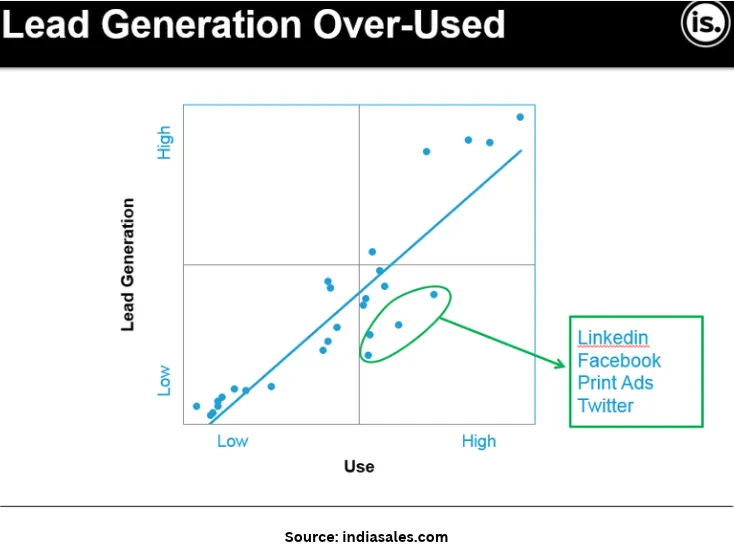
There’s a simpler problem underneath the technical one. A cold connection request without context is asking a stranger to say yes to you before they know why it matters. Directors and VPs at SaaS companies get dozens of these every week, so their filter for “generic sales attempt” is fast and mostly unconscious. A headshot, a job title, and “would love to connect” rarely gets past it as Neil Patel notes, LinkedIn works, but only when the approach is deliberate rather than templated.
What tends to separate a connection request that gets accepted (and later replied to) from one that gets ignored:
- It references something specific about the person’s company, not just their title
- It skips the pitch entirely with no product mention, no link, no “quick chat?”
- It’s sent within days of a relevant trigger event, not on a fixed weekly schedule
- It comes from a profile with real activity and a complete summary, not a blank one
- It asks a genuine, easy-to-answer question instead of proposing a call outright
Targeting the wrong seniority:
Lead lists tend to skew toward titles that sound right on paper Head of Growth, VP Marketing without much checking into whether that person actually controls budget, is currently evaluating anything in your category, or even owns the problem your product solves. A matching title isn’t the same thing as a buying signal, and treating it as one is where a lot of otherwise decent campaigns quietly fall apart.
Company stage makes this worse than it first appears. At a seed-stage or Series A company, a Head of Growth might genuinely be the one signing off on a new tool. At a Series C company, that same title could sit three approval layers below whoever actually decides. Run the same target list logic across both, and you’ll waste sends on one end no matter how the copy reads.
Mistaking activity for pipeline:
There’s a quieter failure mode too measuring the wrong things entirely. Connections sent, connections accepted, messages delivered: these are all activity, not revenue signals. A campaign can post a 40% acceptance rate and still book zero calls, because accepting a connection just means someone recognized a name or logo, not that they’ve got a live problem right now. Teams that don’t track reply rate and booked-meeting rate as the real scoreboard end up scaling a channel that looks productive on a dashboard and isn’t producing much of anything downstream.
See the Full System Behind This
LinkedIn is one piece of a coordinated B2B pipeline not a channel we run in isolation.
Explore Our ServiceWhat Actually Moves a SaaS Prospect from Cold to Booked?
Signal-based targeting, not job-title guessing:
Campaigns that actually work start from intent signals, not job titles: a fresh funding round, a job posting for a role your product supports, a CRM switch, someone in the buying committee liking a post about your category. These tell you when to reach out, which turns out to matter more than who you’re reaching out to. Send a rough, unpolished message right after one of these triggers and it’ll usually beat a polished message sent cold, with no context at all. LinkedIn’s own Sales Solutions blog makes a similar point targeting precision and timing consistently outweigh production value on this platform.
Worth building into any SaaS targeting model:
- Recent funding announcements (seed through Series C)
- Leadership hires in departments your product directly supports
- Job postings that hint at a gap your tool fills
- Tech-stack changes visible through integration partners or careers pages
- Engagement with category-specific content from someone on the buying committee
None of this needs expensive software; it needs a process that actually checks for these things before a list goes out the door, instead of pulling names purely off title and industry filters.
Messaging built around a trigger, not a pitch:
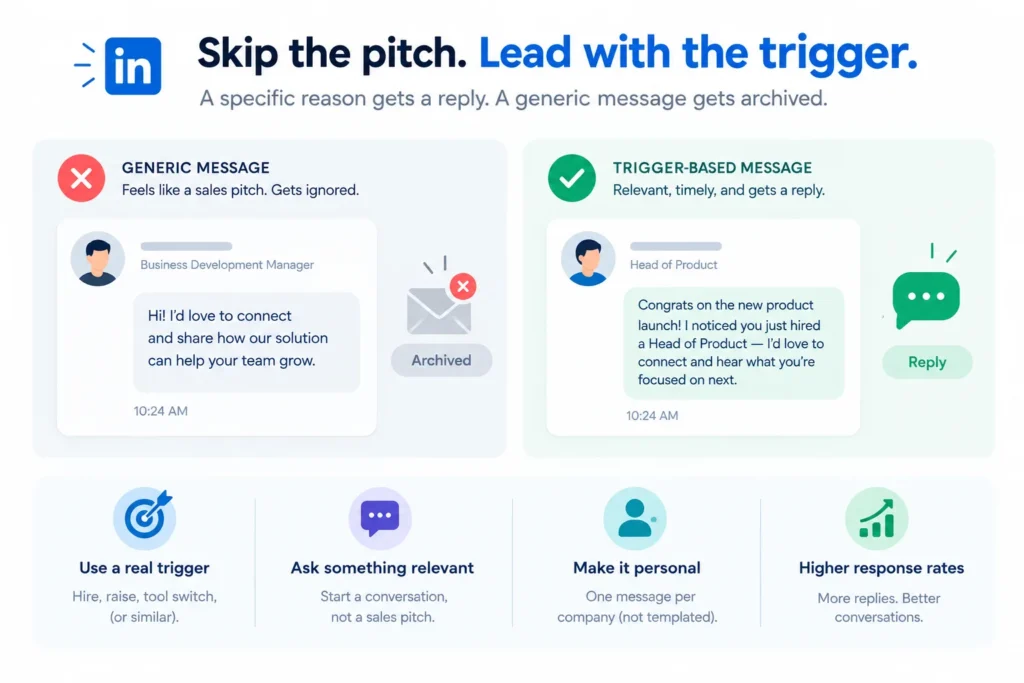
Skip the pitch in message one. Reference the specific reason you reached out the hire, the raise, the tool switch then ask something tied to it. That’s the whole difference between a message that gets a reply and one that gets archived unread. Features and benefits can wait until the prospect’s actually engaged.
Here’s a quick gut check: could this opening line go out unchanged to every company on the list? If yes, it’s not specific enough. Trigger-based messaging resists templating almost by definition, since the trigger itself changes from account to account. Yes, it’s more work up front. It’s also why it converts at a noticeably higher rate than anything sent at scale without customization.
Sequencing matters as much as the first message:
One well-aimed message rarely closes the loop on its own. SaaS buyers are busy mid-evaluation of three other priorities, most likely so a first message often gets seen, noted, and set aside rather than actively rejected. A sequence that works usually runs a connection request, an opening message tied to the trigger, then two or three follow-ups that each bring something new: a relevant case study, a specific result a similar client got, a short question that’s genuinely easy to answer. Follow-ups that just “bump” the thread with nothing new tend to hurt reply rates more than help them.
The LinkedIn Lead Generation Framework We Run for SaaS Clients:
How we turn signal-based targeting into a repeatable pipeline, from ICP mapping through to sales handoff.
ICP and signal mapping:
Before outreach goes anywhere, we map the ideal customer profile down to company stage, tech stack, and category-specific buying triggers, not just title and industry, which is where most lists stop. This is the same standard behind our LinkedIn lead generation services: targeting stays narrow and deliberate instead of broad and hopeful. Exclusion criteria get set here too, so company sizes or stages that historically underperform get cut before the campaign launches, not three weeks in once the numbers already look weak.
Sequence design and message testing:
Sequences run four to six touches across connection, message, and follow-up, and variants get tested against reply rate rather than open rate, which tells you almost nothing on LinkedIn. For SaaS accounts specifically, this gets coordinated with our sales appointment setting process, so what a prospect reads in a LinkedIn message matches what they hear once a call actually gets booked. That consistency matters more than teams tend to assume a gap between the two erodes trust fast, well before anyone gets to a call.
Handoff to sales:
A reply isn’t a lead yet. Qualification happens before handoff, so your AEs spend their time on booked, vetted conversations instead of sorting through “maybe interested” replies on their own. Where it makes sense, this ties into our broader B2B lead generation system so LinkedIn isn’t operating as an island, separate from email and outbound. Qualification checks for budget fit, timeline, and whether the original trigger is even still relevant SaaS buying windows can close about as fast as they open.
Reporting built around pipeline, not vanity metrics:
Weekly reporting tracks reply rate, qualified-reply rate, and booked-meeting rate by target segment, so it’s obvious which parts of the ICP are converting and which need reworking. That’s what lets a campaign actually improve over time, rather than running the same list logic month after month in the hope that more volume will eventually fix a targeting problem it can’t fix.
Here’s roughly where the line sits between a campaign that’s underperforming and one that’s working:
| Metric | Underperforming | Working Well |
| Connection acceptance rate | Under 15% | 25–40% |
| Reply rate on first message | Under 2% | 8–15% |
| Qualified-reply rate | Under 1% | 3–6% |
| Touches per sequence | 1–2 | 4–6 |
| Time from first touch to booked call | 3+ weeks | 7–14 days |
These aren’t hard rules; a highly technical ICP with a small total addressable market will naturally run lower volume with higher precision but a campaign sitting in the “underperforming” column across most rows usually points to a targeting problem, not a copywriting one.
What Good LinkedIn Lead Gen Actually Costs a SaaS Team (Time, Not Just Money)?
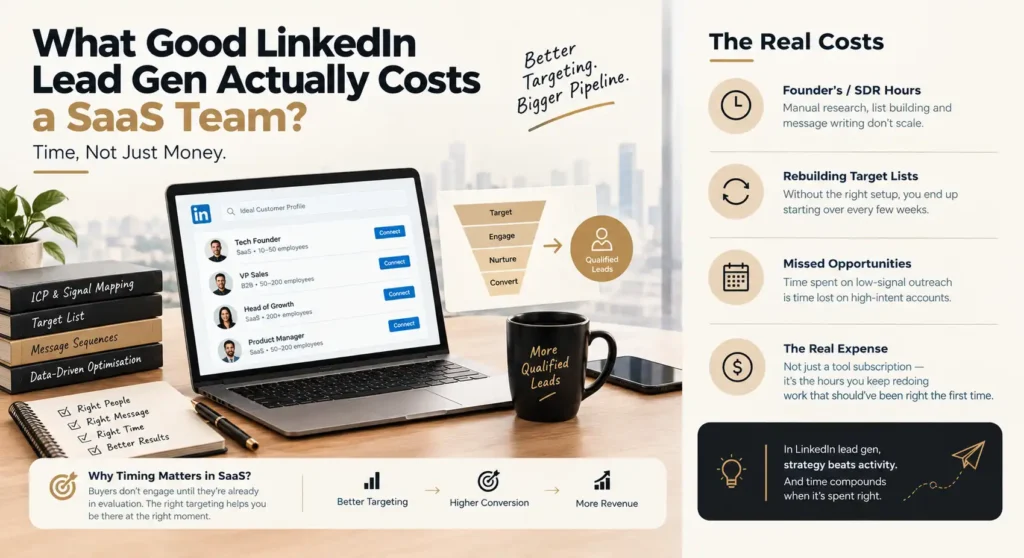
Most teams underestimate where the real cost sits: founder or SDR hours lost to manual research, list building, and message writing, none of which scales well by hand. A properly built system does that heavy lifting once, up front, during ICP and signal mapping, then runs sequences refined against real data instead of guesswork. Skip that step and you end up rebuilding the target list every few weeks, because it was never precise enough the first time. The real expense isn’t a software subscription, it’s the hours that keep piling up redoing work that should’ve been right from the start.
There’s an opportunity cost too, one that rarely makes it into anyone’s spreadsheet. Every week spent on low-signal outreach is a week the sales team wasn’t in front of accounts that were actually ready to buy. In SaaS, where buying windows tied to funding, hiring, or renewals can be narrow, slow or imprecise, targeting doesn’t just lower your conversion rate it means missing some of those accounts entirely. Research on B2B buying behavior backs this up: most buyers don’t engage a seller until they’re already well into their evaluation, which makes timing, not just activity volume, the deciding factor.
Why SaaS Companies Work With Digifinity for LinkedIn Lead Generation?
We don’t run LinkedIn outreach as a standalone tactic. It sits inside a broader B2B pipeline built with cold email outreach, B2B data research, and outbound sales campaigns so your SDRs are working from one coordinated system instead of three disconnected tools. That’s the difference between a campaign that generates connections and one that generates a calendar full of qualified demos.