

What a B2B lead generation agency sees in the data, what has changed since 2024, and how to run outbound that earns meetings.
Ask ten sales leaders whether cold email still works and you will hear ten different answers, mostly shaped by the last campaign each of them ran. At Digifinity, we work as a B2B lead generation agency, so we see both extremes: small, well-researched campaigns booking steady meetings, and 5,000-name blasts that wreck a sending domain within a fortnight. The channel is rarely the problem. Belkins’ 2026 study, which measures replies against total emails sent, describes cold email as harder than it was two years ago, and you can read the full Belkins cold email response rates report for their methodology.
So, is cold email still effective for B2B companies in 2026? Yes. But the version that worked in 2021, built on volume, generic templates and hope, is finished. What replaced it is closer to research than broadcasting.
Why Cold Email Feels Broken for Most B2B Companies?
Most teams who say cold email has stopped working are describing a real experience. Reply rates fall, domains land in spam, and the sales team goes back to waiting for inbound. Three things sit behind it.
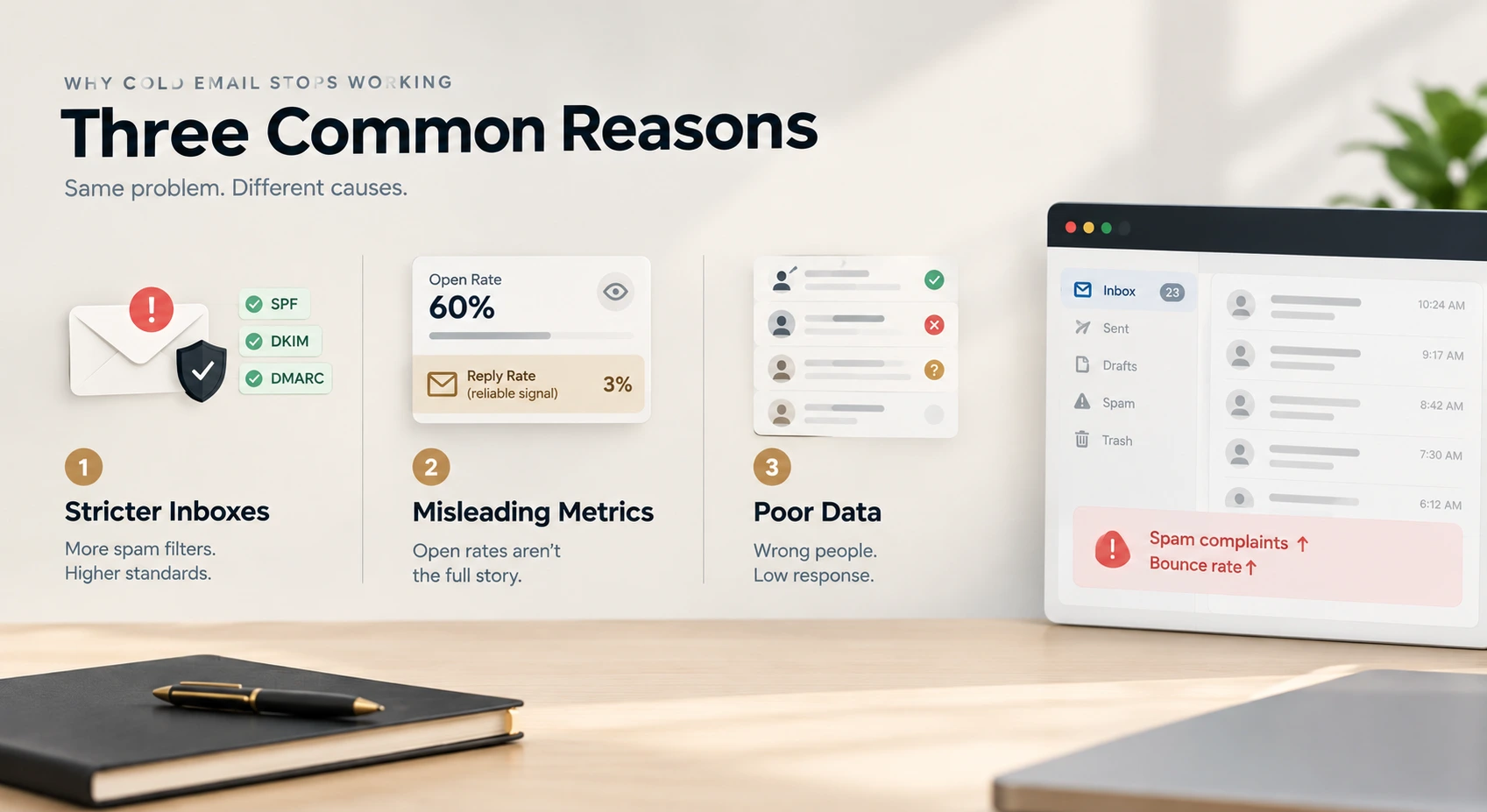
First, the inbox is crowded and the filters are stricter. Mailbox providers now expect authenticated sending (SPF, DKIM and DMARC), and they act on spam complaints quickly. Google’s email sender guidelines set out the technical baseline, and Instantly recommends keeping spam complaints under 0.3% and bounces under 2%. A campaign that ignores those thresholds does not merely underperform. It damages the domain you use for every other email your company sends.
Second, the metrics have misled people for years. Apple Mail Privacy Protection inflates open rates significantly, which is why reply rate is the more reliable signal. If your last report celebrated a 60% open rate, you were probably measuring machines rather than buyers.
Third, and most common, the data is poor. Cleanlist reports that reply rates below 1% usually point to a problem with data quality, targeting or sending set-up. In our experience the list is the culprit far more often than the copy. Rewriting the subject line will not rescue an email sent to someone who left the company in March.
Ready to Fix Your Outbound?
See how Digifinity’s B2B lead generation services combine verified data, protected infrastructure and expert messaging to fill your pipeline.
What the 2026 Data Says?
Benchmarks vary, partly because platforms measure different things. Here is how the main figures sit side by side.
| Metric | Reported figure | How to read it |
| Average reply rate across a large sending platform | 3.43%, with the top 10% of senders above 10% | A realistic target for a tight, verified list |
| US reply rate measured against total sends | 0.51% across more than 5.6 million emails in 2025 | A stricter denominator, so not comparable with the row above |
| Small versus large campaigns | 5.8% reply rate under 50 recipients versus 2.1% for large sends | Precision beats volume |
| Meeting booked rate | 0.5% to 2.5%, depending on deal type, offer clarity and follow-up | The number your finance director actually cares about |
| Share of replies from the first email | 58% of all replies come from step one | Your opening email carries the campaign, but follow-ups still matter |
The 3.43% and 0.51% figures look contradictory until you check the denominator. One counts replies against total emails sent, the other against a broader mix of campaigns and definitions. Neither is wrong. What matters is that you measure your own campaigns consistently and compare against yourself first, because a niche SaaS list and a legal-services list behave very differently. Legal services can reach up to 10% while SaaS often sits under 2%.
The pattern underneath all of these numbers is consistent. Small, targeted, verified campaigns beat large, generic ones, every time we have tested it.
Cold Email Still Works When It Behaves Like Research?
Good cold email outreach starts before anyone writes a word of copy. It begins with a decision about who you are actually trying to reach and why they would care this quarter.
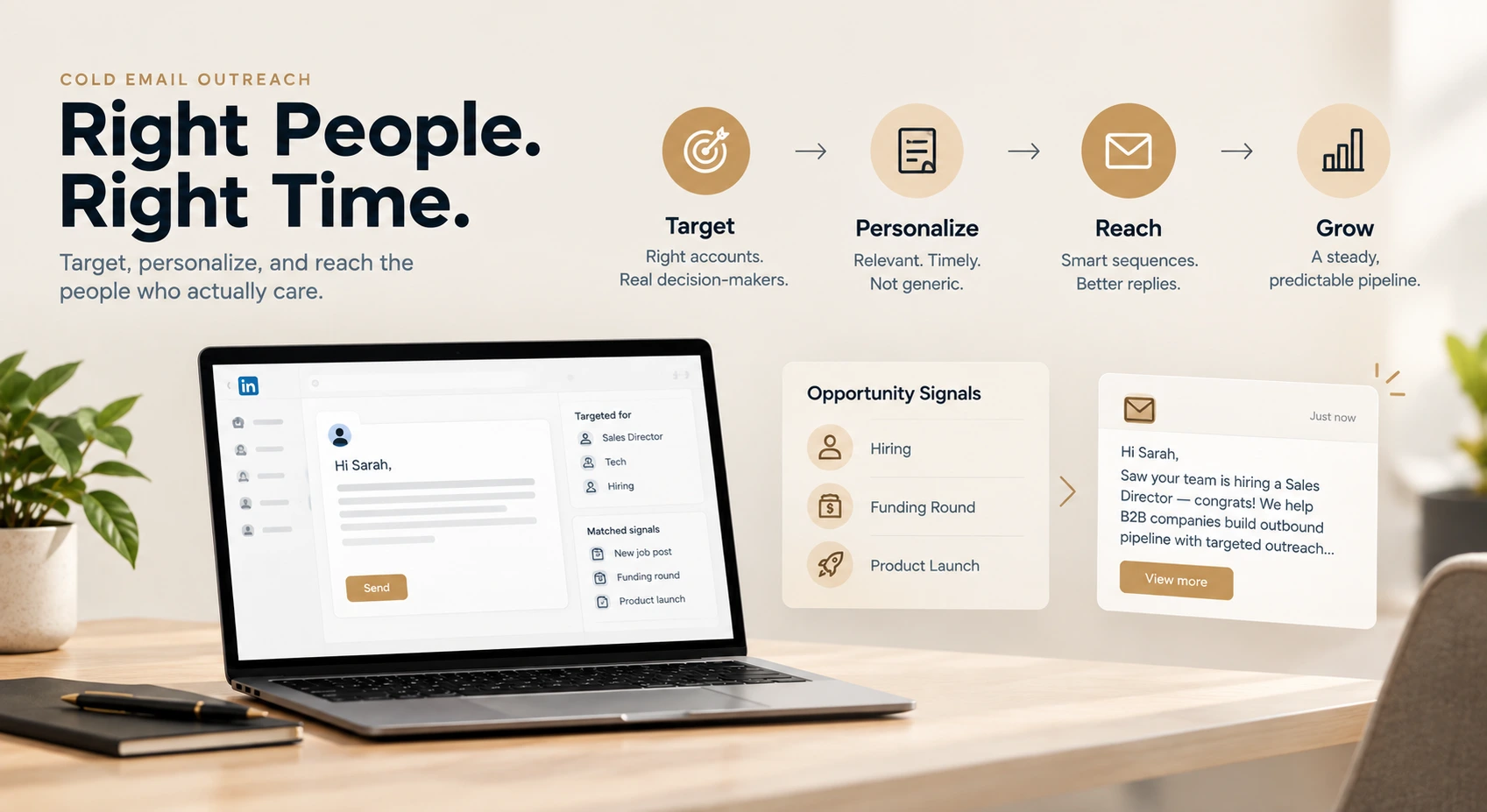
That last point is where 2026 differs from earlier years. Strong outbound teams now time their messages around signals such as hiring, funding rounds and product launches. A note that arrives the week a prospect posts a sales director vacancy reads as relevant. The same note three months later reads as spam.
This is the feature, function, desire and decision in plain terms. The feature is a managed outbound programme: data, infrastructure, messaging and follow-up. The function is that it puts a relevant, well-timed message in front of named decision-makers, then handles the replies. The desire is a predictable pipeline that does not depend on referrals or a lucky quarter of inbound. The decision is timing. Every month spent waiting is a month your competitors spend building relationships with the same accounts.
What a Modern B2B Cold Email Programme Includes?
Whether you build it in-house or work with one of the b2b lead generation companies in the market, a campaign that performs in 2026 usually contains these parts:
- Verified, segmented data. A reliable b2b data provider matters more than any template. Cleanlist claims verified lists earn roughly double the response of unverified ones, though that is a vendor figure, so test it on your own audience.
- Protected sending infrastructure. Separate sending domains, warmed mailboxes and conservative volumes. Keeping to around 50 emails per mailbox per day is a common ceiling.
- Signal-based targeting. Segments built on real triggers rather than job titles alone.
- Short, single-purpose copy. Emails of 50 to 125 words with one clear call to action perform best in Instantly’s benchmarking.
- Sequenced follow-up. One to three follow-ups over 7 to 14 days, with the first follow-up adding 40 to 50% more replies.
- Reply handling and qualification. Positive and negative replies tracked separately, because a 10% response rate can hide a majority of negative replies.
The Business Impact of Getting It Right:
When the fundamentals hold, the benefits are practical rather than glamorous. You get a repeatable source of meetings that you control, rather than one that depends on search rankings or event budgets. Testing an offer takes days rather than months, so you learn what your market wants faster than any content programme could tell you. And every campaign produces data on which segments reply, which objections come up and which messages fall flat. That feeds your wider marketing and sales strategy.
There is a cost to being honest about the numbers, too. Meeting booked rates of 0.5% to 2.5% mean cold email is a volume-of-relevance game, not a magic switch. A B2B digital marketing agency that promises 20% meeting rates is either measuring something else or selling something else. Plan on steady pipeline growth over a quarter, not overnight results.
For B2B companies selling into the US, the timing argument is stronger still. Inbox competition rises every year, and sender reputation takes weeks to build. The teams that start disciplined programmes now will be harder to displace than those who begin next year.
How a B2B Lead Generation Agency Runs a Cold Email Campaign?
Effective outbound lead generation follows a sequence. Skipping steps is where most in-house attempts fail. This is how a well-run programme unfolds:
- Define the ideal customer profile and the offer. Industry, company size, technology, buying triggers and the one problem you solve. If this takes less than a week, it has been rushed.
- Build and verify the list. Named contacts, checked emails, segmented by trigger. A small, clean list beats a large, tired one.
- Set up infrastructure. Authentication, secondary domains, warm-up and monitoring before a single prospect is emailed.
- Write and sequence the messages. Short openers, relevant proof and a low-friction ask, with follow-ups that add something new rather than repeating “just checking in”.
- Launch small and read the replies. Review reply quality weekly, not only reply volume, and adjust segments and messaging while the campaign is live.
- Hand over qualified conversations. Meetings pass to your sales team with context, and pipeline is reported against real opportunities.
The Technology Behind Reliable Outbound:
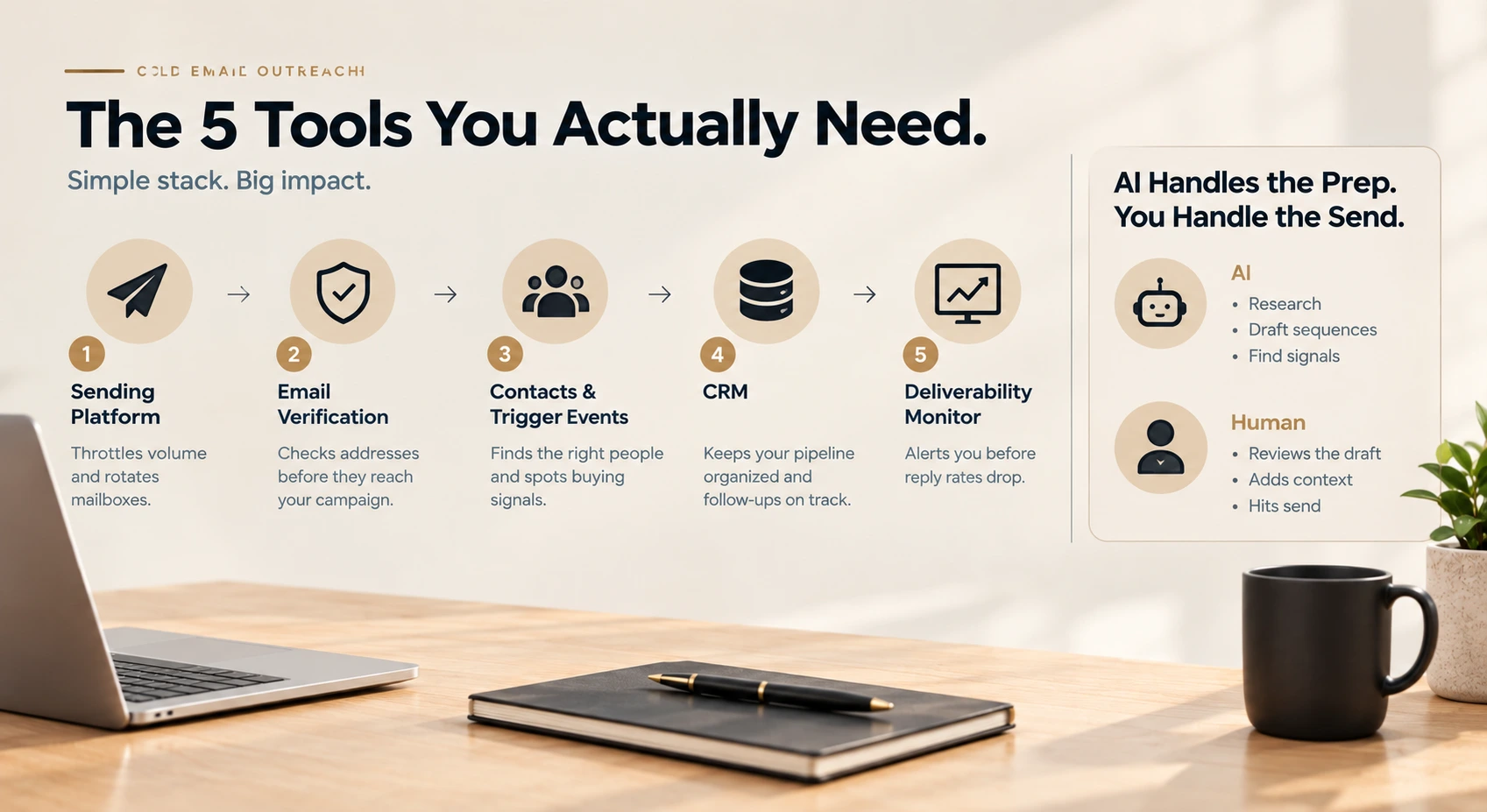
You don’t need an exotic stack. In practice it comes down to five things: a sending platform that can throttle volume and rotate mailboxes, a tool to verify addresses before they go anywhere near a campaign, a source for contacts and trigger events, a CRM, and a deliverability monitor. The monitor is the one people skip, and it is usually the one that would have saved them. Inbox placement can slip for a week before your reply numbers show it.
AI now does a fair amount of the groundwork for good outbound teams, mainly account research and first-draft sequences. That helps. Where it goes wrong is when nobody reads the draft before it is sent. We have seen “personalised” openers that mention the prospect’s company name and nothing else, and mailbox filters pick up on that pattern quickly. Let the tools handle the prep, but keep a person in charge of what actually goes out.
What Cold Email Outreach Costs?
Anyone quoting a flat price without seeing your market is guessing. Cost is driven by five things: the size and difficulty of your target segment, data and verification costs, the infrastructure needed to send safely, the quality of copywriting and strategy, and how much reply handling you want managed for you.
Compared with hiring, the math is instructive. An in-house SDR needs salary, tooling, data subscriptions, management time and a ramp-up period before they are productive. An agency brings the stack, the process and the deliverability experience from day one. Neither route is automatically cheaper, but the agency route is usually faster to a first meeting. We scope pricing after reviewing your ideal customer profile, so what you pay reflects the work rather than a template package.
Why do B2B Companies Choose Digifinity?
Companies rarely come to us because they have never tried cold email. They come because they tried it, saw poor replies and concluded it does not work. Our first job is usually to find out why, and the answer is almost always data, targeting or deliverability rather than the channel itself.
As a b2b lead generation company serving US buyers, we run campaigns the way the benchmarks say they should be run: small, verified segments, protected domains and messages written for a specific reader. Compliance is built in. We follow the FTC’s CAN-SPAM guidance, including honest sender details and simple opt-outs, because a legal risk is a commercial risk. Reporting focuses on booked meetings and pipeline rather than open rates.
[Add one real client result here: sector, timeframe, meetings booked or pipeline value.]
If your worry is that cold email will harm your brand or your domain, that is a fair concern and a solvable one. It is the reason infrastructure comes before copy in our process.